Crowne Plaza's Pakistan Play: Assessing Multan's Upscale Potential
Aleph Hospitality’s strategic move to bring IHG’s premium business brand to an industrial hub signals a calculated bet on regional stability.
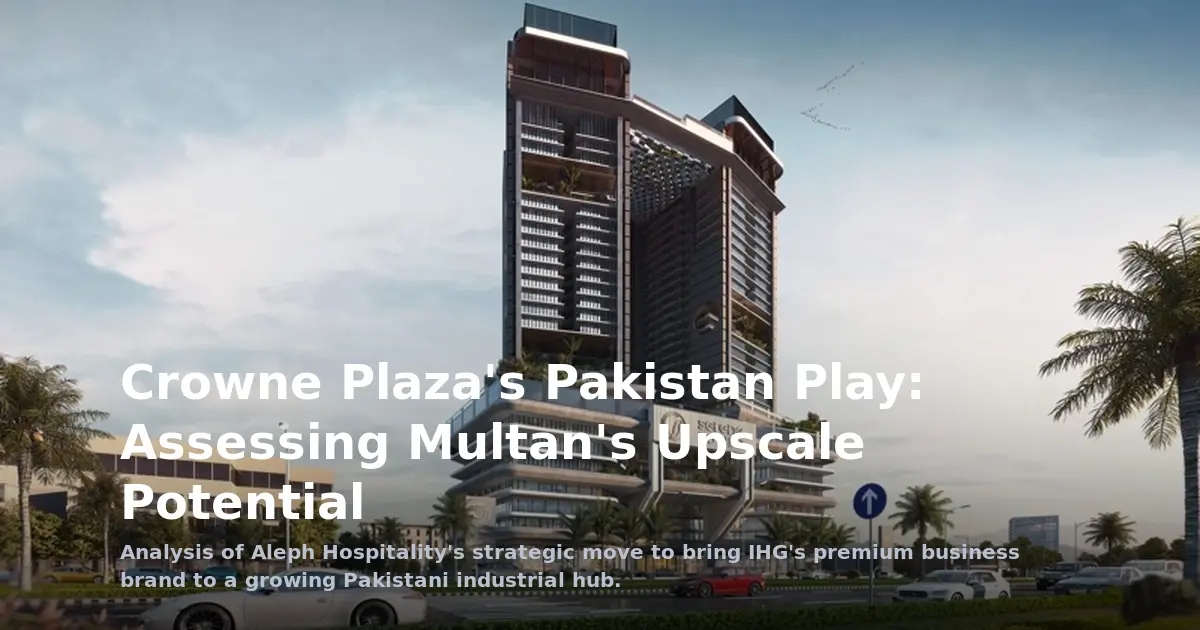
The announcement that a Crowne Plaza will debut in Multan by 2028 is more than a simple addition to a hotel pipeline; it is a litmus test for the appetite of global hospitality brands in Pakistan. By partnering with Serene Tower PVT Ltd, Aleph Hospitality is positioning IHG’s premium business brand in a city that serves as a critical industrial and agricultural nerve center, moving beyond the saturated corporate corridors of Karachi and Lahore.
For years, the narrative surrounding the Pakistani hospitality sector has been one of cautious hesitation. However, the entry of a Crowne Plaza Pakistan project in Multan suggests a shift in strategy. This isn't a tentative foray into the market, but rather a targeted strike at an underserved niche: the high-end corporate traveler who requires international standards in a secondary city.
The Strategic Calculus of Multan
Multan is often overlooked in favor of the coastal megacities, yet its role as a hub for the textile and agricultural sectors makes it a prime candidate for an upscale business hotel. The current hospitality landscape in the region consists largely of independent luxury hotels and smaller boutiques. While these establishments offer local charm, they often lack the rigorous operational standards and global loyalty integration that a brand like Crowne Plaza provides.
The value proposition here is clear. By introducing a standardized, premium business experience, the developers are betting that the industrial growth of the region will generate a consistent flow of international consultants, executives, and government officials who prioritize brand reliability over local idiosyncrasies. The risk, however, lies in the volatility of the local economy. A 2028 opening date means the project must weather several years of potential currency fluctuations and political shifts before it sees its first guest.
The Role of Aleph Hospitality as a Catalyst
Central to this expansion is Aleph Hospitality. As a third-party operator, Aleph acts as a critical bridge between the global brand standards of IHG and the local complexities of Pakistani ownership. This model allows IHG to scale its footprint without taking on the direct operational risks associated with emerging markets.
Aleph’s involvement indicates a sophisticated approach to scaling. Rather than attempting to build a massive footprint overnight, they are identifying high-yield pockets of growth. The use of a third-party operator provides a layer of professional management that can navigate the nuances of local labor laws and supply chain hurdles while ensuring that the final product meets the exacting standards of the Crowne Plaza brand. This operational agility is what will ultimately determine if the project can transition from a blueprint to a profitable asset.
Risk, Reward, and the 2028 Horizon
Setting an opening date for 2028 is a bold move that signals long-term confidence. In the world of hotel development, a four-year lead time is a lifetime. It suggests that the investors—Serene Tower PVT Ltd—and the operators believe that Pakistan's current economic trajectory is headed toward a sustainable plateau of stability.
However, the long-lead timeline also serves as a hedge. It allows the developers to monitor the market's evolution and adjust the property's specifications to meet shifting demand. The primary challenge will be maintaining momentum. If the regional economy dips, the project risks becoming a stranded asset; if it surges, the 2028 opening might actually be too late to capture the initial wave of growth.
A Signal to the Global Market
The decision to bring a Crowne Plaza Pakistan property to Multan sends a ripple effect through the industry. When a recognized global brand commits to a secondary city, it acts as a signal to other international investors that the risk-to-reward ratio in Pakistan is becoming favorable. It validates the region not just as a destination for leisure or religious tourism, but as a viable environment for institutional corporate investment.
As other global chains watch this development, the success of the Multan project will likely dictate the pace of further upscale expansions across the country. If this venture proves that international business standards can thrive in an industrial hub, we can expect a surge of similar entries in other emerging Pakistani cities, fundamentally altering the country's hospitality landscape from a collection of independent players to a network of globally integrated hubs.