Beyond 'AI Ethics': Redefining Accountability in Hotel Tech
Why the hospitality industry must shift from vague ethical guidelines to concrete operational accountability for AI implementation.
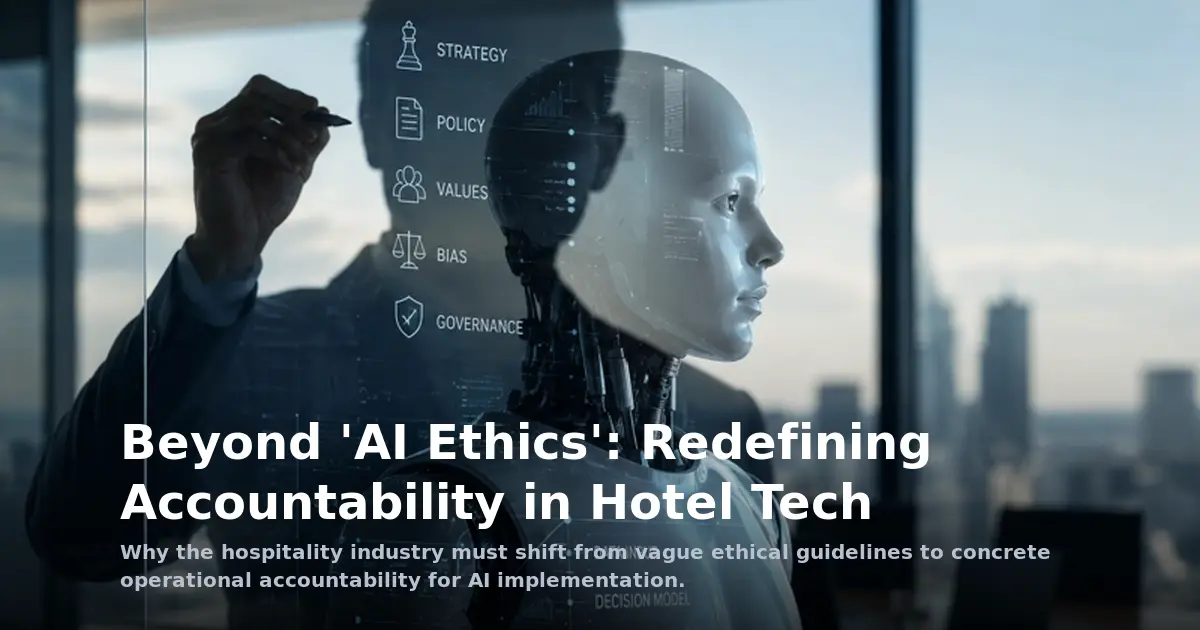
For the past few years, the hospitality C-suite has been enamored with the term 'AI Ethics.' It appears in quarterly reports, vendor slide decks, and corporate governance charters. On the surface, it suggests a commitment to fairness and transparency. In practice, however, 'AI ethics' has become a corporate shield—a linguistic fog that allows hotel groups to deflect responsibility when algorithms fail or exhibit bias.
When a dynamic pricing engine inadvertently discriminates against a specific demographic, or an automated guest screening tool flags a legitimate traveler based on flawed data, the response is often a retreat into an 'ethical framework.' But ethics are subjective; accountability is binary. For the modern hotelier, the danger lies in treating AI governance as a compliance checkbox rather than a core operational risk.
The Gap Between Ethical Claims and Legal Liability
There is a fundamental disconnect between the promises made by AI vendors and the reality of hotel operations. A software provider may claim their Large Language Model (LLM) is 'built on ethical principles,' but that claim offers zero protection when a chatbot promises a guest a free suite upgrade that the hotel cannot honor, or worse, provides inaccurate health and safety information.
In the eyes of the guest and the regulator, the hotel—not the vendor—is the entity of record. The legal liability for an AI error rests with the brand that deployed the tool. This gap highlights the urgent need for hotel AI accountability, shifting the focus from what a tool should do (ethics) to who is responsible when it doesn't (accountability).
When hotels rely on a vendor's 'ethical' certification, they are essentially outsourcing their risk management to a third party whose primary incentive is sales, not liability. True accountability requires a rigorous audit of the decision-making process behind the AI, moving away from 'black box' systems where the logic is hidden behind proprietary code.
From Frameworks to Operational Structures
To protect guest trust and brand reputation, hoteliers must transition from vague ethical guidelines to concrete accountability structures. This means integrating AI oversight into the guest experience journey at every touchpoint.
Instead of a general policy on 'Fairness,' hotels should implement specific operational triggers. For example, if an AI-driven pricing tool fluctuates rates beyond a certain percentage based on user behavior, a human override must be mandatory. If an automated communication tool handles a guest complaint, there must be a transparent trail showing why the AI chose a specific resolution and a clear path for the guest to escalate to a human manager.
For General Managers, this requires a shift in how they audit their tech stack. Rather than asking vendors if their tools are 'ethical,' GMs should demand transparency on the following:
- Data Provenance: Where did the training data come from, and does it contain historical biases that could affect guest screening?
- Error Attribution: In the event of a systemic failure, how is the error traced, and what is the protocol for immediate rectification?
- Human-in-the-Loop (HITL) Requirements: At what exact points in the guest journey is human intervention required to validate AI decisions?
The New Standard for Guest Trust
As AI becomes invisible—embedded in everything from the booking engine to the smart room controls—the opportunity for systemic failure increases. When a guest feels cheated by a pricing algorithm or ignored by a dysfunctional bot, they do not blame the 'lack of an ethical framework'; they blame the hotel.
Establishing a culture of hotel AI accountability means accepting that technology is not a neutral tool, but a series of choices made by developers and managers. The brands that thrive in the next decade will be those that stop hiding behind the vague language of ethics and start building transparent, auditable systems that prioritize guest rights over algorithmic efficiency.
Looking forward, the industry will likely see a move toward mandatory AI transparency disclosures. Much like the shift toward sustainability reporting, hotels will soon be required to prove not just that their AI is 'ethical,' but that it is governed by a rigorous system of checks and balances that protects the guest from the unpredictability of the machine.