Hilton’s Lifestyle Gamble: Can Tempo Capture China’s Urban Youth?
Analyzing Hilton's strategic push into the Asia Pacific lifestyle segment with the debut of Tempo by Hilton in China.
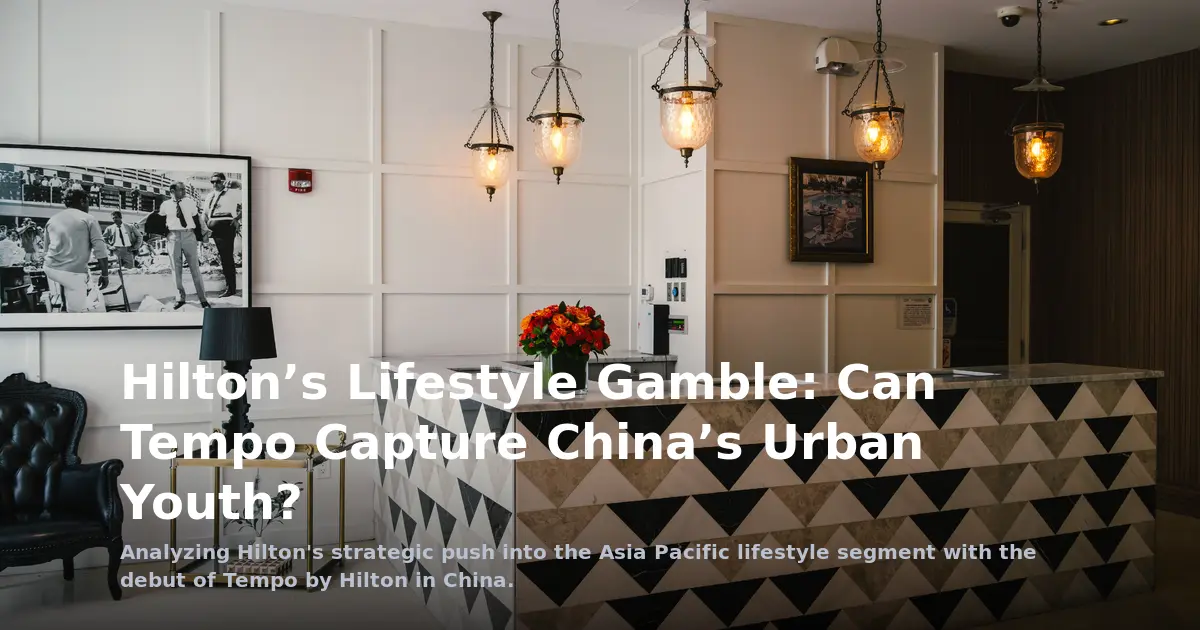
For decades, the global hotel industry operated on a rigid hierarchy of service levels: budget, midscale, and luxury. But the rise of the 'lifestyle' hotel—where design, social curation, and local authenticity trump white-glove formality—has disrupted this order. Hilton is now stepping directly into this fray with the introduction of Tempo by Hilton China, marking the brand's first foray into the Asia Pacific region.
On the surface, the recent signings in Beijing, Chengdu, Xiamen, and Jiaxing look like a standard expansion. However, for those tracking the volatility of the Chinese hospitality market, this move is a calculated gamble. Hilton is not merely adding rooms; it is attempting to pivot its brand perception to capture a demographic that views traditional corporate luxury as sterile and outdated.
Decoding the Geography of Tempo by Hilton China
The choice of cities for the debut of Tempo by Hilton China reveals a sophisticated targeting strategy. By selecting a mix of tier-one powerhouses like Beijing and Chengdu alongside high-growth hubs like Xiamen and Jiaxing, Hilton is hedging its bets.
Beijing and Chengdu represent the epicenters of China's youth culture and creative class. These are cities where Gen Z and Millennial travelers are most likely to prioritize 'Instagrammable' aesthetics and integrated wellness over traditional concierge services. Meanwhile, the inclusion of Xiamen and Jiaxing suggests a desire to capture the 'bleisure' (business + leisure) trend, targeting young professionals who are increasingly mobile and seeking curated experiences in secondary urban centers.
This geographic spread indicates that Hilton isn't just chasing the mass market; it is hunting for specific urban micro-climates where the demand for 'lifestyle' hospitality outweighs the demand for legacy luxury.
The Battle for Authenticity in a Saturated Market
The primary challenge facing Tempo by Hilton China is not a lack of demand, but a surplus of supply. The Chinese lifestyle segment is already crowded with agile local players and established global disruptors. To succeed, Tempo must answer a critical question: can a corporate giant truly deliver 'boutique' authenticity?
Traditional luxury is defined by consistency—the promise that a room in Shanghai will feel like a room in New York. Lifestyle hospitality, however, is defined by divergence. The modern urban traveler wants a hotel that feels like a reflection of the neighborhood, not a corporate template.
Tempo's value proposition rests on its ability to blend Hilton's operational reliability with a design-forward, tech-centric approach. If the brand relies too heavily on the 'Hilton' playbook, it risks being perceived as a 'lifestyle-lite' product—a corporate attempt to mimic youth culture. But if it can successfully decentralize its design and empower local operators to innovate, it could leverage Hilton's massive loyalty engine (Hilton Honors) to steal market share from independent boutiques that lack global reach.
Portfolio Diversification and the APAC Strategy
This expansion is a critical piece of a larger puzzle. Hilton has set an ambitious goal of reaching 250 luxury and lifestyle hotels across the Asia Pacific region. This shift signals a broader strategic pivot: the realization that the growth engine of the next decade is not in the upper-midscale corporate segment, but in the high-margin, high-experience luxury lifestyle sector.
There is an inherent risk of brand dilution here. By flooding the market with various 'lifestyle' iterations, Hilton risks blurring the lines between its offerings. However, the reward is a diversified portfolio that is more resilient to economic swings. By capturing the youth market now, Hilton is effectively playing the long game—building brand loyalty with Gen Z today so they remain within the ecosystem as they ascend into higher spending brackets tomorrow.
The success of Tempo by Hilton China will ultimately serve as a bellwether for the rest of the region. If Hilton can prove that it can scale 'cool' without compromising its operational standards, it will create a blueprint for the future of the global lifestyle segment. The industry is watching to see if this is a genuine innovation in guest experience or simply a corporate exercise in trend-chasing.