Tivoli's Puglia Pivot: Analyzing the Strategic Push into Southern Italy
The opening of Tivoli Palazzo 1880 Lecce marks a calculated bet on the 'slow travel' luxury movement and the decentralization of Italian tourism.
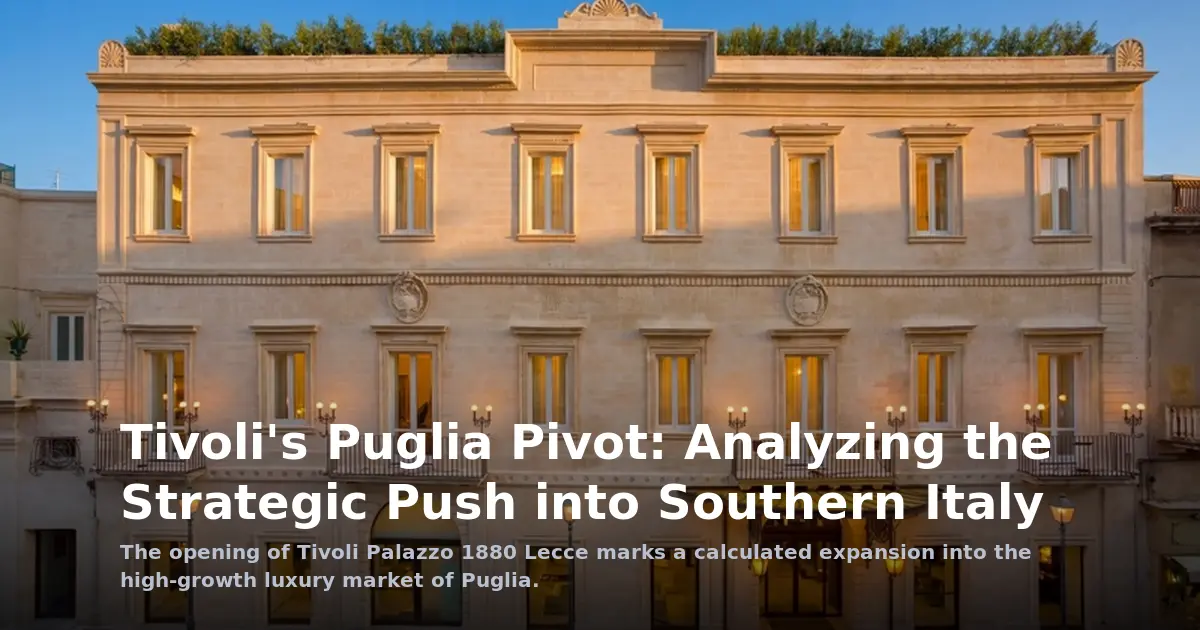
For years, the blueprint for luxury hospitality in Italy has been heavily weighted toward the 'Golden Triangle' of Rome, Florence, and Venice. However, the recent unveiling of the Tivoli Palazzo 1880 Lecce signals a deliberate shift in strategy. By planting a flag in the heel of the boot, the brand is not merely adding a room count; it is pivoting toward a burgeoning luxury ecosystem in Puglia that prioritizes authenticity over artifice.
This latest move in the Tivoli Hotels Italy expansion represents more than just geographic growth. It is a calculated response to the 'slow travel' phenomenon, where high-net-worth individuals are increasingly eschewing over-tourism hubs in favor of secondary cities that offer deeper cultural immersion. Lecce, often dubbed the 'Florence of the South,' provides the ideal backdrop for this transition, blending Baroque architectural splendor with a more relaxed, provincial pace.
The Boutique Bet: Agility Over Scale
At 48 rooms, the Palazzo 1880 is an exercise in restraint. In an era where many luxury operators are chasing massive footprints to maximize RevPAR, Tivoli's decision to maintain a boutique scale is a strategic play for exclusivity and operational agility.
A smaller footprint allows for a higher degree of personalization and a more intimate guest experience, which is the primary currency of modern luxury. From an operational standpoint, a 48-room property is far easier to pivot in response to seasonal demand shifts than a 200-room monolith. This agility is crucial in Puglia, where the luxury market is still evolving and guest expectations are shifting toward hyper-local, curated experiences rather than standardized corporate luxury.
The 'Palazzo' Paradox: Heritage vs. Modernity
The conversion of a historic palazzo into a luxury hotel is a high-wire act of engineering and design. The industry has seen countless 'palazzo' projects fail by either stripping the soul out of the building to fit modern plumbing or leaving the guest experience hampered by architectural limitations.
For the Tivoli Hotels Italy expansion, the challenge in Lecce is integrating 19th-century aesthetics with the rigorous technical standards of 21st-century luxury. This includes the invisible integration of high-speed climate control, acoustic insulation, and digital infrastructure within thick stone walls. When executed correctly, this tension creates a unique value proposition: the feeling of staying in a private residence, supported by the seamless service of a global hospitality brand.
Mapping the Competitive Landscape
Tivoli is not alone in its gaze toward Southern Italy. We are seeing a broader trend where luxury operators are targeting secondary cities to capture a market that is tired of the crowds in Northern Italy. However, Tivoli's approach differs in its focus on the urban core of Lecce rather than the sprawling masserias (fortified farmhouses) that have dominated Puglia's luxury narrative for the last decade.
By positioning itself in the city center, Tivoli is betting on the 'urban luxury' segment of Puglia. While the masserias offer seclusion, the Palazzo 1880 offers connectivity—proximity to galleries, boutiques, and the vibrant street life of Lecce. This differentiates the brand from the rural luxury competitors and positions it as a hub for the culturally curious traveler.
Implications for the Southern Italian Ecosystem
The entry of a recognized brand like Tivoli into Lecce elevates the local hospitality ecosystem. It creates a benchmark for service standards and attracts a tier of international travelers who might have previously overlooked the region. This creates a ripple effect, stimulating local luxury retail and high-end gastronomy, effectively maturing the destination's luxury infrastructure.
Looking ahead, this expansion suggests that the future of Italian luxury lies in decentralization. As the primary cities reach a saturation point, the growth engine will shift toward these regional gems. If Tivoli can successfully bridge the gap between historic preservation and modern luxury in Lecce, it provides a scalable model for further incursions into other undervalued Italian provinces, potentially redefining where the 'luxury map' of Italy begins and ends.