The Rise of the 'Pocket Hotel': Domes Redefines Santorini Luxury
Analyzing the strategic shift toward hyper-boutique properties and exclusive concierge clubs in saturated luxury markets.
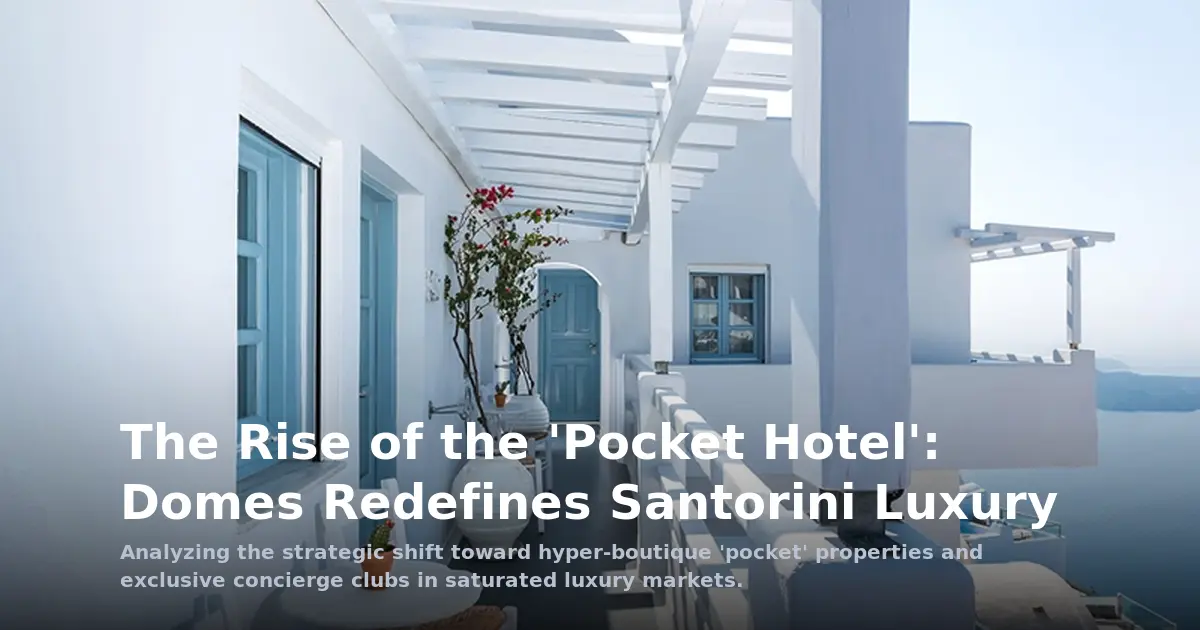
The luxury hotel landscape in Santorini has long been defined by a tension between breathtaking geography and extreme spatial constraints. For years, the industry standard for 'luxury' in the Caldera region involved expansive resorts that fought against the cliffside topography. However, the recent launch of Helestia by Domes signals a pivot toward a more surgical approach to hospitality: the boutique pocket hotel.
This isn't merely a response to a lack of available land. It is a calculated strategic shift. By shrinking the physical footprint while inflating the service value, Domes is betting that the ultra-high-net-worth (UHNW) traveler is moving away from 'mass luxury'—where prestige is tied to the size of the lobby—and toward a model of curated exclusivity.
The Economics of the Boutique Pocket Hotel
In high-demand luxury hotspots, real estate is the primary barrier to entry. The traditional resort model requires significant capital expenditure on infrastructure that often struggles to keep pace with the agility required by modern luxury guests. The boutique pocket hotel model solves this by optimizing operational efficiency.
Smaller properties require fewer staffing overheads for general maintenance and housekeeping, allowing the operator to reallocate capital toward high-touch, personalized services. When a property operates with a handful of keys rather than hundreds, the ratio of staff to guests can shift from a standard luxury benchmark to an almost one-to-one level of attention. This operational leaness doesn't just protect margins; it enhances the guest's perception of privacy and prestige.
Furthermore, the pocket model allows brands to penetrate saturated markets without the need for massive land acquisitions. It transforms the limitation of a small plot into a marketing asset: the 'exclusive hideaway.'
Beyond the Room: The Concierge Club as a Revenue Engine
Perhaps the most intriguing element of the Helestia model is the integration of a 'Concierge Club.' In the traditional hotel model, the room is the primary product, and the concierge is a supporting utility. Domes is flipping this script by treating the club as a standalone value proposition.
This strategy addresses a critical challenge in the luxury sector: driving non-room revenue. By creating a membership-style ecosystem, the hotel can monetize its expertise, local network, and curated experiences independently of occupancy rates. This increases the guest lifetime value (LTV) by transforming a one-time visitor into a recurring member of an elite circle.
For the UHNW traveler, the value is no longer in the thread count of the sheets—which is now a baseline expectation—but in the 'access' provided. Whether it is securing a private yacht at a moment's notice or gaining entry to closed-door cultural events, the Concierge Club converts the hotel from a place to sleep into a gateway to the destination.
The Competitive Shift in the Caldera
Santorini's luxury sector is currently witnessing a divergence. On one side are the legacy resorts that rely on scale and visibility. On the other is a new wave of hyper-boutique offerings that prioritize invisibility and curation.
By deploying a boutique pocket hotel, Domes is differentiating itself from the 'resort' label, which can sometimes carry connotations of crowded pools and standardized luxury. Instead, they are positioning themselves in the realm of private residential hospitality. This appeals to the modern luxury traveler's desire for 'quiet luxury'—a trend where the most expensive experiences are those that feel the least like a commercial transaction.
The Future of Scalable Exclusivity
Whether the boutique pocket hotel is a scalable trend or a localized response to Santorini's geography remains to be seen. However, as global luxury travel continues to shift toward 'slow travel' and deep personalization, the blueprint is clear. The industry is moving toward a fragmented model where a single brand may operate one flagship resort and a constellation of pocket hotels across a region.
This approach allows hospitality groups to hedge their bets, diversifying their portfolio across different tiers of exclusivity while maintaining a dominant brand presence. As real estate in the world's most coveted destinations becomes increasingly scarce, the ability to deliver a five-star experience within a minimal footprint will become the ultimate competitive advantage.