The Self-Leadership Mandate: Redefining the Hotel GM's Toolkit
Why psychological maturity is now the non-negotiable foundation for hospitality leadership in an era of operational volatility.
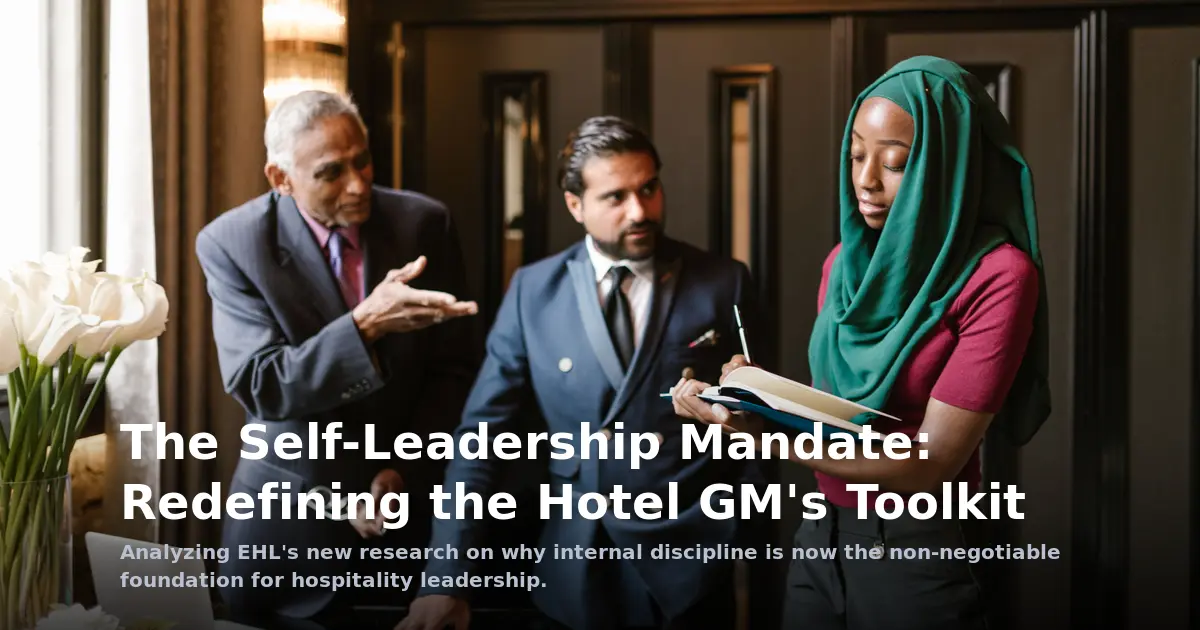
For decades, the trajectory to the General Manager's office was paved with technical mastery. If you could manage a P&L, optimize RevPAR, and maintain a pristine guest satisfaction score, you were deemed a leader. The industry treated hospitality leadership skills as a cumulative collection of operational checklists—a 'more is better' approach to professional development.
However, this obsession with technical KPIs has created a dangerous leadership vacuum. In high-stress, 24/7 operational environments, technical proficiency is merely the entry fee. The real differentiator—and the current point of failure for many mid-level managers—is not a lack of operational knowledge, but a deficit in self-leadership.
The Fallacy of the 'More Skills' Strategy
Recent research into the architecture of management reveals a critical truth: adding more tactical skills to a flawed foundation does not create a better leader. Instead, the industry must pivot toward a model based on four distinct domains of competency. While strategic thinking and people management are essential, they are secondary to the foundational layer of self-leadership.
Self-leadership is the ability to regulate one's own emotions, maintain discipline under pressure, and possess the self-awareness to recognize how one's behavior impacts a team. In the pressure cooker of a luxury hotel or a high-volume resort, a manager who lacks this internal discipline becomes a liability. When a leader cannot manage their own stress, that volatility trickles down, eroding staff morale and degrading the guest experience. Technical skill can fix a billing error, but only self-leadership can fix a toxic culture.
From Technical Proficiency to Emotional Intelligence
There is a widening chasm between traditional hospitality management and the modern requirements of the role. The traditional model was hierarchical and transactional: the GM gave the order, and the staff executed. Today's workforce, particularly Gen Z and Millennials, requires a leadership style rooted in empathy, transparency, and psychological safety.
This shift transforms the required hospitality leadership skills from a set of hard skills into a suite of self-regulatory competencies. The move from 'manager' to 'leader' requires a transition from controlling others to mastering oneself. The most effective leaders are no longer those who have the fastest answers, but those who have the highest level of emotional intelligence and the discipline to remain steady when the operation is in chaos.
The Training Gap: Executive Expectations vs. Reality
Despite this need, a systemic gap persists in the training pipeline. Most mid-level management programs still focus on the 'how-to' of hotel operations—scheduling, procurement, and reporting. There is remarkably little emphasis on the 'how-to-be' of leadership.
Executives often express frustration that their Assistant Managers or Department Heads lack 'leadership presence,' yet they continue to provide training that only enhances technical output. We are preparing managers for the tasks of the job, but not for the psychological weight of the role. Until the industry treats self-leadership as a core competency rather than a 'soft skill,' the turnover rate among middle management will remain a permanent crisis.
The Leadership Audit: A Self-Assessment
To bridge this gap, current leaders must move beyond the P&L and audit their own internal sub-skills. Based on the identified competencies of modern leadership, leaders should ask themselves:
- Self-Regulation: Do I react impulsively to operational failures, or do I respond with a calibrated strategy?
- Cognitive Flexibility: Can I pivot my leadership style based on the individual needs of my team, or do I apply a one-size-fits-all approach?
- Integrity and Alignment: Are my daily actions consistent with the values I demand from my staff?
- Stress Tolerance: Do I maintain a sense of calm that stabilizes the team, or does my anxiety amplify the surrounding tension?
The Future of the Hospitality Mandate
As the industry continues to automate routine technical tasks, the value of the 'technical manager' will plummet. The future of the hotel industry belongs to the 'human-centric leader'—those who can navigate the complex emotional landscapes of both guests and employees. The mandate is clear: psychological maturity is no longer a luxury; it is the non-negotiable foundation of the profession. Those who fail to invest in their own self-leadership will find themselves technically proficient but functionally obsolete.