The 'Super-Tour' Effect: How Pop Icons are Breaking Madrid's ADR Records
As Bad Bunny and BTS push Madrid's hotel rates to historic highs, the industry must evolve from reactive pricing to event-intelligence models.
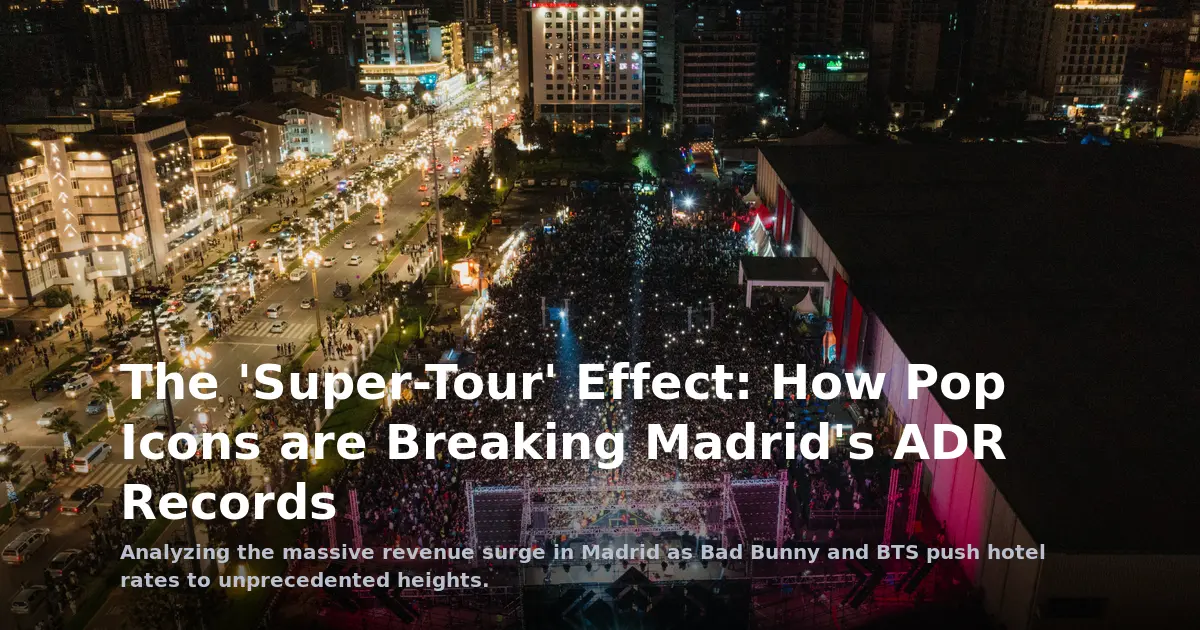
Madrid is currently witnessing a seismic shift in its hospitality economics, and the catalyst isn't traditional summer tourism or corporate conventions. Instead, it is the raw, concentrated power of global fandom. Recent data reveals that the Spanish capital hit a record June ADR of €199.97 and a RevPAR of €164.32, figures that signal a departure from historical norms and the arrival of the 'Super-Tour' era.
This surge was not an accident of the calendar but a direct result of high-impact performances by Bad Bunny and BTS. When global icons descend on a city, they don't just fill stadium seats; they fundamentally rewire the local hotel market. For a brief window, the city ceases to be a destination and becomes a hub for a specific, high-spending demographic that prioritizes proximity and accessibility over price sensitivity.
Quantifying the Celebrity Premium and Event-Driven Hotel Demand
The disparity between traditional seasonal growth and the spikes seen during these tours illustrates the volatility of event-driven hotel demand. While a typical summer peak in Madrid is predictable, the 'celebrity premium' creates an artificial scarcity that allows hotels to push rates far beyond their standard ceilings.
However, the nature of this demand varies significantly based on the tour's structure. The impact of Bad Bunny’s 10-night stadium run created a sustained plateau of high ADR, allowing hotels to maintain premium pricing over a longer duration. In contrast, the BTS Arirang World Tour shows triggered a more acute, violent surge—a vertical spike in demand that creates immediate sell-outs but offers a shorter window for yield optimization.
For revenue managers, the lesson is clear: not all events are created equal. A multi-night residency provides a different strategic opportunity than a single-night phenomenon. The former allows for a gradual ramp-up in pricing, while the latter requires an immediate, aggressive jump to capture the peak of the curve.
From Reactive Pricing to Event-Intelligence
For too long, the hotel industry has operated on a reactive model: wait for the booking curve to climb, observe the pace, and raise rates accordingly. In the age of the Super-Tour, this approach is leaving money on the table. By the time a revenue manager notices a spike in occupancy, the most lucrative window for pricing has often already passed.
To maximize yield, hotels must shift toward an 'event-intelligence' model. This means integrating non-traditional data streams into their forecasting tools. Instead of relying solely on historical internal data, hotels should be monitoring:
- Ticket Sale Velocity: Tracking the speed at which stadium tickets sell out provides a real-time proxy for hotel demand.
- Social Sentiment Analysis: Monitoring the 'hype cycle' of a global tour can signal the likelihood of international travel versus local attendance.
- Ancillary Logistics: Analyzing flight search data to specific hubs during tour dates to predict the volume of overnight guests.
By synthesizing data from sources like CoStar with external cultural indicators, hotels can set 'event-anchor' rates months in advance, ensuring they don't undersell their inventory during a global pop-culture moment.
The Risk of the High-Impact Surge
While the record-breaking RevPAR in Madrid is a victory for the short term, there is an inherent risk in over-relying on erratic event demand. Corporate travel remains the bedrock of stability for urban hotels, providing a predictable baseline of mid-week occupancy. Event-driven demand, while lucrative, is fickle. A tour cancellation or a change in venue can evaporate a projected revenue spike overnight.
Furthermore, there is the risk of brand alienation. While 'surge pricing' is accepted in the airline industry, hotel guests may perceive extreme rate hikes during pop concerts as opportunistic. The challenge for operators is to balance maximum yield with long-term guest loyalty, ensuring that the 'celebrity premium' doesn't alienate the corporate and leisure travelers who sustain the property throughout the rest of the year.
As the scale of global tours continues to grow, the intersection of pop culture and hospitality will only tighten. The hotels that thrive will be those that stop viewing concerts as 'lucky windfalls' and start treating them as predictable, data-driven revenue streams. The future of urban hospitality lies in the ability to predict the unpredictable, turning the chaos of fandom into a precision science of yield management.