Beyond the Lobby: How TRIBE Auckland is Monetizing Analog Nostalgia
An analysis of TRIBE's partnership with Real Groovy and the rise of curated cultural programming in lifestyle hotels.
For years, the 'lifestyle hotel' sector has been plagued by a paradox of homogeneity. From Miami to Melbourne, the aesthetic playbook remains largely the same: mid-century modern furniture, a curated cocktail menu, and a generic 'local' art piece in the lobby. While these elements create a polished atmosphere, they often fail to deliver a genuine sense of place. The industry is currently facing a 'cookie-cutter' crisis where the pursuit of a consistent brand identity has stripped away the very soul that guests seek when they travel.
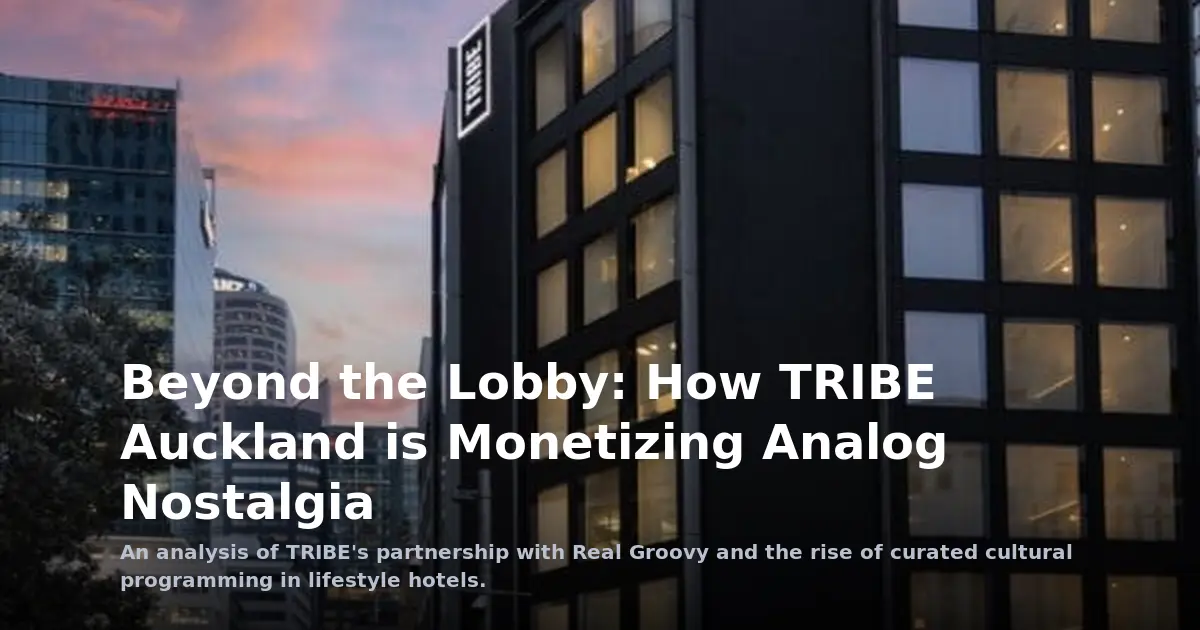
TRIBE Auckland Fort Street is attempting to break this cycle by pivoting away from generic amenities and toward hyper-local cultural integration. Their latest venture, the TRIBE Vinyl Club, launched in partnership with the legendary Auckland record store Real Groovy, represents more than just a musical installation. It is a strategic move to monetize analog nostalgia and embed the hotel within the city's actual cultural fabric.
The Strategic Pivot in Lifestyle Hotel Trends
When analyzing current lifestyle hotel trends, there is a visible shift from 'curation' to 'collaboration.' Curation is an internal process—a hotel designer choosing a record player for a room. Collaboration is an external process—partnering with a local institution to define the sonic identity of a space. By aligning with Real Groovy, TRIBE isn't just buying records; they are borrowing decades of local credibility.
This approach addresses a critical gap in the modern guest experience. The contemporary traveler, particularly Gen Z and Millennials, is increasingly driven by 'analog revival.' In an era of algorithmic discovery and digital saturation, physical media—vinyl, film photography, print magazines—offers a tactile, intentional experience. For a hotel, this means the lobby ceases to be a transit zone and becomes a 'third place,' a community hub where the boundary between guest and local blurs.
Risk, Reward, and the Independent Partnership
There is a significant operational risk in partnering with independent local businesses over corporate vendors. Corporate vendors provide scalability, standardized SLAs, and predictable outcomes. Independent partners, however, bring authenticity and a level of passion that cannot be manufactured in a boardroom.
The reward for this risk is the creation of genuine brand equity. When a hotel integrates a local record store's expertise, it signals to the guest that the hotel is an insider, not an intruder. This creates a psychological layer of trust. The TRIBE Vinyl Club doesn't just provide background music; it provides a cultural gateway. Guests are not just staying at a hotel; they are participating in Auckland's music scene.
Creating Community Through the 'Third Place'
The success of such programming lies in its ability to foster a sense of belonging. The 'Vinyl Club' concept transforms the hotel's public spaces into social anchors. By hosting events and showcasing curated collections, the hotel attracts a local demographic that would otherwise have no reason to enter the building. This diversification of revenue—moving from purely room-night dependence to experience-driven foot traffic—is essential for the long-term viability of lifestyle properties.
Comparing this to other global lifestyle brands, we see a divide. Many brands attempt to 'simulate' local culture through interior design choices. TRIBE’s approach is different because it is active rather than passive. It is a living program that evolves with the city's tastes, rather than a static design choice made during the construction phase.
The Future of Cultural Integration
As the hospitality landscape continues to evolve, the pressure to differentiate will only intensify. The industry is moving toward a model where the hotel acts as a cultural concierge, facilitating deep connections between the visitor and the destination. The TRIBE Auckland experiment suggests that the future of luxury and lifestyle is not found in more expensive linens or gold-plated fixtures, but in the authenticity of the partnerships a hotel fosters.
Ultimately, the move toward analog experiences and hyper-local collaborations will likely become the benchmark for success. Hotels that continue to rely on globalized design standards will find themselves interchangeable and irrelevant. Those that embrace the grit and specificity of their local environment will be the ones to capture the loyalty of the modern, experience-hungry traveler.