The Dual-Brand Gamble: Analyzing the Woodway Hilton Listing
The sale of a pre-developed Home2 Suites/Tru site in Texas signals a strategic reckoning for the dual-brand development model.
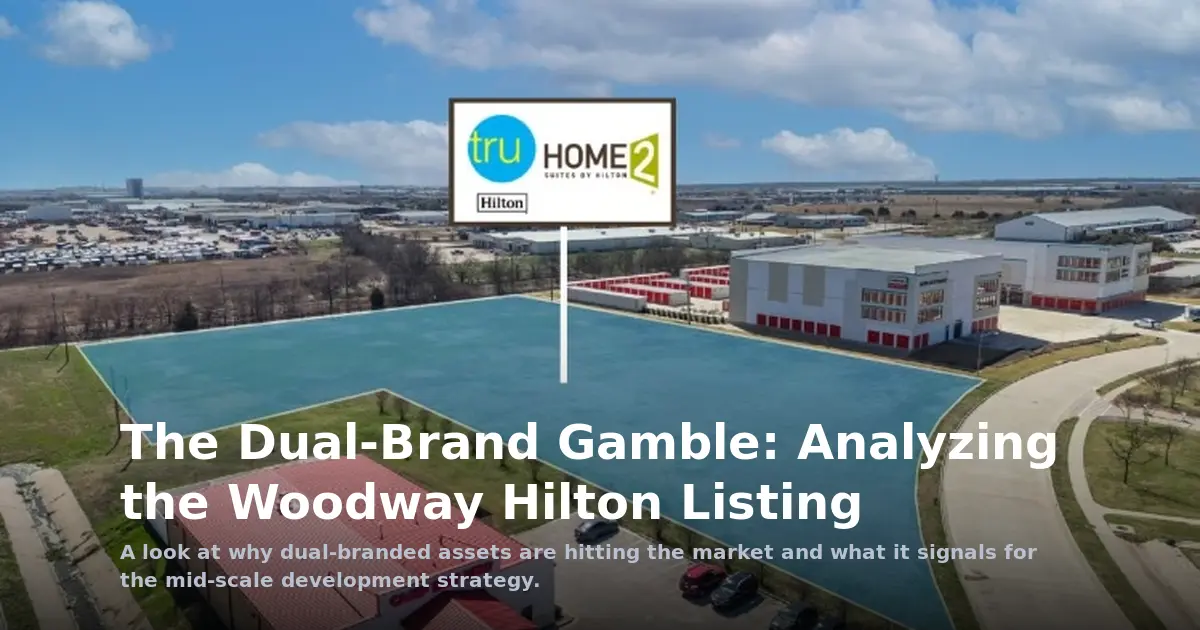
The listing of a pre-developed site for a Home2 Suites and Tru by Hilton in Woodway, Texas, is more than a simple real estate transaction. In an era of tightening credit and shifting developer appetites, the decision to offload a shovel-ready project—rather than breaking ground—serves as a bellwether for the current state of dual-branded hotel investment.
For several years, the industry has been enamored with the 'dual-brand' synergy: the idea that placing two distinct flags under one roof maximizes land utility and captures two different customer segments simultaneously. In this case, the pairing of Home2 Suites (extended stay) and Tru (mid-scale limited service) is a classic Hilton play designed to hedge bets across transient and long-term demand. However, when a developer exits the project at the pre-construction phase, it suggests that the mathematical allure of this model is colliding with the harsh realities of the current macroeconomic environment.
The Economics of Dual-Branded Hotel Investment
The fundamental appeal of the Home2/Tru combination lies in operational efficiency. By sharing a footprint, these properties can consolidate back-of-house operations, utilize a single management team, and split the cost of shared amenities. From an investor's perspective, this theoretically lowers the break-even point while diversifying the revenue stream. If corporate travel dips, the extended-stay component of Home2 Suites often provides a stabilizing floor; if long-term demand wanes, the high-turnover nature of Tru captures the immediate transient market.
Yet, the risk-reward profile of dual-branded assets is more complex than that of single-flag properties. While the operational synergies are real, the capital expenditure required for a dual-brand build is significantly higher than a standalone mid-scale project. In a low-interest-rate environment, this was a negligible hurdle. In today's market, where the cost of capital has surged, the 'premium' for dual-branding may no longer be justifiable for developers who are seeing their margins compressed by construction inflation and higher debt service costs.
Market Dynamics: The Woodway Variable
Woodway, Texas, presents a specific set of regional dynamics. Situated on the periphery of the Waco market, the area has seen steady growth, but it lacks the explosive density of the Texas Triangle's primary hubs. The question for any potential buyer is whether the local demand can truly support two distinct brands in one location without cannibalizing their own occupancy.
When a pre-developed site hits the market, it typically indicates one of two things: a strategic pivot by the original owner to liquidate assets for more liquid ventures, or a realization that the projected RevPAR (Revenue Per Available Room) no longer aligns with the increased cost of construction. If the original developer—who spent the time and capital to secure the permits and the brand flags—is unwilling to take the project to completion, it suggests a cautious outlook on the immediate absorption rate of the Woodway market.
Synergy vs. Complexity
Hilton’s brand synergy is a powerful tool. The ability to cross-sell and leverage a massive loyalty ecosystem across two flags in one building is a significant advantage. However, the operational complexity of managing two different brand standards under one roof can create friction. From staffing to housekeeping, the nuances between a limited-service hotel and an extended-stay suite can lead to operational leakage if not managed with precision.
For the savvy investor, the Woodway listing represents a shortcut. Buying a pre-developed site removes the entitlement risk and the headache of initial planning. But the underlying question remains: is the dual-brand model a sustainable evolution of the mid-scale segment, or was it a product of an era of cheap money?
As the industry moves forward, we are likely to see a flight to quality and a preference for flexible assets. The dual-brand model will persist, but the 'gold rush' phase is over. Future developments will be scrutinized not just for their brand synergy, but for their ability to withstand a high-interest-rate regime where operational efficiency must be proven in the P&L, not just promised in a pitch deck.