The Death of the RFP: How Independents Win Unmanaged Corporate Travel
Bypassing traditional corporate contracts is becoming the new growth engine for agile independent hotels.
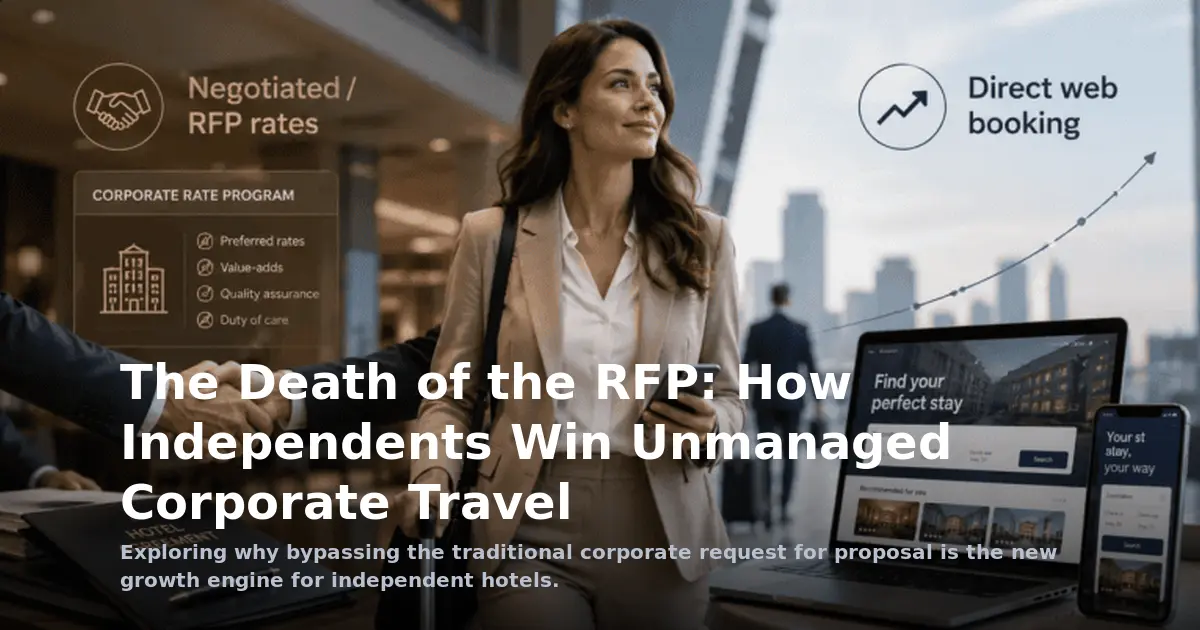
For decades, the corporate Request for Proposal (RFP) was the undisputed gateway to high-volume business travel. Hotels spent months negotiating rigid contracts, fighting for a spot on a preferred vendor list, and slashing rates to win a volume guarantee that often failed to materialize. But the landscape is shifting. The traditional, managed corporate contract is no longer the only—or even the most profitable—way to capture business travel.
We are witnessing the rise of unmanaged corporate travel, a segment where business travelers book outside of a strict corporate mandate. Whether it is a startup with no formal travel policy or a mid-sized firm allowing employees more autonomy, this shift is liberating for independent hotels. It moves the competition away from bureaucratic negotiation and toward real-time visibility and value.
The Shift Toward Agility and Unmanaged Corporate Travel
The decline of the RFP isn't a sign of disappearing corporate demand; rather, it is a fragmentation of how that demand is captured. Managed travel, dictated by Global Travel Management Companies (TMCs), often forces hotels into a "race to the bottom" on pricing. In contrast, unmanaged corporate travel allows hotels to maintain higher Average Daily Rates (ADR) because the traveler is prioritizing convenience, location, and quality over a corporate-mandated discount.
For the independent hotelier, this is a strategic pivot. Instead of dedicating a sales team to chase a handful of monolithic contracts, hotels can now cast a wider net. By focusing on the unmanaged segment, hotels can capture a diverse array of corporate guests who are booking on the fly, which naturally hedges the risk of relying on a single large account that might suddenly pivot its travel policy.
The GDS: The Critical Gateway to Visibility
To win in the world of unmanaged corporate travel, visibility is the only currency that matters. This is where the Global Distribution System (GDS) becomes the primary engine for growth. While many independents have pivoted toward direct-booking strategies to avoid OTA commissions, the GDS remains the essential tool for the corporate traveler.
Most corporate travelers—even those in unmanaged environments—still use GDS-connected tools or corporate booking portals to ensure their travel is trackable and reimbursable. If an independent hotel is not loading its rates correctly into the GDS, it effectively does not exist to a significant portion of the business market.
Loading GDS rates is not merely a technical task; it is a strategic move. By ensuring that dynamic or negotiated rates are visible and accurate, hotels can appear in the search results of thousands of corporate travel agents and automated booking tools globally. This creates a passive lead-generation machine that operates 24/7, bypassing the need for a costly, manual RFP process.
Profitability and the Risk of Over-Reliance
When comparing the margins, the math favors the unmanaged approach. RFP agreements typically require deep discounts in exchange for volume. However, these "guaranteed" volumes are often optimistic. When a hotel accepts a low RFP rate and the volume doesn't materialize, they have essentially left money on the table for every single room sold.
Unmanaged corporate bookings typically occur at a higher price point, closer to the Best Available Rate (BAR). This increases the RevPAR (Revenue Per Available Room) and improves the overall profit margin per guest.
However, a warning is necessary: over-reliance on the GDS can lead to a dangerous dependency on third-party intermediaries. The goal should not be to replace one middleman (the RFP manager) with another (the GDS). Instead, the GDS should serve as the discovery mechanism. Once a corporate traveler has found the hotel through the GDS, the hotel's internal operations must focus on converting that guest into a direct booker for their next visit through superior service and loyalty incentives.
An Audit Roadmap for Independent Owners
For owners without a dedicated sales team, auditing corporate visibility doesn't require a consultant. Start with these three steps:
- GDS Rate Audit: Verify that your rates are loading correctly across all major GDS platforms. Check for parity and ensure that your property descriptions and amenities are up to date.
- Market Segment Analysis: Review your current guest data to identify "hidden" corporate accounts—companies that book frequently but aren't under a formal contract. These are your prime targets for unmanaged growth.
- Direct Conversion Strategy: Implement a simple "Corporate Direct" landing page on your website, offering a slight incentive for business travelers to book directly rather than through a portal.
As the corporate world continues to move toward flexibility and decentralized decision-making, the power is shifting back to the property. The hotels that thrive will be those that stop waiting for an invitation to a corporate RFP and instead build a digital presence that makes them impossible to ignore.