The New Loyalty Playbook: Analyzing the Hyatt and Aeroplan Alliance
Beyond point conversions, the World of Hyatt and Aeroplan partnership signals a strategic shift toward ecosystem-based loyalty and data interoperability.
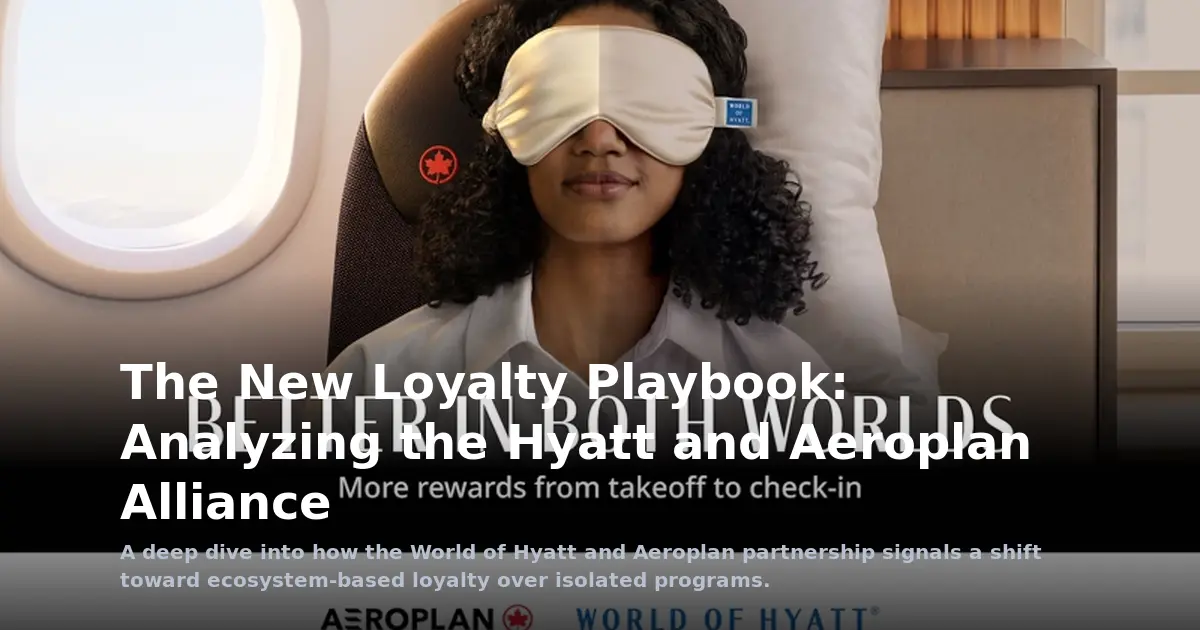
For decades, the relationship between airlines and hotels was transactional. A traveler stayed at a property, earned a few points, and perhaps converted them into a flight once every few years. These were isolated silos of value, connected by clunky conversion tables that often disadvantaged the consumer. However, the recent announcement that World of Hyatt and Air Canada’s Aeroplan are linking their loyalty programs suggests a fundamental pivot in how hospitality brands view the customer relationship.
While the press release focuses on the ability to earn and redeem points across both platforms, the editorial reality is far more strategic. This is not merely a convenience play; it is a data play. By moving toward 'linked accounts,' Hyatt and Aeroplan are attempting to dissolve the boundaries between air and land, creating a unified view of the high-value traveler.
Beyond Points: The Shift to Ecosystem Loyalty
Traditional hotel loyalty partnerships have historically functioned as simple referral engines. One brand sends a customer to another, and a small commission or point-transfer fee is exchanged. The Hyatt-Aeroplan alliance represents a shift toward 'ecosystem loyalty,' where the goal is not just a transaction, but the ownership of the entire traveler journey.
When accounts are linked, the data flow becomes bidirectional and continuous. Hyatt no longer just knows when a guest checks into a room in Toronto; they potentially gain insights into the flight patterns, lounge preferences, and spending habits associated with an Aeroplan member. This level of data interoperability allows brands to move from reactive service to predictive personalization. If a brand knows a guest is flying into a city on a specific tier of membership, the hotel experience can be tailored long before the guest reaches the front desk.
Lowering Acquisition Costs and Reducing Churn
From a financial perspective, the cost of acquiring a new high-lifetime-value (LTV) guest is skyrocketing. Digital marketing spend is yielding diminishing returns, and the 'loyalty' of the modern traveler is notoriously fickle. By aligning with Aeroplan, Hyatt is effectively tapping into a pre-qualified pool of affluent North American travelers without the heavy lifting of traditional customer acquisition campaigns.
This alliance serves as a hedge against brand switching. When a traveler is embedded in an ecosystem where their air and hotel rewards are inextricably linked, the friction required to switch to a competitor increases. It is no longer just about whether a traveler prefers a Marriott or a Hyatt; it is about whether they are willing to disrupt a streamlined data and reward loop that spans their entire trip. For Hyatt, this is a critical move to solidify its footprint in the North American market against larger-scale competitors who have more expansive, albeit often less integrated, partner networks.
The Data Interoperability Frontier
The true victory in this partnership lies in the move toward seamless integration. The industry is moving away from the 'point-to-point' model and toward a 'platform' model. In this new era, the currency is not the point itself, but the insight derived from the point's movement.
As Hyatt and Aeroplan synchronize their memberships, they are building a blueprint for the future of the 'Travel Super-App' experience. The goal is a frictionless journey where the hotel knows the flight is delayed, the airline knows the hotel room is ready, and both brands can offer a personalized upgrade or amenity in real-time based on shared loyalty status.
This evolution suggests that the future of hospitality will be defined by who owns the most comprehensive data set on the traveler. The brands that can successfully bridge the gap between different modes of transport and accommodation will be the ones that capture the highest share of wallet.
As other major players observe the rollout of this alliance, expect a wave of similar 'deep-link' partnerships. The era of the isolated hotel loyalty program is ending, replaced by a network of strategic alliances designed to track, predict, and monetize every step of the traveler's journey.