The Loyalty Loop: Why Hyatt and Air Canada are Betting on Ecosystems
Beyond the points exchange: Analyzing the strategic pivot toward cross-industry travel integration to capture high-value corporate spend.
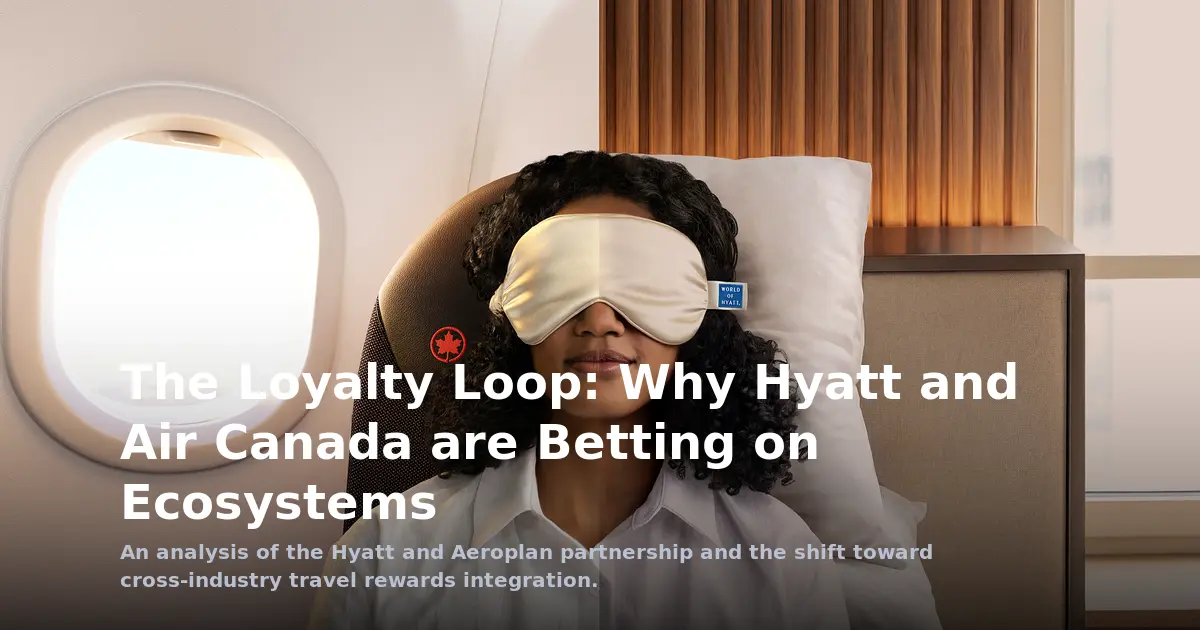
The announcement that World of Hyatt and Air Canada’s Aeroplan are integrating their reward systems is being framed as a win for the traveler. On the surface, it is a classic value-add: more ways to earn, more ways to redeem, and a frictionless path to the next free night or flight. However, looking beneath the surface of this partnership reveals a more calculated strategic maneuver. This is not merely a perk; it is a defensive play in an increasingly fragmented distribution landscape.
For years, hotel brands operated within 'closed-loop' loyalty systems, where the goal was to keep the guest entirely within the brand's own ecosystem. But the rise of flexible OTA (Online Travel Agency) booking and the shift toward corporate travel autonomy have eroded the traditional moat. Today’s high-value traveler—particularly the corporate road warrior—is less loyal to a single brand and more loyal to the utility of their rewards. By opening the loop, Hyatt is not giving up control; it is expanding its net.
The Strategic Pivot in Hotel Loyalty Partnerships
The shift toward open-loop ecosystems represents a fundamental change in how hotel brands view guest acquisition. Traditionally, the cost of acquiring a new high-tier loyalty member was an expensive exercise in direct marketing and aggressive discounting. By aligning with Aeroplan, Hyatt effectively outsources a portion of its acquisition strategy to one of Canada's most powerful travel engines.
In the Canadian market, this move is particularly surgical. Air Canada possesses a deep repository of data on high-net-worth travelers who may not currently be Hyatt loyalists but possess the spending power and travel frequency Hyatt craves. By lowering the barrier to entry through seamless point redemption, Hyatt reduces its guest acquisition costs while simultaneously increasing the 'stickiness' of its brand. When a traveler can see their Aeroplan balance as a viable path to a Hyatt stay, the psychological friction of choosing a different hotel brand increases.
Ecosystems as a Defense Against OTAs
While the partnership focuses on rewards, the underlying battle is over the booking window. OTAs have long dominated the discovery phase of travel by offering a one-stop shop. When a traveler can manage their flight and hotel rewards through a unified ecosystem, the incentive to use a third-party aggregator diminishes.
Unlike older, more rigid airline-hotel alliances that often felt like clunky afterthoughts, the integration between Aeroplan and World of Hyatt aims for a level of fluidity that mimics a digital platform. This is a move toward 'lifestyle integration.' If the rewards experience is seamless, the booking behavior follows. This creates a powerful lock-in effect: the more a traveler utilizes these interconnected points, the higher the switching cost becomes, not just in terms of money, but in terms of lost accumulated value.
The Risk of Brand Dilution
Despite the strategic advantages, this move is not without risk. The primary concern for any luxury-leaning brand like Hyatt is the potential for brand dilution. When loyalty is shared across different service sectors, the prestige of the 'exclusive' club begins to fade. If a room is perceived as a commodity that can be traded for airline miles, the emotional connection to the hotel brand may weaken, replaced by a transactional relationship based on point optimization.
Furthermore, the success of these hotel loyalty partnerships depends entirely on the execution of the technology. If the redemption process remains cumbersome or if 'blackout dates' persist, the partnership becomes a source of frustration rather than a value-add. The goal is to move from a 'points exchange' to a 'unified currency'—a transition that requires significant technical alignment and a willingness to share sensitive customer data.
As the industry moves forward, we can expect a wave of similar consolidations. The era of the standalone hotel loyalty program is ending, replaced by an era of travel conglomerates. The winners will not be the brands with the most points, but those who build the most comprehensive ecosystems, turning the act of travel into a continuous loop of integrated rewards that make leaving the network unthinkable.