The SOP Trap: Why Rigid Standards are Killing Luxury Loyalty
Analyzing the shift from checklist-driven service to emotional intelligence as the primary driver of high-end guest retention.
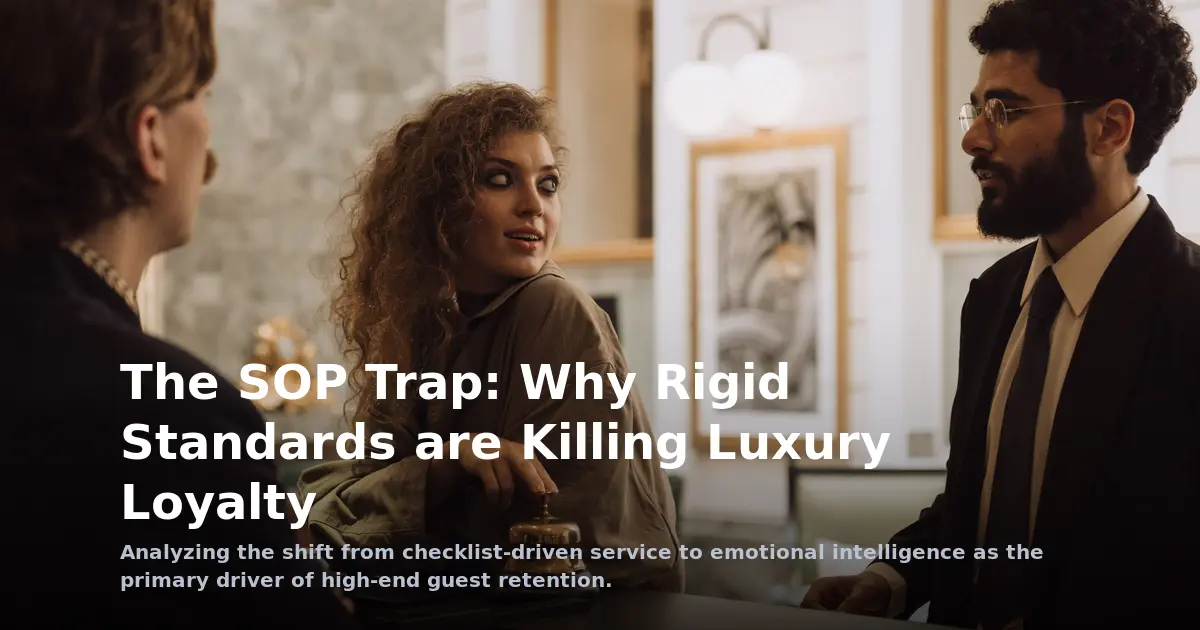
For decades, the gold standard of high-end hospitality has been the pursuit of the frictionless experience. The industry perfected the art of the Standard Operating Procedure (SOP)—a meticulous blueprint ensuring that every towel is folded at a precise angle and every greeting is delivered with a rehearsed cadence. But in the current landscape of ultra-luxury travel, this obsession with flawless execution has hit a point of diminishing returns. When perfection becomes the baseline, it ceases to be a differentiator and begins to feel like a barrier.
We are witnessing the rise of 'robotic luxury,' a state where service is invisible and efficient, yet entirely devoid of soul. For the modern high-net-worth traveler, who is increasingly seeking authenticity and emotional resonance over sterile precision, a rigid adherence to luxury hospitality standards can actually alienate the guest. The paradox is clear: the more a hotel focuses on the manual, the less it connects with the human.
The Gap Between Technical Precision and Emotional Intelligence
There is a fundamental distinction between 'invisible' service and 'felt' service. Invisible service is the hallmark of a well-run SOP; it is the art of the room being cleaned while the guest is at breakfast. It is necessary, but it is transactional. Felt service, however, is rooted in emotional intelligence (EQ) and cultural fluency. It is the ability of a staff member to read a guest's mood, anticipate an unstated need, and pivot their approach in real-time.
Most luxury training programs are heavily weighted toward technical tasks. Staff are taught the 'how'—how to pour the champagne, how to check in a VIP, how to manage a luggage cart—but they are rarely taught the 'why' of human connection. This creates a training gap where employees are technically proficient but emotionally stunted. When a guest is distressed or seeking a genuine moment of connection, a staff member tethered to a manual will often default to a scripted response, effectively shutting down the opportunity for a meaningful interaction.
Empowering the Front Line to Break the Rules
True luxury begins where the standards end. The most memorable guest experiences—the 'magic moments' that drive long-term loyalty—almost always occur when an employee has the courage to abandon the SOP. Whether it is a concierge spending an extra hour sourcing a rare vintage of wine or a housekeeper leaving a handwritten note based on a casual conversation, these acts require autonomy.
When management empowers staff to break a rule in the pursuit of guest delight, they are shifting the metric of success from 'compliance' to 'impact.' This autonomy does more than just please the guest; it transforms the employee's role from a service provider to a curator of experiences. There is a direct correlation between employee agency and guest Lifetime Value (LTV). Guests do not return to hotels because the linens were crisp; they return because they felt seen and understood by the people working there.
Redefining Luxury Hospitality Standards for the Modern Era
To survive the shift toward experiential luxury, brands must stop viewing SOPs as the destination and start viewing them as the foundation. The goal should not be the elimination of error, but the cultivation of intuition. This requires a radical shift in leadership, moving away from a culture of surveillance and toward a culture of trust.
- From Scripts to Frameworks: Replace rigid dialogue scripts with behavioral frameworks that encourage staff to adapt their tone and approach based on the guest's emotional state.
- Investing in Cultural Intelligence: Training must move beyond language proficiency to include the nuances of global social cues and emotional literacy.
- Rewarding Intuition: Shift performance KPIs to reward those who take calculated risks to enhance the guest experience, rather than those who simply follow the checklist.
As the luxury sector continues to evolve, the competitive advantage will no longer belong to the brand with the most comprehensive manual, but to the one that empowers its people to be human. The future of high-end hospitality lies in the tension between precision and spontaneity. Those who can balance the two will capture the loyalty of a generation that values a genuine connection over a perfectly folded towel.