The Luxury Paradox: Analyzing Langham’s Circular Kitchen Model
Can high-end hospitality truly scale food waste circularity without compromising the prestige of the luxury guest experience?
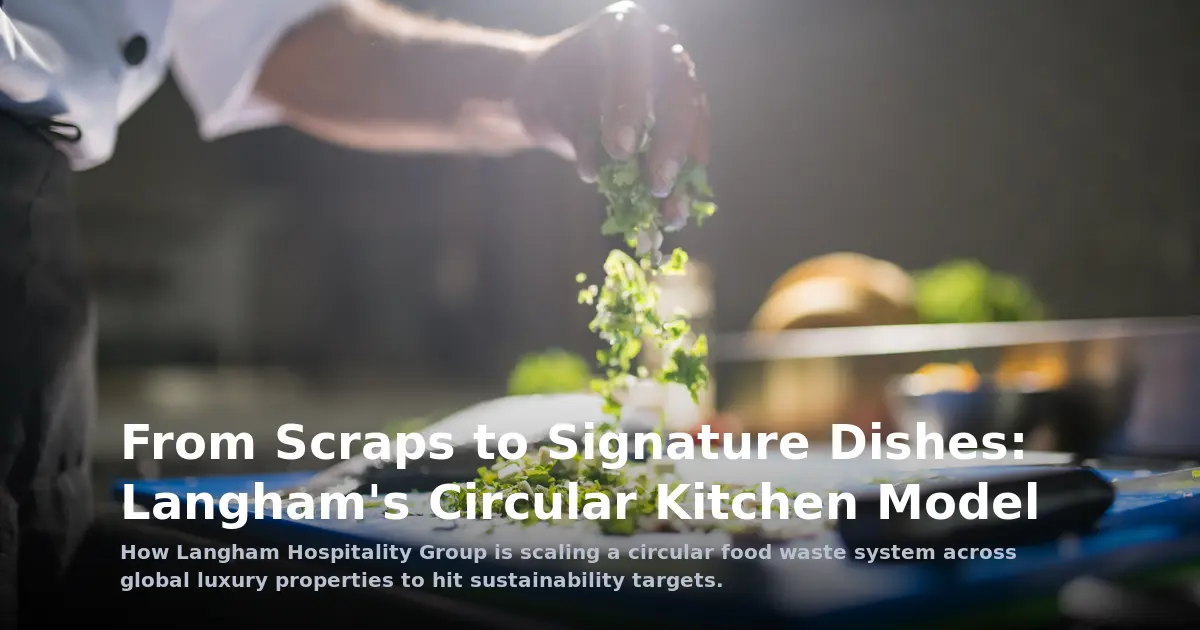
In the rarefied air of luxury hospitality, the concept of 'waste' has traditionally been invisible. For decades, the industry standard for sustainability was a quiet efficiency—discreetly hauling away excesses to maintain a facade of effortless abundance. However, Langham Hospitality Group (LHG) is attempting to flip this script, moving beyond the passive act of disposal toward a proactive model of hotel food waste circularity.
By transforming kitchen byproducts into signature menu items across properties in Auckland, Boston, the Gold Coast, Jakarta, and Hong Kong, LHG is betting that the modern luxury traveler values ecological intelligence as much as white-glove service. But as the group scales this circular approach, it faces a fundamental tension: how to market 'waste' as a premium culinary experience.
Scaling Circularity Across Diverse Markets
The operational challenge of a circular food system is that it cannot be a corporate mandate issued from a headquarters; it must be a localized culinary innovation. The byproducts available in a Jakarta kitchen differ wildly from those in Boston. To achieve true hotel food waste circularity, LHG is empowering chefs to treat 'scraps' as raw materials rather than refuse.
This shift represents a departure from industry-standard composting or donation models. While composting is a linear 'end-of-pipe' solution—reducing the harm of waste—circularity is a regenerative strategy. By reintegrating ingredients back into the revenue stream, LHG is not just reducing its carbon footprint but potentially enhancing its margins. The ability to turn a vegetable peel or a protein trim into a high-value amuse-bouche transforms a cost center (waste management) into a profit center (menu innovation).
The EarthCheck Metric and Operational Efficiency
LHG’s push toward circularity is mirrored in its pursuit of EarthCheck Master status, currently held by six of its properties. In the luxury sector, certifications often risk becoming mere badges of 'conscious luxury'—branding exercises designed to soothe the guest's conscience. However, EarthCheck’s rigorous auditing suggests a deeper correlation between sustainability and operational efficiency.
When a hotel tracks its waste down to the kilogram, it gains a granular understanding of its supply chain inefficiencies. A reduction in food waste is not merely an environmental win; it is a direct reflection of tighter inventory control and smarter procurement. For LHG, the pursuit of Master status is likely driving a leaner, more disciplined operational model that reduces the volatility of food costs in an era of global inflation.
The Perception Gap: Waste vs. Worth
The most significant hurdle in this transition is the psychological barrier of the luxury guest. The term 'waste' is antithetical to 'luxury.' If a guest perceives they are paying a premium for 'scraps,' the brand equity evaporates.
To navigate this, LHG must rely on the narrative of 'culinary craftsmanship.' The success of this model depends on the chef's ability to frame circularity as an artisanal choice—emphasizing flavor extraction and sustainability as a form of sophistication. The goal is to move the guest from a mindset of 'I am eating waste' to 'I am experiencing a curated, sustainable delicacy.'
The Future of Regenerative Hospitality
LHG’s experiment serves as a bellwether for the wider industry. As regulatory pressures on food waste mount and guests demand genuine transparency, the 'invisible' waste model is no longer viable. The transition from linear disposal to circularity requires a cultural shift within the kitchen, where sustainability is viewed not as a constraint, but as a creative catalyst.
If LHG can prove that circularity scales across disparate global markets without eroding the luxury brand, it will set a new benchmark for the industry. The future of high-end hospitality will likely be defined not by how much a hotel can provide, but by how intelligently it manages what it already has.