Financial Fortification: The Strategic Evolution of the Modern Hotel DOF
Analyzing how leadership appointments like Ashish Pandey at Renaissance Goa signal a shift from clerical accounting to strategic financial planning in luxury resorts.
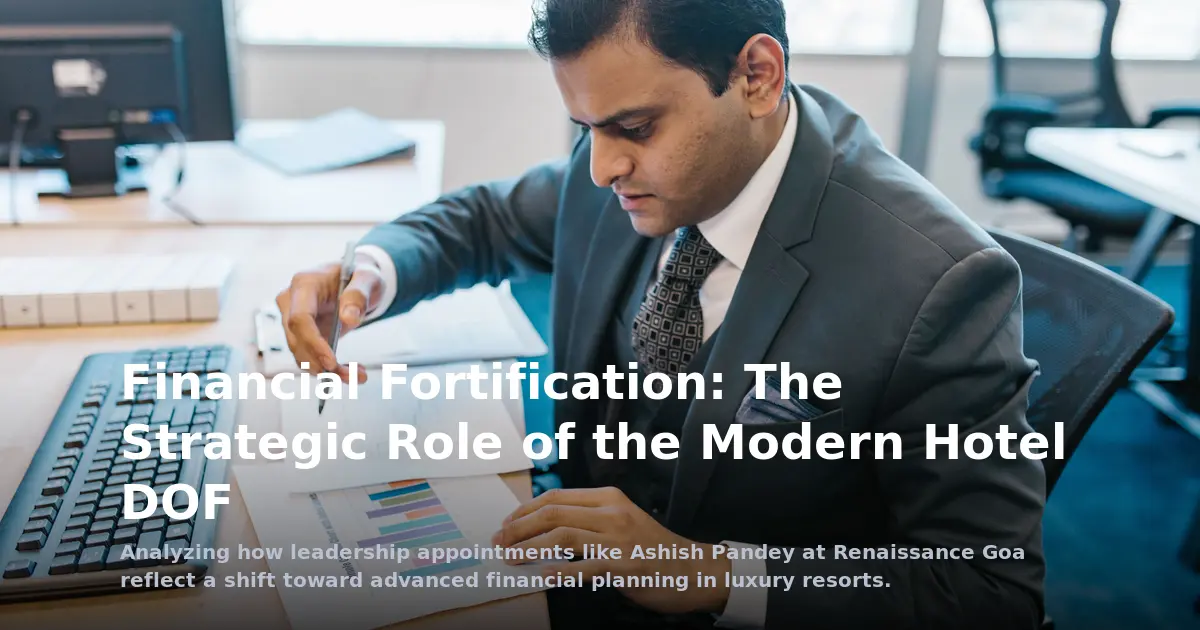
The appointment of a Director of Finance (DOF) was once viewed by hotel general managers as a necessary administrative formality—a role dedicated to balancing ledgers, managing payroll, and ensuring the books were closed on time. However, the modern luxury resort landscape has rendered the 'clerical accountant' obsolete. Today, the role is being reimagined as a strategic pivot point for the entire operation.
The recent appointment of Ashish Pandey as Director of Finance at the Renaissance Goa Hotel serves as a prime case study in this shift. With over 13 years of specialized hospitality experience, Pandey’s profile emphasizes Financial Planning and Analysis (FP&A) over simple bookkeeping. In the high-stakes environment of a Marriott-branded luxury property, this distinction is critical. The modern DOF is no longer just reporting on what happened last month; they are predicting what will happen next quarter.
From Bookkeeping to Strategic Hotel Financial Leadership
Across the global hospitality sector, there is a visible migration toward hotel financial leadership that prioritizes FP&A. This evolution is driven by the increasing complexity of revenue streams and the volatility of consumer behavior. In a luxury resort setting, the DOF must navigate the delicate balance between aggressive revenue growth and the stringent cost controls required to maintain healthy margins.
Strategic financial leadership involves moving beyond the P&L statement to analyze the 'why' behind the numbers. This includes:
- Dynamic Forecasting: Moving away from static annual budgets toward rolling forecasts that respond to real-time market shifts.
- Yield Optimization: Working closely with revenue managers to ensure that ADR (Average Daily Rate) growth does not come at the expense of unsustainable operational overhead.
- Capex Strategy: Determining exactly when and where to invest in property renovations to ensure the highest possible Return on Investment (ROI) without disrupting the guest experience.
The Goa Challenge: Seasonality and Operational Overhead
For properties in markets like Goa, the financial stakes are uniquely high. The region is characterized by extreme seasonality, where a few peak months must subsidize the operational costs of the lean season. A DOF without deep hospitality expertise can easily fall into the trap of over-cutting during the off-season, which inevitably erodes service quality and damages the brand's luxury standing.
This is where a decade-plus of experience becomes a stabilizing force. A seasoned leader understands that luxury is an investment in the guest experience. By optimizing resource allocation—shifting labor and energy costs dynamically based on occupancy trends—a strategic DOF can maintain the 'gold standard' of service even when the occupancy dip hits. The goal is not merely to save money, but to allocate it with surgical precision to the touchpoints that drive guest loyalty.
Branded Rigor vs. Boutique Flexibility
There is also a distinct difference in how financial leadership operates within a global powerhouse like Marriott compared to an independent boutique. In a branded environment, the DOF must operate within a rigorous framework of corporate standards and global reporting metrics. The challenge here is to find 'local agility' within 'global rigidity.'
A DOF at a branded property must translate complex corporate mandates into actionable local strategies. They act as the bridge between the owner's desire for profit and the brand's requirement for quality. While a boutique DOF might have more flexibility in how they track spend, a branded leader must master the art of the 'standardized' report while finding the hidden efficiencies that allow the property to outperform its competitive set.
The Future of the Back Office
As the industry moves further away from the pandemic era, the mandate for financial leaders is clear: stability through sophistication. The reliance on basic accounting software is being replaced by AI-driven predictive analytics and integrated ERP systems. This technological shift means the DOF will spend less time on data entry and more time on business intelligence.
The trajectory of hotel financial leadership is moving toward a 'Chief Financial Officer' model, where the DOF is a primary architect of the hotel's commercial strategy. Those who can blend rigorous fiscal discipline with a deep understanding of the luxury guest journey will be the ones who ensure their properties remain both profitable and prestigious in an increasingly crowded market.