The €50M Bet: Brown Hotels' Berlin Refurbishment and the European Pivot
Analyzing the strategic shift from aggressive acquisition to value-add optimization across Europe's key hotel markets.
The recent movement in European hospitality assets suggests a fundamental shift in how owners view growth. For years, the playbook for institutional investors was simple: acquire prime real estate in gateway cities and ride the wave of rising ADRs. However, the current economic climate—characterized by high borrowing costs and a tightening of capital—has forced a pivot. We are seeing the emergence of the 'value-add' era, where the goal is no longer just owning the asset, but aggressively repositioning it to capture a new segment of the market.
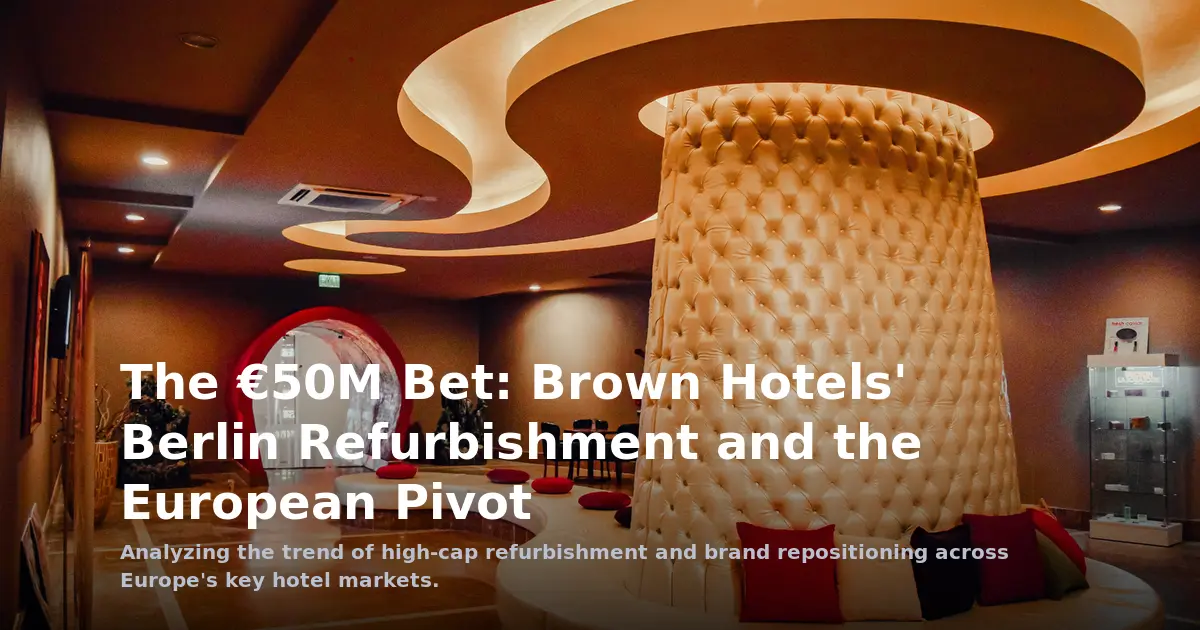
Nowhere is this more evident than in Brown Hotels' €50M investment into its Berlin project. A refurbishment of this scale is not merely a cosmetic update; it is a strategic bet on the resilience of the urban luxury-lifestyle segment. By committing such significant capital to a refurbishment rather than a new build, Brown Hotels is signaling a broader trend: the optimization of existing footprints to maximize yield without the regulatory and temporal headaches of ground-up development.
The Strategic Shift in European Hotel Investment Trends
When analyzing recent transaction data across Italy, Germany, Austria, Norway, the UK, and France, a clear pattern emerges. The industry is moving away from the 'buy-and-hold' mentality toward 'reposition-and-harvest.' This shift is visible in the increasing number of brand repositionings accompanying ownership changes. Investors are no longer buying a hotel for what it is, but for what it could be under a different brand identity.
This trend is driven by several macroeconomic factors:
- Cost of Capital: With interest rates remaining elevated, the hurdle rate for new developments has become prohibitively high for many.
- ESG Mandates: Refurbishing existing structures often aligns better with sustainability goals than the carbon-heavy process of new construction.
- Market Maturity: In cities like Berlin, London, and Paris, prime sites are scarce. The only way to scale is to acquire underperforming assets and elevate them through design and brand alignment.
Assessing the Risk-Reward Ratio: Refurbishment vs. New Build
Comparing the investment appetite across the six primary markets reveals a nuanced landscape. In Germany and the UK, the focus is heavily on urban repositioning, where the risk is mitigated by established demand. In contrast, markets like Norway and Austria are seeing more targeted, niche investments that leverage regional strengths.
The risk-reward ratio of a €50M refurbishment is complex. On one hand, you avoid the zoning battles and construction delays associated with new builds. On the other, you inherit the 'ghosts' of a previous building—outdated plumbing, inefficient layouts, and structural limitations. However, the speed-to-market advantage is currently the deciding factor. A repositioned asset can be brought online and begin generating cash flow significantly faster than a new development, which is critical when investors are under pressure to show returns to LPs.
The Broader Implications for Hospitality Ownership
These transactions signal that we have entered a period of professionalization in asset management. Ownership is no longer a passive activity. The success of the European hotel investment trends moving forward will depend on the ability of owners to identify 'mispriced' assets—hotels that are fundamentally sound but conceptually dated.
We are seeing a convergence of real estate investment and brand curation. The value is no longer just in the bricks and mortar, but in the 'vibe'—the ability to pivot a traditional business hotel into a lifestyle hub that attracts the digital nomad and the high-spending leisure traveler simultaneously.
The long-term implication is a more fragmented but specialized market. As more operators follow the Brown Hotels model of high-cap refurbishment, we can expect a surge in 'boutique-scale' luxury assets that prioritize design and experience over raw room count. The winners of the next cycle will not be those with the largest portfolios, but those with the most agile repositioning strategies, turning stagnant assets into high-yielding cultural landmarks.