Beyond the Badge: The ROI of Hotel Sustainability Certification
Analyzing whether the pivot toward Green Key status is a genuine operational evolution or a strategic exercise in corporate ESG reporting.
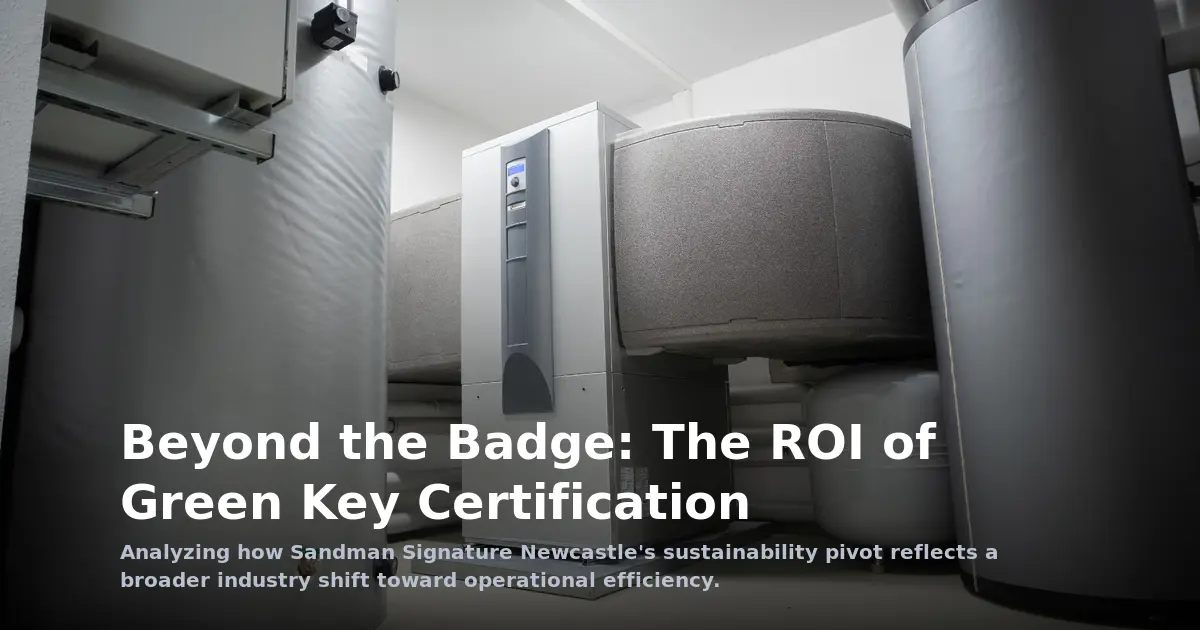
The recent announcement that Sandman Signature Newcastle has achieved Green Key status—meeting a rigorous set of 150 criteria—serves as a microcosm for a larger tension currently playing out across the global hospitality landscape. For years, sustainability in hotels was relegated to the "greenwash" era: a card on the desk asking guests to reuse towels while the boiler room continued to burn fossil fuels at an inefficient rate. Today, the shift toward formal hotel sustainability certification suggests a move toward systemic operational change, but the question remains: where does the marketing end and the genuine ROI begin?
The Operational Friction of Green Key Standards
Achieving a Green Key certification is not a passive exercise. The 150 criteria involved in the process cover everything from waste management and water conservation to the procurement of sustainable cleaning agents. For modern builds, these requirements are often baked into the architecture. However, for legacy properties, the implementation is a battle of attrition against aging infrastructure.
The most significant friction occurs in the tension between guest luxury expectations and strict resource conservation. In the upscale segment, the "luxury experience" has historically been defined by abundance—high-pressure rainfall showers, oversized tubs, and climate-controlled rooms kept at precise temperatures regardless of external conditions. Implementing aggressive water-saving measures or capping energy usage requires a delicate psychological pivot: convincing the high-paying guest that a lower-flow shower head is a badge of honor rather than a reduction in service quality.
OpEx Reduction vs. ESG Reporting
While the badge on the website appeals to the conscious traveler, the true value of a hotel sustainability certification lies in the reduction of Operational Expenditure (OpEx). The correlation between energy-efficient heating systems and long-term profitability is no longer theoretical. By optimizing HVAC systems and migrating to smart sensors, hotels are seeing a direct hit to their utility bills, which remain one of the most volatile cost centers in the industry.
However, there is a growing divide between operational efficiency and corporate ESG (Environmental, Social, and Governance) reporting. For many hotel groups, these certifications are less about the planet and more about the portfolio. As institutional investors and REITs increasingly tie funding to ESG metrics, a Green Key or LEED certification becomes a financial instrument. It lowers the risk profile of an asset and increases its valuation during a sale, regardless of whether the hotel has actually reduced its carbon footprint in a meaningful way.
The B2B Shift: The New Corporate Mandate
Perhaps the most immediate impact of these certifications is felt in the B2B sector. In the UK market, corporate travel procurement is undergoing a fundamental shift. Large corporations are no longer simply looking for the best room rate or the most convenient location; they are now mandated to report on their "Scope 3" emissions—the indirect emissions that occur in their value chain, including hotel stays.
When a corporate travel manager filters for properties with a recognized hotel sustainability certification, hotels without these credentials are effectively erased from the RFP process. This has turned sustainability from a "nice-to-have" amenity into a prerequisite for capturing high-yield corporate business. In this environment, the certification is not just an environmental statement; it is a critical tool for revenue management.
Framing the Global Standard
When comparing Green Key to other frameworks like LEED (Leadership in Energy and Environmental Design) or BREEAM, a clear distinction emerges. While LEED and BREEAM are heavily focused on the physical shell and construction of the building, Green Key focuses on the operation of the hotel. This makes it a more dynamic tool for general managers, as it measures the behavior of the staff and the choices of the procurement team rather than just the quality of the insulation in the walls.
As the industry moves toward 2030, the gap between "certified" and "sustainable" will likely narrow. We are entering an era of radical transparency where guests and corporate clients will demand real-time data on water and energy usage. The properties that treat certification as a checklist for a plaque on the wall will find themselves obsolete, while those that use these frameworks to fundamentally re-engineer their OpEx will lead the next cycle of hospitality profitability.