Hyatt's Mexico Push: A Calculated Gamble on Ultra-Luxury
Analyzing the strategic risk and reward of Hyatt's dual-brand expansion in Mexico's most competitive corridors.
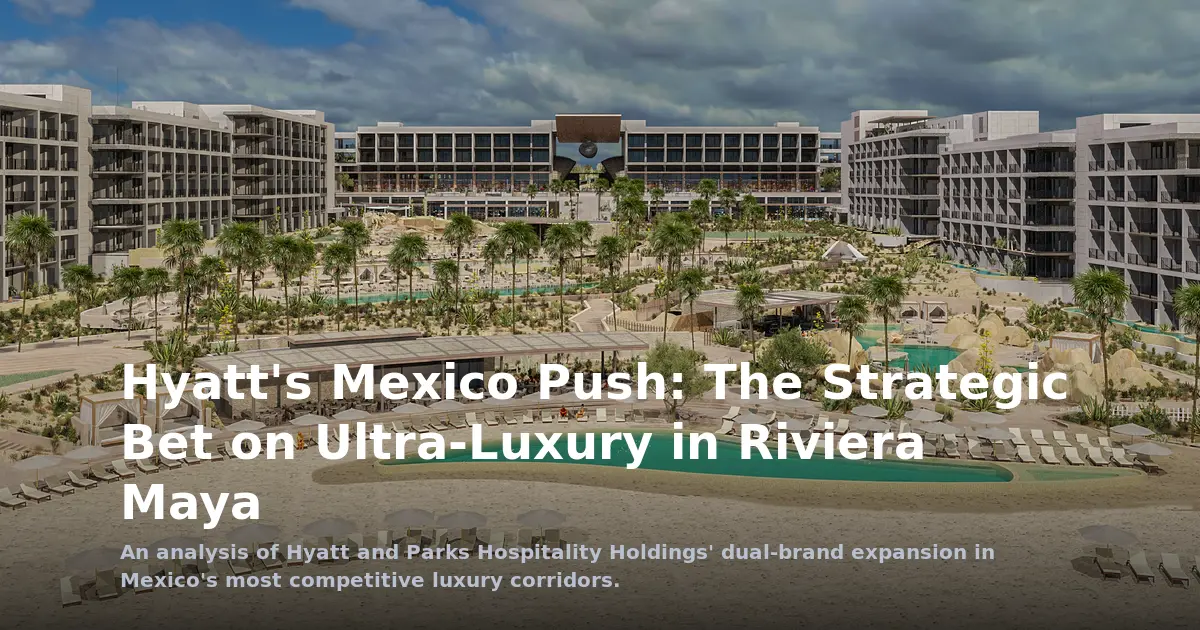
The luxury hospitality landscape in Mexico is no longer just about scale; it is about precision. Hyatt’s recent move to deepen its footprint through a partnership with Parks Hospitality Holdings (PHH) signals a pivot toward a high-conviction strategy in the ultra-luxury segment. By simultaneously deploying the Park Hyatt and Grand Hyatt flags in the Riviera Maya and Los Cabos, the company is not merely adding rooms—it is attempting to capture two distinct tiers of high-net-worth demand in a single regional push.
This Hyatt Mexico expansion represents a departure from the cautious, incremental growth seen in previous years. Instead, Hyatt is leaning into a dual-brand strategy that seeks to segment the market from the top down. The Park Hyatt Riviera Maya will target the 'ultra-luxury' traveler—those seeking secluded, high-design exclusivity—while the Grand Hyatt Los Cabos will cater to the affluent, large-scale luxury traveler who demands comprehensive amenities and brand reliability.
The PHH Partnership: Asset-Light Growth vs. Operational Risk
The alliance with Parks Hospitality Holdings is the engine driving this growth. For Hyatt, this is a textbook execution of an asset-light strategy, allowing the brand to scale rapidly without the heavy capital expenditure of land acquisition and construction. However, this reliance on a third-party owner introduces a layer of operational risk. The success of these properties depends entirely on PHH’s ability to execute the physical product to the exacting standards of the Park Hyatt brand, which is notoriously uncompromising.
In the Riviera Maya, where the competition includes everything from Aman to Four Seasons, the margin for error is razor-thin. If the execution falls short of the 'ultra-luxury' promise, the brand risks diluting its prestige in a region where the traveler's expectations are at an all-time high. Conversely, if PHH delivers a world-class product, Hyatt secures a dominant foothold in a corridor that continues to attract the global 1%.
Navigating a Saturated Luxury Landscape
Critics might argue that the luxury corridors of Los Cabos and the Riviera Maya are reaching a saturation point. The proliferation of branded residences and boutique luxury hotels has created a crowded marketplace. However, the Hyatt Mexico expansion suggests that Hyatt sees a gap in the market: the lack of consistent, scalable luxury that can be integrated into a global loyalty ecosystem.
While independent boutiques offer charm, the Grand Hyatt and Park Hyatt brands offer a level of predictability and reward-integration that attracts the corporate elite and the frequent luxury traveler. By layering these two brands, Hyatt is essentially hedging its bets. They are capturing the 'trophy' traveler at Park Hyatt and the 'luxury-lifestyle' traveler at Grand Hyatt, effectively boxing out competitors who only offer one of the two experiences.
Infrastructure and the High-Net-Worth Shift
The timing of these openings aligns with a broader shift in regional tourism infrastructure. Mexico has seen a surge in private aviation and high-end transport logistics, making these destinations more accessible to the ultra-wealthy than ever before. The demand for 'experiential luxury'—where the hotel is not just a place to sleep but a destination in itself—is driving the design of these new properties. The move toward ultra-luxury is not just a brand preference; it is a response to a global shift in wealth concentration toward the top 0.1%.
The Strategic Horizon
This aggressive push into Mexico serves as a litmus test for Hyatt’s broader international growth strategy. If the dual-brand approach succeeds here, expect to see similar clusters in other high-growth luxury markets across Latin America and Asia. The goal is no longer just to be present in a destination, but to own multiple segments of the luxury pyramid.
As the industry moves toward a more fragmented definition of 'luxury,' the ability to pivot between the understated elegance of a Park Hyatt and the vibrant scale of a Grand Hyatt will be a critical competitive advantage. The success of this venture will ultimately be measured not by the number of keys added, but by the ability to maintain average daily rates (ADR) in an increasingly crowded sea of gold-leafed resorts.