Oman's Youth Surge: The Rise of Local Leadership in Luxury Hospitality
The appointment of Abdullatif Al Farsi as the youngest Omani GM at Anantara Al Jabal Al Akhdar signals a systemic shift in the Sultanate's luxury tier.
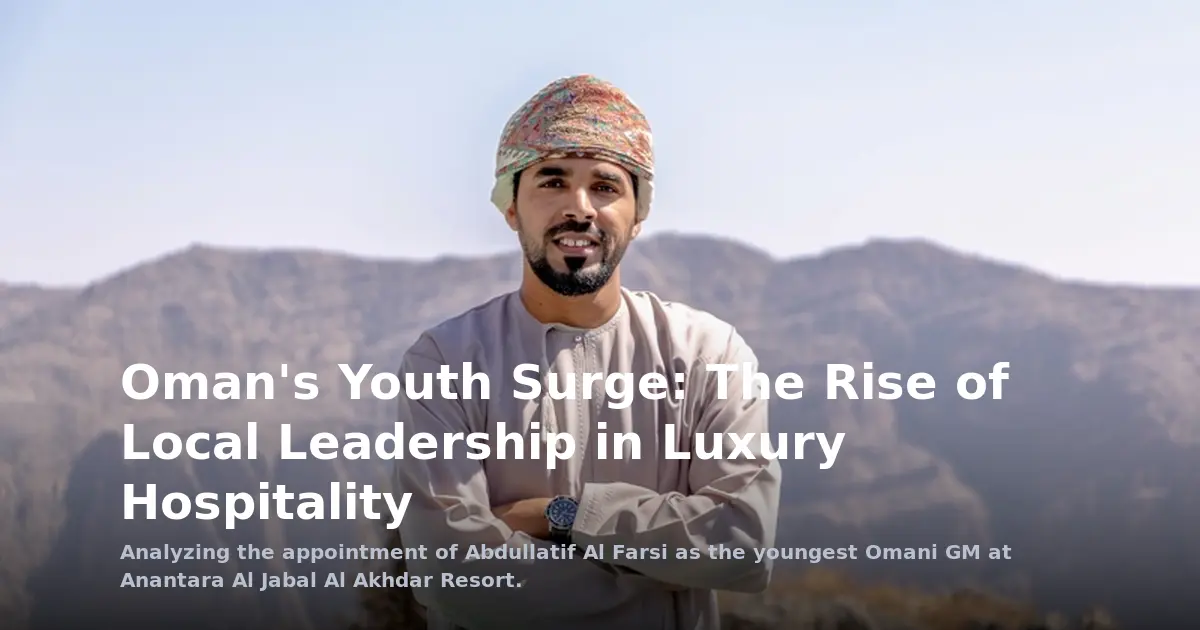
For decades, the upper echelons of luxury hospitality in the Middle East followed a predictable script: seasoned expatriate veterans, often from Europe or North America, were flown in to steer the ship, while local talent occupied the supporting cast. However, the narrative is shifting. The recent appointment of Abdullatif Al Farsi as General Manager of the Anantara Al Jabal Al Akhdar Resort is more than a corporate promotion; it is a bellwether for a broader structural transformation in Omani luxury hospitality leadership.
Al Farsi’s ascent to the helm of one of the region's most prestigious mountain retreats—and his status as the youngest Omani to lead a luxury resort in the Sultanate—marks a departure from the traditional 'wait-your-turn' trajectory. It suggests that the industry is moving beyond superficial quotas toward a genuine integration of local talent into strategic decision-making roles.
Beyond 'Omanization': From Quotas to Competency
To understand the significance of Al Farsi's appointment, one must look at the evolution of 'Omanization.' While government-led mandates to increase the percentage of national employees in the private sector have existed for years, the luxury sector has historically been the slowest to localize at the executive level. The rationale was often rooted in a perceived need for 'international standards'—a euphemism for the expatriate management style.
However, the current trend indicates a pivot. The modern luxury guest is no longer seeking a generic, polished version of Swiss or American service; they are seeking authenticity. By placing a young Omani at the helm, Anantara is acknowledging that cultural fluency is now a primary luxury amenity. Local leadership possesses an intuitive understanding of the Sultanate's heritage, social nuances, and hospitality ethos that cannot be taught in a corporate manual in Singapore or London.
This shift represents a transition from 'compliance-based' hiring to 'competency-based' leadership. Al Farsi's role demonstrates that the new generation of Omani hoteliers is not just filling gaps but is actively redefining what luxury leadership looks like in the Gulf.
Redefining the Guest Experience Through Local Lens
The implications for the guest experience are profound. When leadership is localized, the 'cultural bridge' between the guest and the destination becomes shorter. A General Manager who is native to the land can curate experiences that feel organic rather than orchestrated. At a property like Al Jabal Al Akhdar, where the environment is as much a part of the product as the room, this indigenous perspective is invaluable.
Moreover, this transition impacts the internal ecosystem of the hotel. For the junior staff, seeing a young national in the top office creates a powerful psychological shift. It transforms the career path from a ceiling to a ladder. The traditional model—where local staff peaked at middle management—is being replaced by a visible pipeline to the C-suite.
The Anantara Blueprint for Talent Development
Anantara’s decision to entrust a young Omani with such a high-profile asset suggests a strategic bet on internal talent development. By accelerating the trajectory of leaders like Al Farsi, the brand is effectively decentralizing its expertise. This approach mitigates the risk of 'leadership churn' associated with expatriate contracts, where institutional knowledge often leaves the building every three to five years.
Instead, the brand is building a legacy of sustainable leadership. This model requires a willingness to take calculated risks on youth, prioritizing agility and local insight over decades of tenure in foreign markets.
The Future of the Gulf's Luxury Tier
The rise of Omani luxury hospitality leadership is not an isolated event but part of a wider regional movement seen across the GCC. As Saudi Arabia and the UAE continue to aggressively diversify their economies, the demand for sophisticated, locally-led hospitality will only grow.
We are entering an era where the 'Global Standard' of luxury is being rewritten to include 'Local Authenticity' as a core pillar. The success of leaders like Al Farsi will likely trigger a competitive race among luxury brands to identify and cultivate the next generation of national talent. The focus will shift from simply employing locals to empowering them, ensuring that the future of luxury in the Middle East is not just managed by the world, but led by the people who call it home.