The Event Effect: Decoding Sydney's June Occupancy Surge
Analyzing whether Sydney's return to pre-pandemic occupancy levels signals a structural recovery or a temporary event-driven spike.
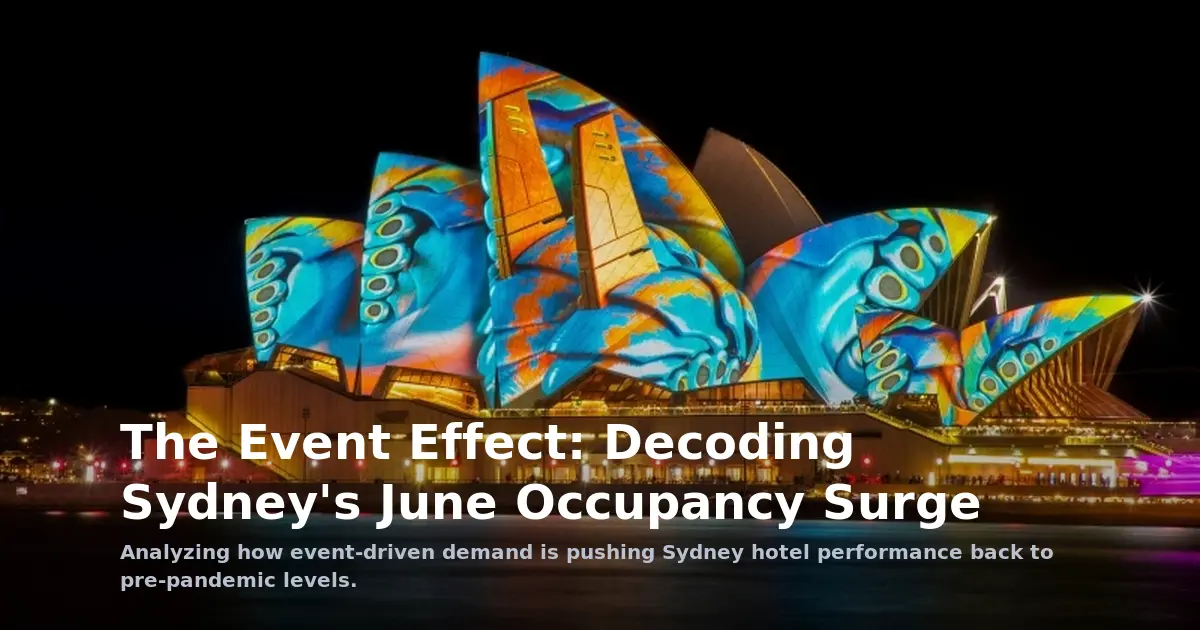
For the first time since the global travel hiatus of 2020, Sydney's hotel sector has hit a critical milestone. June data reveals that occupancy levels have climbed to their highest point since 2019, marking a symbolic return to the city's pre-pandemic performance baseline. However, for industry stakeholders, the question isn't just whether the rooms are full, but why they are full and whether this momentum is sustainable.
On the surface, the numbers are encouraging. Year-over-year gains in Average Daily Rate (ADR) and Revenue Per Available Room (RevPAR) suggest a market that has not only recovered its volume but has successfully pivoted to a higher pricing tier. Yet, a closer look at the calendar reveals that this surge is not the result of a broad-based return of leisure tourism, but rather a concentrated 'event effect.'
The Mechanics of the June Spike
Sydney hotel occupancy in June was driven by a perfect storm of high-yield corporate events and large-scale conventions. Unlike the steady, predictable flow of organic tourism, event-driven demand creates aggressive, short-term spikes that allow hoteliers to push ADR to premium levels. This creates a lucrative but volatile environment. When a city's performance is tethered to a specific event calendar, the risk is that the 'recovery' is actually a series of isolated peaks rather than a rising tide.
Comparing current figures to 2019 benchmarks reveals a fascinating shift in the 'new normal.' While occupancy has returned to pre-pandemic levels, the RevPAR growth is being driven more heavily by pricing power than by sheer volume. This suggests that Sydney's hotel operators have successfully transitioned to a value-over-volume strategy, capitalizing on the scarcity of high-end inventory during peak event windows.
Structural Recovery vs. Temporary Volatility
To determine if this represents a genuine structural recovery, Sydney must be viewed alongside other APAC gateway cities. While Singapore and Tokyo have seen a more linear return of international visitors, Sydney's recovery has been more erratic, heavily reliant on the return of high-yield corporate group travel. The June surge is a strong indicator that the corporate 'road warrior' and the convention delegate have returned, but it leaves a gap in the mid-week, non-event organic demand.
There are three key factors that will determine if this growth is sustainable:
- Diversification of Demand: Can the city maintain high occupancy without a major convention in town?
- Pricing Elasticity: Will corporate clients continue to accept the significantly higher ADRs seen in the post-pandemic era?
- Labor Stability: Can the hospitality workforce scale quickly enough to meet these sudden, event-driven surges without compromising service quality?
The Return of High-Yield Corporate Travel
Perhaps the most significant takeaway from the June data is the reappearance of the high-yield corporate segment. For years, the industry feared that the shift toward virtual meetings had permanently eroded the demand for corporate group bookings. The recent surge in Sydney hotel occupancy suggests otherwise. The 'human element' of business—networking, face-to-face negotiation, and large-scale industry gatherings—remains an irreplaceable driver of hotel revenue.
However, the nature of this travel has changed. We are seeing a trend toward 'bleisure,' where corporate travelers extend their stays into the weekend, blending business with leisure. This hybrid model could provide the steady organic growth that the city needs to bridge the gaps between major events, potentially smoothing out the volatility of the event calendar.
As the industry looks toward the remainder of the year, the focus will shift from celebrating the return to 2019 levels to establishing a new growth trajectory. The June surge proves that the appetite for Sydney as a premier destination is intact. The challenge now is to convert these episodic spikes into a consistent, sustainable baseline of demand that can weather the fluctuations of a global economy.