Beyond the Tier-1 Hubs: Analyzing Hyatt Place's Strategic Pivot in China
The opening of Hyatt Place Jiaxing Nanhu signals a calculated shift toward select-service growth in China's emerging regional centers.
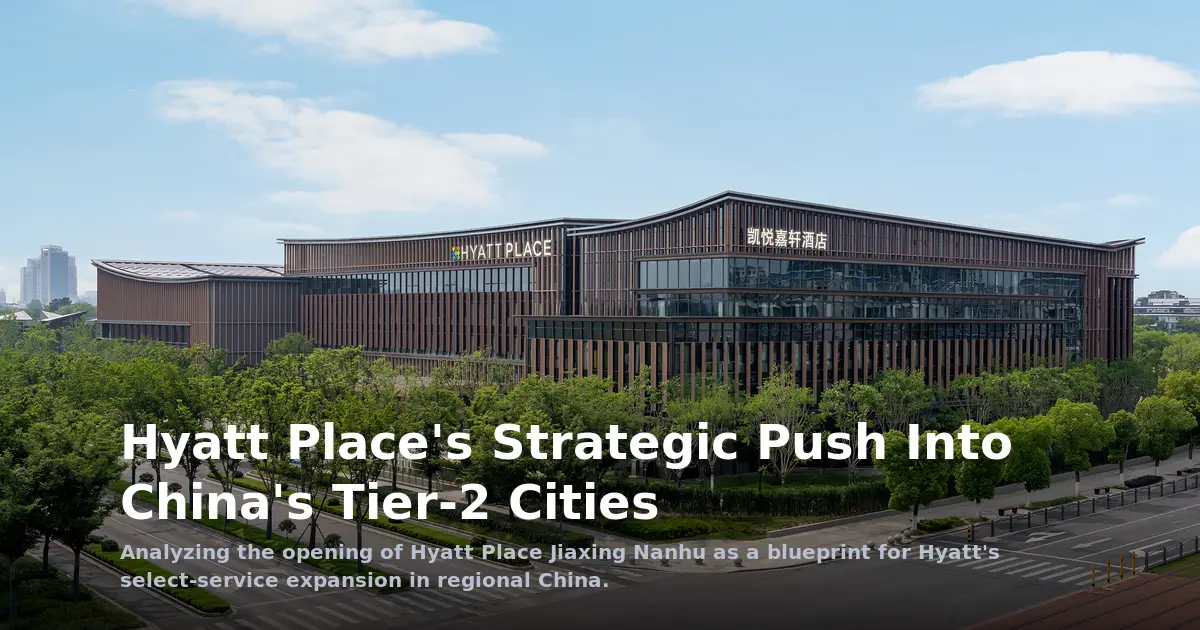
The hospitality landscape in China is undergoing a fundamental realignment. For years, the narrative of international hotel growth centered on the 'Big Four'—Beijing, Shanghai, Guangzhou, and Shenzhen. However, the recent debut of Hyatt Place Jiaxing Nanhu suggests a more nuanced strategy is now in play. By planting a flag in Jiaxing, Hyatt is not merely adding a room count to its portfolio; it is executing a precise play to capture the burgeoning demand of Tier-2 and Tier-3 cities.
While the luxury segment has long been the face of international brands in China, the current recovery phase is being driven by a different engine: the regional business traveler and the domestic 'bleisure' explorer. The decision to deploy the Hyatt Place brand specifically—a select-service model—indicates that the company is prioritizing scalability and agility over the high-overhead prestige of full-service luxury.
Decoding the Geography: Why Jiaxing Matters for Hyatt China Expansion
Jiaxing is not a random selection. Positioned strategically between the economic powerhouses of Shanghai and Hangzhou, the city serves as a critical node for industrial growth and regional administration. The Nanhu district, in particular, acts as a localized destination driver, blending historical significance with modern business infrastructure.
For Hyatt, this represents a hedge against the saturation of primary hubs. In Shanghai, the competition for luxury guests is a war of attrition. In a city like Jiaxing, Hyatt Place can establish a dominant position as a premium, reliable international standard for a professional class that is increasingly mobile but seeks efficiency over opulence. This move reflects a broader trend in the Hyatt China expansion strategy: moving away from the 'trophy hotel' mentality and toward a network-based approach that mirrors the actual flow of regional commerce.
Select-Service vs. Luxury: The New Growth Engine
The shift toward select-service brands is a response to the changing economics of the Chinese market. The cost of land and labor in Tier-1 cities has made the ROI on massive luxury builds increasingly precarious. Conversely, the mid-scale and upper-mid-scale segments are seeing a surge in demand as domestic travelers seek 'attainable luxury.'
By scaling Hyatt Place, the company achieves several strategic goals:
- Faster Time-to-Market: Select-service hotels typically have shorter development cycles than full-service resorts.
- Lower Operational Risk: Reduced staffing requirements and streamlined amenities lower the break-even point.
- Brand Diversification: It allows Hyatt to capture a younger, more digitally native demographic that values flexibility and functional design over traditional white-glove service.
However, this pivot is not without risk. The regional Chinese market is fiercely competitive, with domestic giants like Huazhu and Jin Jiang operating lean, high-tech models that can undercut international brands on price while offering similar levels of convenience. Hyatt's challenge will be maintaining its 'premium' perception while competing in a space where value-for-money is the primary driver.
The Global Blueprint and Regional Reality
This expansion in Jiaxing is a localized manifestation of Hyatt's global mandate to diversify its brand portfolio. For years, the company was viewed as a luxury-heavy operator. The aggressive push into select-service is a corrective measure intended to balance the portfolio and increase the frequency of guest touchpoints.
In the context of China, this means transforming from a brand that guests visit for a special occasion into a brand that guests use for their Tuesday night business trip. The success of the Jiaxing Nanhu property will likely serve as a litmus test for further deployments in similar regional clusters across the Yangtze River Delta.
As the Chinese hospitality market continues to stabilize, the industry will see a definitive move away from the 'mega-hotel' era. The future belongs to brands that can blend global standards with hyper-local relevance. Hyatt's ability to successfully navigate the cultural and economic nuances of Tier-2 cities will determine whether it can maintain its relevance in the world's most dynamic travel market or remain a niche player in a sea of domestic disruptors.