Signal or Symbol? Choice Hotels Elevates AI Governance to the Board Level
The appointment of Ali Keshavarz suggests a pivot toward algorithmic operational efficiency, but the real test lies in the ROI for midscale franchisees.
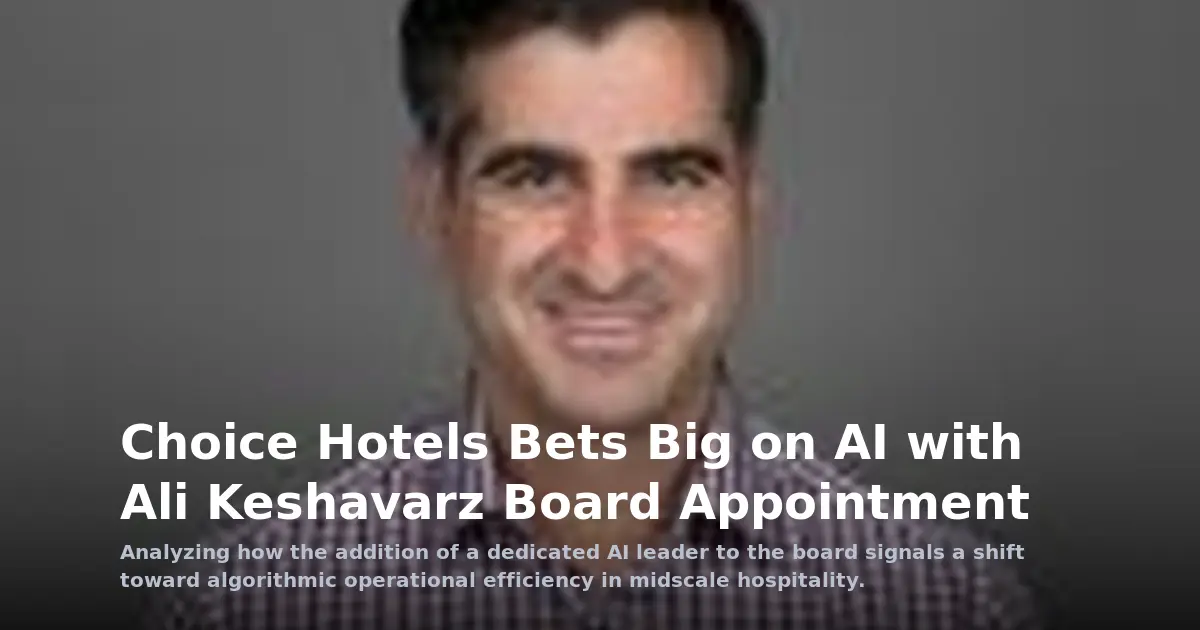
The appointment of Ali Keshavarz to the Board of Directors at Choice Hotels is more than a routine corporate governance update; it is a calculated signal to the market. By placing a dedicated artificial intelligence leader at the highest level of oversight, Choice is acknowledging that the next era of hospitality competition will not be won through real estate acquisition alone, but through the mastery of the data layer.
In the midscale and budget segments, where margins are notoriously thin and labor costs are volatile, the promise of AI is not about futuristic robot concierges. It is about the brutal efficiency of the back end. Keshavarz brings a pedigree of scaling AI systems that translates directly into the levers of hotel profitability: dynamic pricing, predictive staffing, and hyper-personalized guest acquisition. The question for industry observers is whether this move represents a genuine strategic pivot toward AI-driven disruption or a symbolic gesture designed to satisfy investors hungry for 'tech-forward' governance.
Redefining the Hotel AI Strategy: Operational Leanness vs. Guest Experience
When examining the broader hotel AI strategy landscape, a clear divide has emerged. Giants like Marriott and Hilton have spent years building massive, centralized tech stacks that prioritize the guest-facing ecosystem—mobile keys, digital check-ins, and loyalty integration. Choice, however, operates in a different ecosystem. Its success relies on a vast network of independent franchisees who require tools that reduce overhead without requiring a PhD in data science to operate.
Keshavarz’s influence is likely to be felt most acutely in the transition from descriptive analytics (what happened?) to prescriptive analytics (what should we do?). For a midscale operator, an AI-driven approach to revenue management that can predict local demand spikes with 95% accuracy is worth more than any flashy chatbot. If Choice can successfully implement AI to automate the mundane aspects of property management, they can effectively lower the barrier to entry for new franchisees while increasing the yield per room.
However, there is a tension here. AI-driven efficiency often leads to a leaner workforce. In the budget segment, the line between 'efficient' and 'sterile' is thin. The risk is that in the pursuit of algorithmic perfection, the human element of hospitality—the very thing that differentiates a hotel from an Airbnb—becomes a casualty of the cost-cutting mandate.
The Franchisee Friction: Cost-Sharing and Tech Mandates
For Choice's franchise owners, the arrival of an AI-centric board member may trigger a mixture of optimism and anxiety. The primary concern in the franchise model is always the cost of implementation. When a brand pivots its hotel AI strategy, it often comes with a mandate for new software, updated hardware, or recurring SaaS fees that eat into the operator's bottom line.
If Keshavarz pushes for a rapid rollout of AI tools, the company must address the ROI gap. Will these tools actually reduce labor costs enough to offset the licensing fees? Or will the AI be used primarily to optimize corporate-level data harvesting, leaving the franchisee to manage the operational fallout? The true measure of this board appointment will be whether Choice develops a cost-sharing model that allows small-scale operators to benefit from enterprise-grade AI without risking their solvency.
Beyond the Hype: The Search for Tangible ROI
The hospitality industry is currently saturated with AI hype. Every vendor claims to have a 'generative AI solution' for guest queries. But in the midscale sector, the market is allergic to vanity tech. The real value lies in the unglamorous parts of the business: energy management, laundry optimization, and automated procurement.
By placing AI expertise on the board, Choice is positioning itself to move beyond the 'pilot phase' of technology adoption. They are signaling a shift toward integrating AI into the core capital allocation process. This means AI will no longer be a project managed by the IT department, but a lens through which the company views its entire growth strategy.
As the industry moves toward a more automated future, the success of this move will depend on the ability to balance high-tech governance with high-touch service. If Choice can leverage AI to remove the friction of hotel management, they may set the blueprint for the rest of the midscale market. The move is a bold bet that the future of the budget hotel is not just about the bed, but about the algorithm that puts the guest in it.