The 'Premiumization' Trap: What Frontier's Starlink Pivot Means for Budget Hotels
As low-cost carriers embrace high-end tech to drive revenue, budget hospitality brands face a critical crossroads in guest expectations.
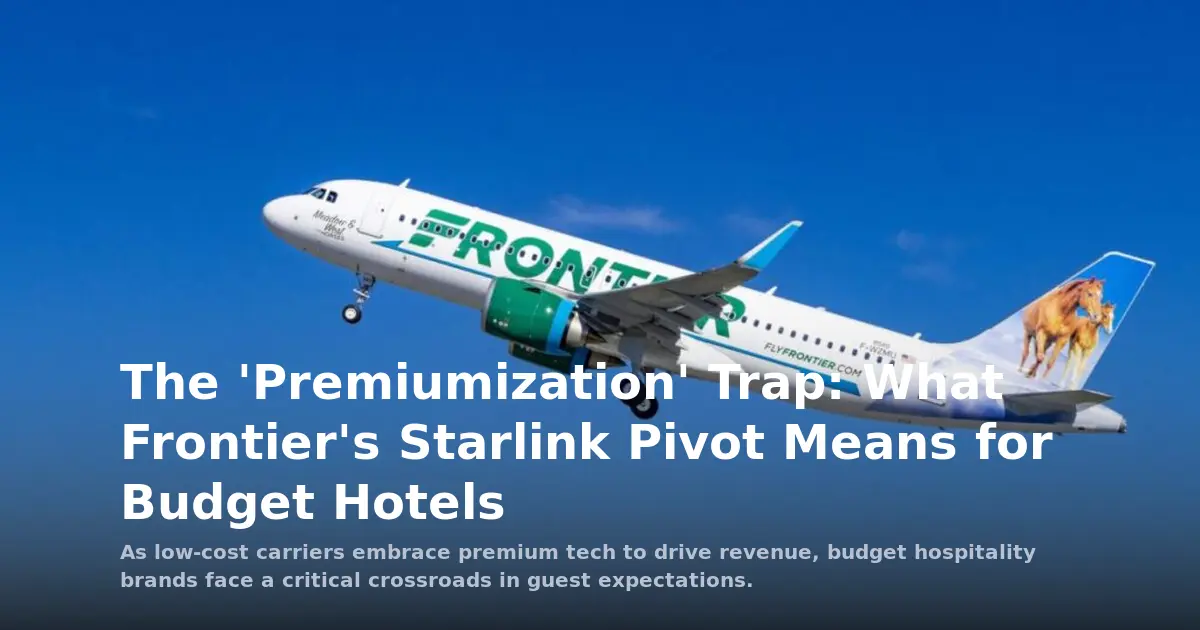
The announcement that Frontier Airlines—a carrier defined by its uncompromising commitment to the low-cost model—is installing Starlink high-speed internet is more than a corporate update; it is a signal of a shifting psychological boundary in consumer behavior. For years, the budget travel sector operated on a simple social contract: the customer accepts a stripped-back experience in exchange for a significantly lower price point. But that contract is being rewritten in real-time.
For the hospitality industry, specifically those operating in the economy and mid-scale segments, this pivot by a low-cost carrier serves as a cautionary tale. It highlights a growing tension in budget hospitality trends: the struggle to maintain operational leaness while fighting the gravitational pull of 'premiumization.'
The Death of the 'Bare-Bones' Baseline
In the early days of the budget hotel boom, the value proposition was clear. You paid for a clean bed and a shower; everything else was an extra. However, the digital landscape has fundamentally altered what guests perceive as a 'basic' need. High-speed connectivity has transitioned from a premium amenity to a fundamental utility, akin to electricity or running water.
When a low-cost carrier like Frontier decides that even its most price-sensitive passengers now require satellite-grade internet, it suggests that the 'budget' label no longer grants brands a pass to ignore high-tech infrastructure. In the hotel sector, this manifests as a dangerous 'amenity creep.' Budget brands are increasingly pressured to invest in high-speed Wi-Fi, smart room controls, and seamless mobile check-ins just to maintain a baseline level of guest satisfaction. The risk here is operational: when a budget hotel spends its CAPEX on premium tech to keep up with trends, it risks eroding the very cost advantage that allows it to offer lower rates.
The Tiered Revenue Gamble
Frontier’s move toward Starlink isn't purely about guest satisfaction; it is about revenue optimization. By introducing a premium product into a budget environment, they are testing the elasticity of their customers' wallets. Budget hospitality brands are attempting a similar dance, moving from a 'one size fits all' budget room to tiered offerings—premium bedding, enhanced connectivity packages, or 'digital nomad' suites.
However, this strategy carries a psychological risk. For the core price-sensitive customer, the introduction of tiered premiums can feel less like an opportunity and more like a penalty. If a guest chooses a budget hotel specifically to avoid the 'nickel-and-diming' of luxury brands, discovering that the high-speed Wi-Fi they need for work is locked behind a paywall can lead to immediate brand resentment. The challenge for budget operators is determining where the 'right' ends and the 'luxury' begins.
Connectivity as a Competitive Weapon
Comparing the airline and hotel sectors reveals a stark difference in the impact of connectivity. For a passenger on a four-hour flight, Starlink is a convenience. For a guest in a budget hotel—who may be a remote worker, a contractor, or a digital nomad—reliable internet is the primary driver of the stay's success.
As budget hospitality trends shift toward longer-stay patterns and the blurring of business and leisure travel (bleisure), the quality of the digital experience becomes the primary differentiator. A budget hotel with flawless, high-speed internet will almost always beat a mid-scale hotel with spotty connectivity, regardless of the quality of the linens. This creates a paradox where the most 'budget' of properties must now make the most 'premium' investments in infrastructure to remain viable.
The Path Forward: Strategic Leaness
The industry is moving toward a future where the 'budget' category is defined not by what it lacks, but by what it optimizes. The winners will not be those who chase every premium trend, but those who identify the few non-negotiable digital expectations and execute them perfectly while ruthlessly cutting costs elsewhere.
If budget hotels follow the trajectory of low-cost carriers, we will see a consolidation of 'essential premiums.' The goal is no longer to be the cheapest option on the map, but to be the most efficient provider of a high-functioning environment. The danger remains that in the pursuit of this digital gold standard, brands may forget that their primary audience is still looking for a fair price. The balance between technological evolution and cost discipline will define the next decade of the economy lodging sector.