Checked In: The Boutique Hotel Boom Reshaping Secondary Markets
How a shift toward 'hyper-localism' and strategic soft-branding is driving occupancy surges in America's mid-sized cities.
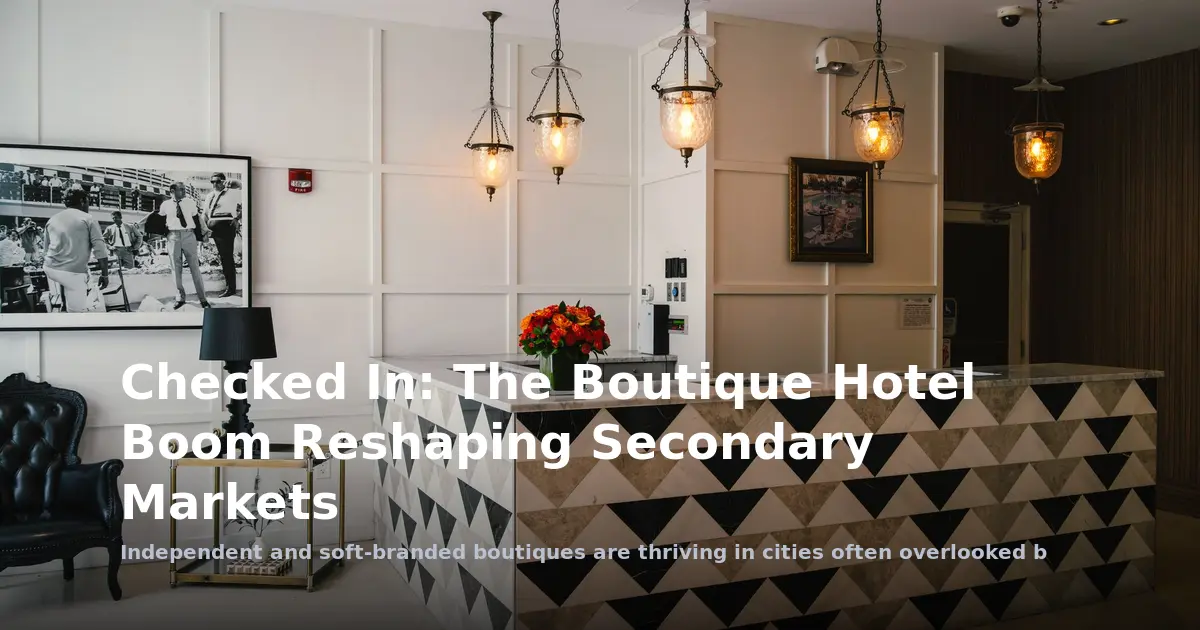
The luxury hotel playbook is being rewritten in cities where the skyline isn't the primary draw. In markets like Tulsa, Tucson, and Indianapolis, a new breed of boutique properties is outperforming the legacy giants. Recent data indicates these independent and soft-brand hotels are posting occupancy rates 8-12 percentage points above their traditional competitive sets, signaling a fundamental shift in how travelers allocate their spend. The era of the homogenized corporate lobby is ending, replaced by a demand for architectural specificity and cultural immersion.
The Economics of the 'Secondary' Shift
For developers, the migration toward secondary markets is a calculated financial play. In Tier 1 cities like New York or London, land acquisition costs and zoning restrictions have pushed Internal Rates of Return (IRR) to precarious levels. Conversely, in secondary markets, developers are finding prime real estate at a fraction of the cost, allowing them to allocate more capital toward high-touch guest experiences and bespoke interior design.
This shift is fueled by a transition in consumer behavior. The 'revenge travel' surge of the post-pandemic years evolved into a preference for 'slow travel,' where guests prioritize the vibe of a neighborhood over the prestige of a zip code. This has created a vacuum that boutique operators are filling. By focusing on a smaller room count—typically between 40 and 120 keys—these hotels maintain a level of operational agility that Marriott or Hilton cannot replicate. They are leveraging lower overheads to invest in high-margin amenities, such as curated rooftop bars and local art galleries, which serve as both guest draws and community hubs.
The Rise of the 'Soft Brand' Powerhouse
While the aesthetic of these hotels is independent, the engine under the hood is increasingly corporate. The most successful boutique projects in secondary markets are utilizing 'soft brands'—collections like Autograph Collection (Marriott), Curio Collection (Hilton), and Tribute Portfolio. These arrangements allow developers to retain their unique identity and local branding while plugging into a global distribution system and a massive loyalty program.
This hybrid model solves the 'discoverability' problem. A 60-room boutique hotel in Tucson might have a world-class cocktail program and mid-century modern architecture, but without a global search engine, it struggles to capture the high-spending international traveler. By joining a soft brand, the property gains access to millions of loyalty members who are incentivized to stay at 'unique' properties to earn points. The result is a strategic advantage: the soul of an indie hotel with the booking muscle of a Fortune 500 company. This synergy is precisely why these properties are seeing a 10% average premium on Average Daily Rate (ADR) compared to standard limited-service hotels in the same vicinity.
Hyper-Localism as a Revenue Driver
Authenticity is no longer a marketing buzzword; it is a quantifiable revenue driver. The most profitable boutique hotels in these emerging markets are those that function as 'neighborhood anchors.' Instead of generic continental breakfasts, they are partnering with local sourdough bakeries. Instead of corporate gym chains, they are integrating with nearby yoga studios.
This strategy captures a critical demographic: the 'bleisure' traveler. As remote work persists, the line between business and leisure has blurred. Professionals are choosing to spend a week in a city like Tulsa, working from a boutique hotel's lobby-cafe and exploring the local arts district. This has extended the traditional weekend peak into a full-week occupancy model. Data suggests that these properties are seeing a 15-20% increase in mid-week occupancy compared to traditional business hotels, which typically rely on corporate contracts that are now shrinking in favor of flexible work arrangements.
Market Implications and the Road Ahead
The success of the boutique boom in secondary markets creates a new set of challenges for legacy operators. The 'cookie-cutter' model is failing to capture the Gen Z and Millennial segments, who view standardized hotel rooms as an obsolete commodity. To compete, larger chains are attempting to 'boutique-ify' their existing portfolios through aggressive renovations and the introduction of lifestyle brands like Moxy or Edition, but these often lack the genuine local grit that travelers crave.
Furthermore, this trend is driving a real estate ripple effect. The arrival of a high-end boutique hotel often acts as a catalyst for further neighborhood revitalization, increasing the value of surrounding commercial parcels. We are seeing a pattern where the hotel is not just a lodging provider, but the primary driver of a district's economic rebirth.
Moving forward, the winners in this space will be those who can balance scalability with intimacy. The future of the industry lies in the 'micro-market' strategy: identifying undervalued cities with strong cultural identities and deploying high-design, low-density assets. The boutique boom is not a temporary trend; it is a permanent restructuring of the hospitality map, shifting the center of gravity away from the metropolis and toward the authentic heart of the secondary city.