The $40M Bet: Omni Amelia Island's High-Stakes Luxury Pivot
Analyzing how a comprehensive resort-wide overhaul aims to recapture the ultra-luxury segment in a competitive Florida market.
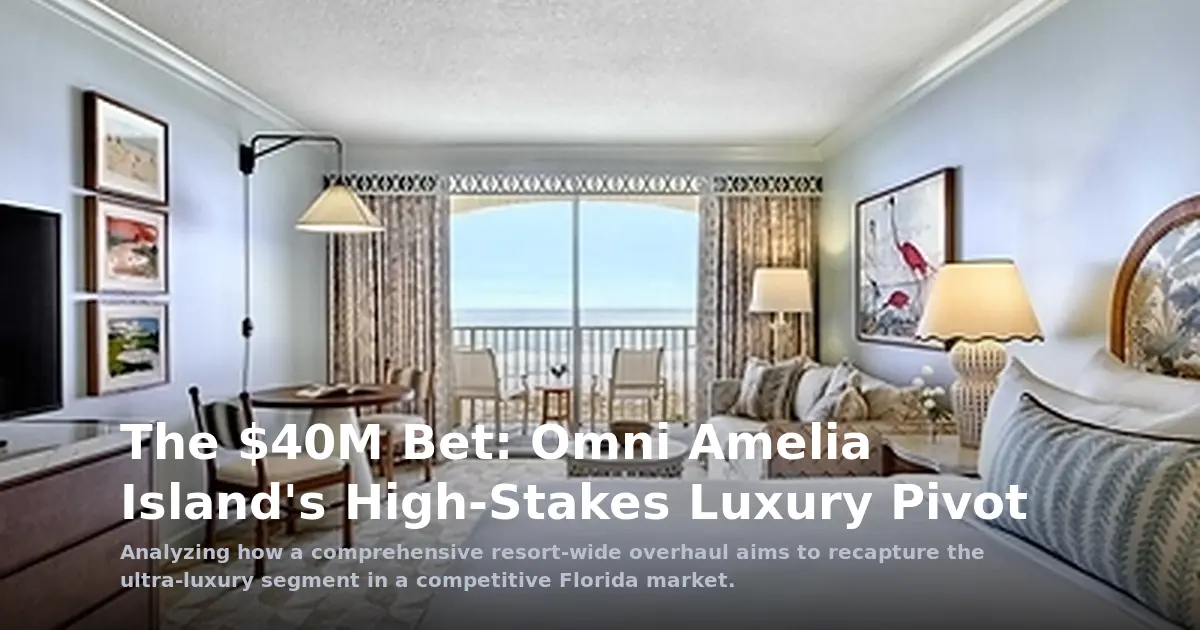
In the volatile landscape of Florida’s coastal hospitality, the line between 'upscale' and 'ultra-luxury' is often defined by the freshness of the paint and the modernity of the amenities. For Omni Amelia Island Resort & Spa, the completion of a $40 million renovation is less about aesthetic upkeep and more about a strategic defensive maneuver. As boutique entrants and rebranded luxury flags saturate the Southeast, legacy resorts face a critical inflection point: evolve or concede the high-net-worth traveler to newer, leaner competitors.
This is not a mere refresh. A $40 million capital expenditure across guestrooms, suites, dining, spa, and golf represents a comprehensive attempt to eliminate 'luxury leakage'—the phenomenon where guests stay at a resort but migrate to nearby boutique properties for dining or wellness experiences because the primary property feels dated.
Deconstructing the Luxury Resort Renovation Strategy
When analyzing the allocation of a $40 million budget, the ROI is not found in a single area but in the synergy of the guest journey. By updating everything from the art collections to the golf amenities, Omni is addressing the risk of a fragmented guest experience. In the ultra-luxury segment, a stunning guestroom paired with a dated lobby or a lackluster spa facility creates a cognitive dissonance that prevents a property from commanding top-tier Average Daily Rates (ADR).
The decision to overhaul the spa and dining venues simultaneously with the rooms suggests a shift toward 'destination wellness.' In the post-pandemic era, luxury travelers are no longer looking for a place to sleep; they are seeking an ecosystem of curated experiences. By integrating updated public spaces and art collections, the resort is positioning itself as a cultural hub rather than just a lodging provider, a move specifically designed to justify price premiums in an increasingly crowded market.
The Competitive Calculus of the Florida Coast
To understand the scale of this investment, one must look at the competitive set along the Florida coast. The region has seen a surge in 'quiet luxury' developments—smaller, high-touch properties that prioritize intimacy over scale. For a larger resort like Omni, the challenge is maintaining the efficiencies of scale while delivering the perceived exclusivity of a boutique hotel.
This luxury resort renovation serves as a hedge against that trend. By modernizing the suites and public areas, Omni is attempting to bridge the gap between the convenience of a full-service resort and the aesthetic rigor of a luxury boutique. The timing is critical; as the initial post-pandemic travel surge stabilizes, the market is shifting from 'revenge travel' back to discerning luxury, where the quality of the hard product is once again the primary driver of loyalty.
Driving ADR Through Aesthetic Authority
One of the more nuanced aspects of this overhaul is the focus on art collections and public spaces. In the luxury sector, art is not merely decoration; it is a signal of prestige. Updated curation in public areas functions as a visual shorthand for 'current' and 'relevant,' which directly impacts the property's ability to push ADR. When a guest enters a lobby that feels like a contemporary gallery, the psychological barrier to a $1,000+ per night room rate is significantly lowered.
Furthermore, the updates to golf amenities ensure that the resort remains a powerhouse for the high-spending sports tourism segment. In Florida, golf is often the 'hook' that brings the guest, but the quality of the surrounding luxury infrastructure is what determines the length of stay and the total spend per guest.
The Broader Industry Implication
Omni Amelia Island’s aggressive reinvestment signals a broader trend in the hospitality industry: the end of the 'pandemic grace period.' For several years, demand was so high that guests overlooked aging interiors. That window has closed. We are entering an era of 'hard-product accountability,' where legacy resorts must either invest heavily in comprehensive renovations or risk a slow slide into the mid-scale category.
As other legacy properties observe the results of this $40 million pivot, expect a wave of similar capital expenditures across the Sun Belt. The goal is no longer just to maintain standards, but to redefine them in a market where the luxury consumer has more options—and higher expectations—than ever before.