The Friction Factor: Can Faster Airport Clearances Revive High-Yield Corporate Bookings?
Analyzing how the SAFEGUARDS Act and reduced international screening friction could revitalize the C-suite's appetite for global travel.
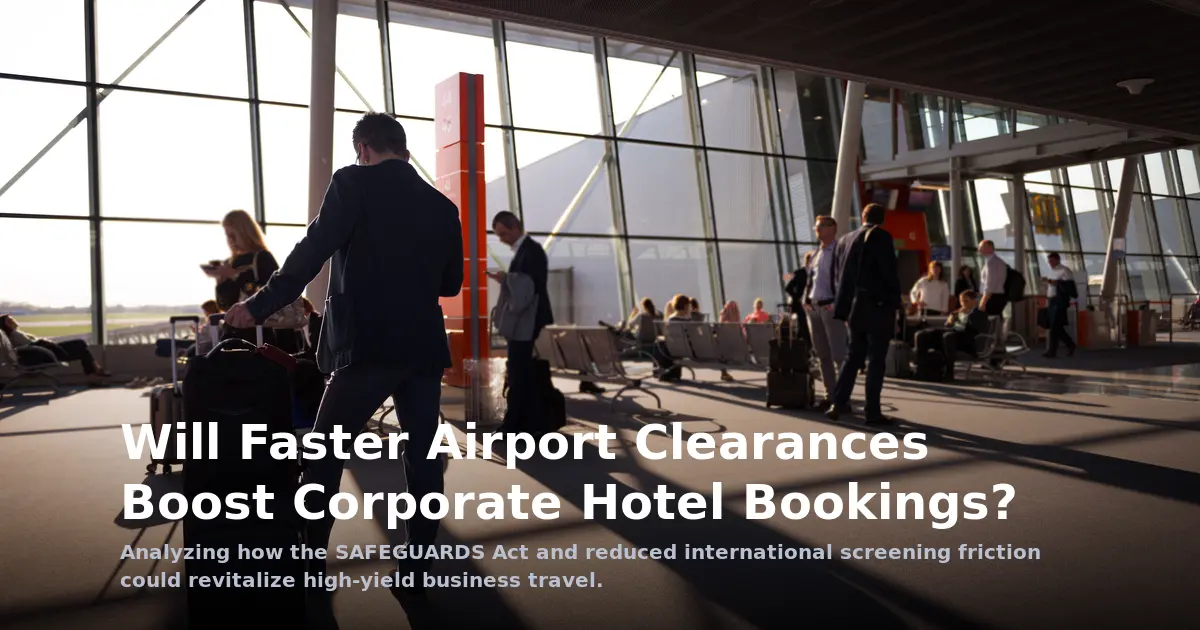
For the modern C-suite executive, the primary deterrent to international travel is rarely the flight itself, but the 'friction' surrounding it. The psychological toll of redundant security screenings, unpredictable customs delays, and the general chaos of transit has turned high-yield business trips into a calculated risk of productivity loss.
Recent legislative movements in the U.S., specifically the passage of the SAFEGUARDS Act and the One Stop Pilot Program Extension Act, aim to dismantle these barriers. While the Global Business Travel Association (GBTA) views these as security and funding wins, the hotel industry should view them as a catalyst for a shift in corporate travel trends. When the 'friction' of transit decreases, the propensity for last-minute, high-value bookings typically increases.
Dismantling the Transit Barrier
The One Stop Pilot Program Extension Act is particularly significant for the hospitality sector. By reducing redundant international screenings, the legislation targets the exact pain points that lead corporate travelers to opt for Zoom over a transatlantic flight. For the luxury hotel segment, this is a critical lever. High-yield corporate guests are not price-sensitive; they are time-sensitive.
When a traveler knows that their transition from tarmac to hotel suite is seamless, the perceived cost of the trip drops. We have seen a correlation where reduced transit friction leads to a resurgence in 'spontaneous' corporate travel—trips booked within a 7-to-14-day window. These bookings are historically the most profitable for hotels, allowing for aggressive yield management and higher Average Daily Rates (ADR).
Corporate Travel Trends vs. Budgetary Constraints
However, a critical question remains: are streamlined security checkpoints enough to offset the current climate of corporate budget tightening? Many firms are still operating under leaner travel mandates, prioritizing 'essential' travel over 'relationship' travel.
Security efficiency is a powerful lubricant, but it does not operate in a vacuum. Hotels must weigh these legislative wins against other systemic barriers, such as airfare volatility and the lingering inertia of remote work culture. While a faster TSA line removes a psychological barrier, it does not necessarily rewrite a company's quarterly travel budget.
To capitalize on these improvements, hotels must evolve their corporate packages. The opportunity lies in bridging the gap between the airport and the room. We are seeing a trend where hotels integrate 'frictionless' arrival services—such as coordinated private transfers and expedited check-ins—to mirror the efficiency of the new airport protocols. If the airport is faster, the hotel must be faster to maintain the momentum of the traveler's experience.
The Strategic Pivot for Hospitality
To truly leverage these shifts in corporate travel trends, hotel operators should move beyond the standard corporate rate. The strategy should shift toward 'Executive Wellness and Efficiency' packages. If the SAFEGUARDS Act makes the journey less taxing, hotels can market the destination as a place of high-productivity recovery.
- Hyper-Personalized Transit: Offering seamless integration from the 'One Stop' clearance to the hotel lobby.
- Dynamic Pricing for Short-Lead Bookings: Implementing targeted offers for the C-suite that reward the 'spontaneous' nature of reduced-friction travel.
- Enhanced In-Room Productivity Suites: Ensuring the transition from a streamlined airport to a high-functioning workspace is instantaneous.
The Long View on Global Mobility
Legislative victories in airport security are rarely the sole driver of industry growth, but they serve as a necessary foundation. As international borders become more porous for the business elite, the hospitality industry will see a gradual return of the 'power traveler.' The winners will not be the hotels that simply wait for these travelers to return, but those that align their operational efficiency with the new, streamlined reality of global transit. The goal is no longer just providing a room, but managing the entire trajectory of the executive's journey.