Beyond the Barn: The Commercial Viability of 'Farm Charm' Hotels
Analyzing whether the surge in agri-tourism is a sustainable business model or an operational liability for luxury operators.
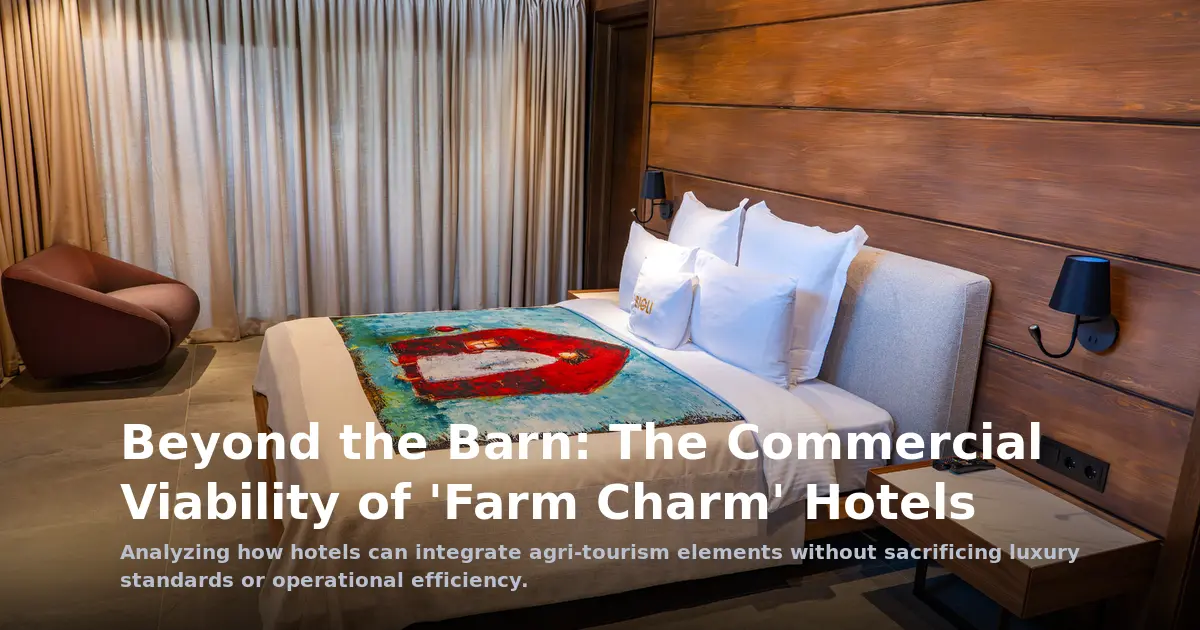
The hospitality industry is currently enamored with the concept of "slow travel," a movement that prioritizes mindfulness, local immersion, and a deliberate decoupling from the digital grind. The latest consumer data suggests a massive appetite for this shift, with a vast majority of travelers expressing a desire for farm-adjacent stays. However, for the seasoned hotel operator, the gap between a guest's romanticized vision of a rustic getaway and the grueling reality of agricultural management is a chasm that can swallow profit margins whole.
While the aesthetic of "farm charm"—exposed beams, organic gardens, and farm-to-table dining—is highly marketable on social media, the operational infrastructure required to maintain these standards is complex. The industry is seeing a surge in agri-tourism hotel trends, but there is a critical tension between providing a curated luxury experience and managing a working farm.
The Operational Friction of Rustic Luxury
Integrating authentic agricultural elements into a hotel property is not as simple as planting a few heirloom tomatoes and calling it a "garden-to-glass" program. True agri-tourism requires a specialized labor force that traditional hotel management structures are not equipped to handle. A concierge can manage a dinner reservation, but they cannot manage crop rotation, livestock health, or the unpredictable volatility of seasonal harvests.
When luxury hotels attempt to pivot toward this model, they often face a choice: outsource the farming to a third party or attempt to manage it in-house. Outsourcing often leads to a disconnect in brand storytelling, while in-house management introduces significant operational risk. The "charm" of a farm is often rooted in its imperfection, yet the luxury guest expects a seamless, sanitized experience. Managing the intersection of mud, livestock, and high-thread-count linens is an operational tightrope that few properties walk successfully.
ROI and the Risk of Aesthetic Greenwashing
From a financial perspective, the conversion of traditional amenities—such as a standard gym or a generic spa—into nature-based activities like foraging tours or artisanal cheese-making workshops presents a challenging ROI calculation. These activities are labor-intensive and have low throughput compared to traditional revenue centers.
Furthermore, there is a growing risk of "aesthetic greenwashing." Many properties are adopting the visual markers of agri-tourism—rustic decor and "locally sourced" labels—without actually integrating into the local agricultural ecosystem. This superficial adoption is a dangerous game; today's traveler is increasingly sophisticated and can easily distinguish between a genuine community partnership and a marketing veneer.
Properties that successfully pivot to a true slow-travel model, however, are seeing a positive impact on their Average Daily Rate (ADR). By shifting the value proposition from the room itself to the experience of the land, hotels can command a premium. The key is moving away from the "hotel with a farm" model toward a "destination centered on agriculture," where the farm is the primary draw rather than a decorative backdrop.
Scalability: Boutique Authenticity vs. Corporate Mimicry
One of the most contentious aspects of current agri-tourism hotel trends is the attempt by large-scale hotel chains to mimic the boutique farm stay. Scalability is the natural enemy of authenticity. The charm of a farm stay is derived from its intimacy and its connection to a specific piece of earth. When a global brand attempts to standardize this experience across a portfolio, the result is often a sterilized version of rural life that feels more like a theme park than a retreat.
Boutique operators have a distinct advantage here. Their ability to maintain a lean, flexible operation allows them to embrace the seasonality of farming. A large chain, bound by quarterly consistency and rigid brand standards, struggles to adapt to a season where the harvest fails or the weather turns. For the corporate giant, the "farm charm" trend is a design choice; for the boutique operator, it is a business philosophy.
As the industry moves forward, the winners will not be those who simply add a few vegetable patches to their landscape. Instead, success will belong to operators who treat agriculture as a core competency rather than a marketing amenity. The future of luxury lies in authenticity, but that authenticity requires a willingness to embrace the operational chaos of the natural world. Those who can balance the grit of the farm with the grace of high-end hospitality will define the next era of the guest experience.