The Silo Trap: Can AI Restore Cross-Functional Rhythm in Hotel Groups?
Analyzing whether a new layer of AI leadership can bridge the gap between hyper-optimized departments and the actual guest experience.
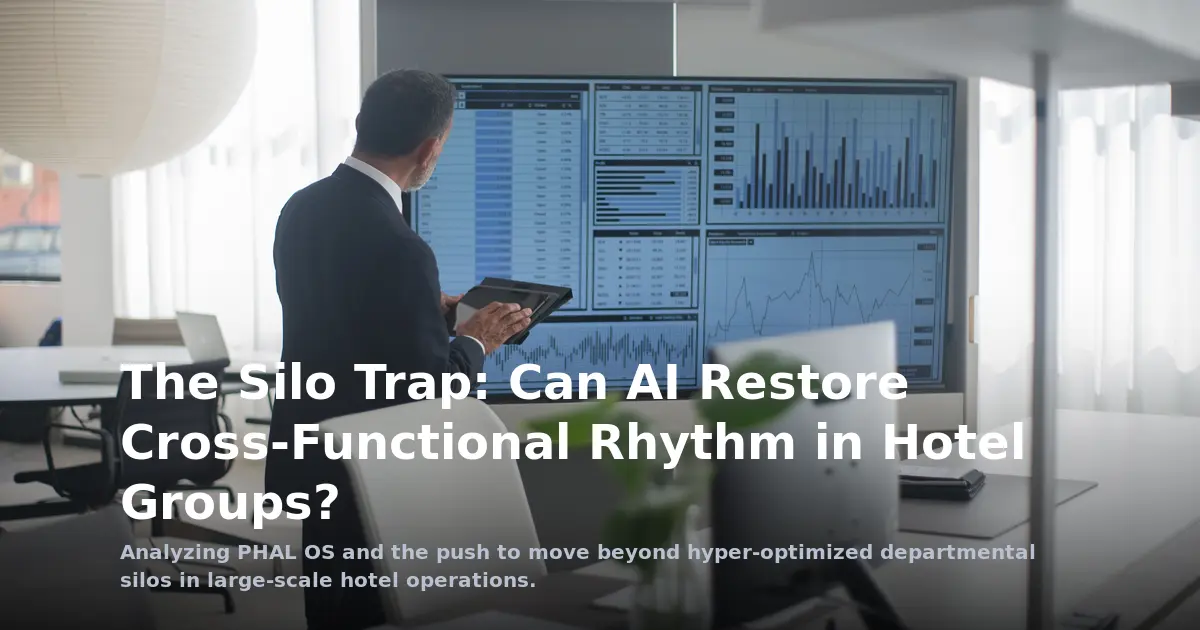
For decades, the large-scale hotel group has operated on a philosophy of compartmentalization. Revenue management optimizes the rate; marketing optimizes the reach; housekeeping optimizes the turn; and the front office manages the friction. On paper, this is efficiency. In practice, it is the creation of a 'silo trap'—a state where individual departments achieve their specific KPIs while the holistic guest journey fractures.
When a revenue manager pushes a high-occupancy strategy to maximize RevPAR, but the operations team is understaffed and the guest experience plummets, the organization has succeeded in its metrics but failed in its mission. This is the paradox of hyper-optimization: the more we refine the individual parts, the more we risk breaking the whole.
The Rise of Hotel Operational AI as a Leadership Layer
The introduction of PHAL OS signals a shift in how the industry views technology. For years, the Property Management System (PMS) has been the record of truth, but it has remained a passive database—a place where data lives, not where decisions are synthesized. The promise of a dedicated 'leadership layer' powered by hotel operational AI is to move beyond data storage and toward organizational orchestration.
Unlike traditional software that adds another dashboard for a manager to monitor, this approach attempts to create a 'cross-functional rhythm.' The goal is to synchronize the disparate pulses of a hotel group, ensuring that the marketing promise aligns with the operational capacity and the revenue target. If AI can act as the connective tissue, it transforms the manager's role from a firefighter jumping between silos to a conductor overseeing a synchronized performance.
Technical Solution or Management Mirage?
However, a critical question remains: is cross-functional dysfunction a technical problem that can be solved with code, or is it a permanent human management challenge?
In the top-10 global hotel groups, the friction is rarely about a lack of data. These organizations are swimming in data. The friction is cultural. Revenue managers and General Managers often have conflicting incentives; one is driven by yield, the other by guest satisfaction and labor costs. Replacing these tensions with an AI-driven layer risks masking the underlying cultural divide rather than solving it.
There is a danger that hotel operational AI could become another layer of complexity—a 'black box' that tells managers what to do without explaining the 'why,' further distancing leadership from the ground-level reality of the property. For this to work, the technology must not just provide an answer, but foster a shared language across departments.
Scalability: Global Giants vs. Boutique Operators
The scalability of a leadership-layer AI differs wildly between a global behemoth and a boutique operator. For a boutique hotel, cross-functional rhythm is often achieved through proximity; the GM knows the head of housekeeping and the revenue lead personally. The 'silo' is smaller and easier to bridge.
For the global giants, the distance between the corporate boardroom and the lobby floor is vast. In these environments, the need for an AI-driven orchestrator is most acute, but the implementation is most perilous. To succeed, such a system must be able to account for regional variances, diverse labor markets, and the nuanced brand standards that define a luxury experience.
The Future of the Integrated Hotel
The industry is reaching a tipping point where the cost of fragmentation is outweighing the benefits of departmental specialization. The move toward a unified operational rhythm is no longer a luxury; it is a requirement for survival in an era of rising labor costs and intensifying guest expectations.
If the industry can successfully pivot from 'managing functions' to 'orchestrating experiences,' the result will be a leaner, more responsive organization. The true measure of success for the next generation of hotel operational AI will not be the efficiency of the individual department, but the invisibility of the seams between them. The goal is no longer to be eight high-performing functions, but to operate as one cohesive entity.