Air India's Super-App Ambitions: A New Threat to Hotel Direct Booking?
Analyzing how Air India's integrated travel ecosystem could shift distribution power away from hotel brands and OTAs.
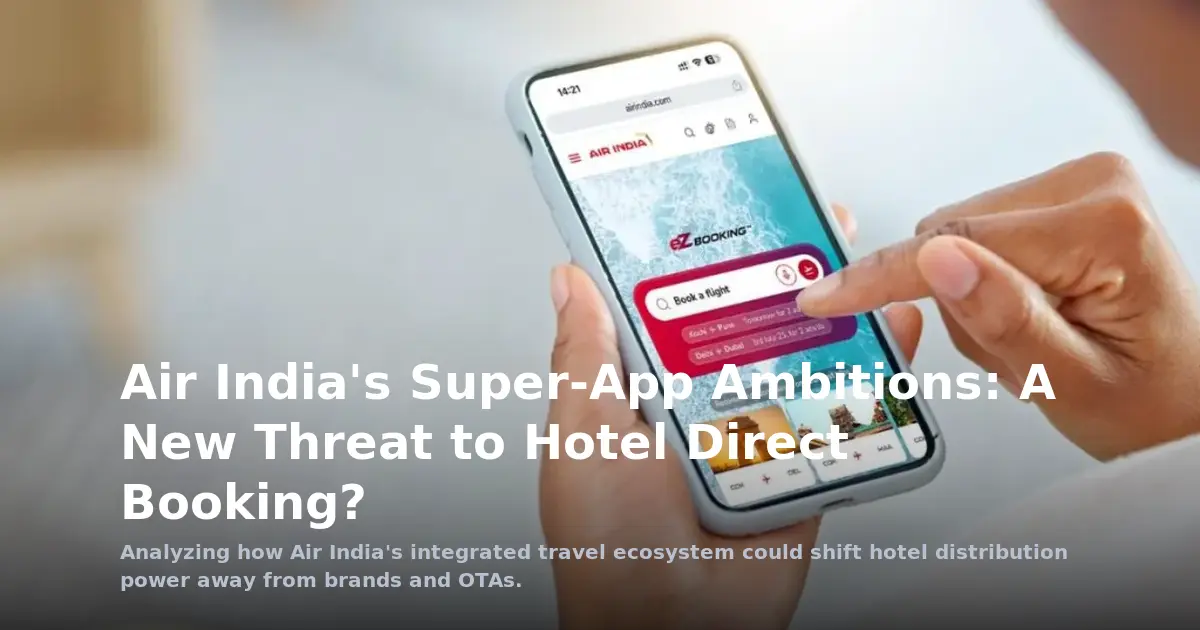
The travel industry has long been a fragmented landscape of separate transactions. A traveler typically manages a flight confirmation from an airline, a room reservation from a hotel or OTA, and a ground transfer via a third-party app. Air India is attempting to shatter this silos by rebuilding its digital infrastructure into a comprehensive 'super-app.' While the surface-level update focuses on a slicker user interface and faster payments, the strategic undercurrent is far more disruptive: the pursuit of total ownership over the traveler's journey.
For the hotel industry, this move represents a significant shift in the power dynamics of distribution. When an airline successfully implements a seamless airline hotel integration, it isn't just offering a convenience; it is positioning itself as the primary gatekeeper of the customer relationship.
The Battle for the Guest Relationship
For years, hotel brands have fought a grueling war to reclaim guests from Online Travel Agencies (OTAs) like Expedia and Booking.com. The goal has always been 'direct booking,' which allows hotels to own the guest data, control the pricing, and avoid hefty commission fees. However, Air India’s super-app approach introduces a new layer of disintermediation.
If a traveler books their flight, hotel, and cab through a single integrated ecosystem, the airline becomes the 'system of record.' The hotel is relegated to a service provider rather than a brand partner. This creates a precarious situation for hotel RevPAR (Revenue Per Available Room) strategies. When hotels are bundled into airline packages, they often lose the ability to upsell directly to the guest or leverage dynamic pricing in real-time, as the airline's ecosystem may prioritize the bundle's attractiveness over the hotel's individual yield management.
Beyond the immediate revenue impact, the loss of guest data is the most concerning variable. In a world of personalized hospitality, data is currency. If the airline controls the booking and the payment, the hotel may never receive the nuanced profile of the guest—their preferences, spending habits, and loyalty triggers—until the moment they check in. This erodes the hotel's ability to build long-term loyalty, effectively turning the guest into a 'tenant' of the airline's ecosystem.
AI and the 'Single-Pane' Experience
One of the most potent weapons in Air India's new arsenal is the integration of AI to manage travel disruptions. We have all experienced the 'travel nightmare' where a flight delay necessitates a frantic scramble to notify a hotel or rebook a car. By integrating these services into one AI-driven interface, the airline can automate the 'fix.'
Imagine a scenario where a flight is delayed by six hours; the AI automatically pushes a notification to the hotel to hold the room and adjusts the airport pickup time without the traveler lifting a finger. While this is a massive win for consumer experience, it further cements the airline's role as the indispensable orchestrator of the trip. The hotel becomes a commodity in a larger, automated chain of events, further distancing the brand from the guest.
Airline Hotel Integration vs. Traditional OTAs
It is tempting to view this as just another OTA play, but the logic is fundamentally different. Traditional OTAs are marketplaces; they aggregate options. An airline super-app is an ecosystem; it integrates a journey.
- OTAs focus on price comparison and variety.
- Airline Super-Apps focus on frictionless continuity and reliability.
Because the airline controls the most critical part of the trip—the transport—they have a natural advantage in capturing the 'intent to travel' before any other provider. Once a user is inside the Air India app to book a flight, the friction of leaving that app to find a hotel is higher than the friction of simply clicking a suggested hotel partner within the same interface.
The Road Ahead for Hospitality
As this model gains traction, hotels must decide whether to fight the tide or find a way to integrate more deeply. The risk of becoming a nameless commodity in an airline's bundle is real, but the opportunity to tap into a pre-qualified stream of high-value travelers is equally significant.
The industry is moving toward a 'single-pane' reality. Hotels that rely solely on legacy direct-booking portals may find themselves invisible to a growing segment of travelers who prioritize the efficiency of a super-app over brand loyalty. The challenge for hoteliers will be maintaining their identity and data ownership in an era where the airline is no longer just a carrier, but the digital concierge for the entire trip.