The AI Cost of Independence: Breaking the OTA Grip
Analyzing whether the high cost of AI implementation is a fair trade for reducing reliance on third-party booking platforms.
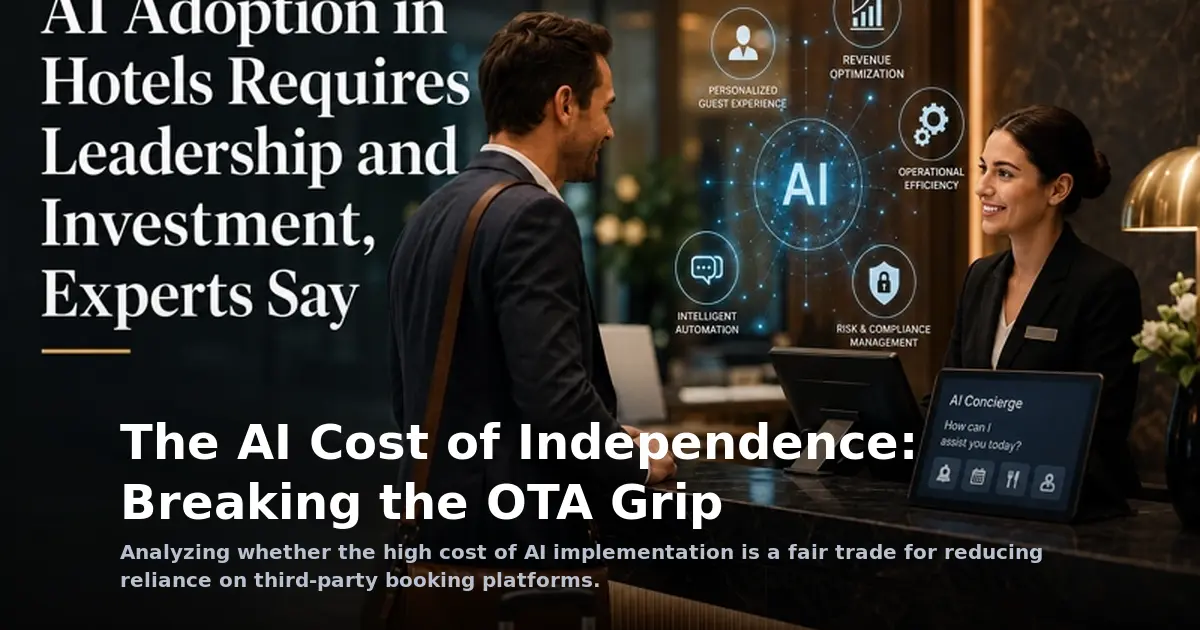
For decades, the relationship between hoteliers and Online Travel Agencies (OTAs) has been a Faustian bargain. The platforms provide the visibility and the volume, but they extract a heavy toll in commissions and, more critically, ownership of the guest relationship. As the industry enters the era of generative intelligence, a new strategic tension has emerged: is the steep cost of hotel AI adoption a justifiable trade-off for reclaiming direct-booking sovereignty?
For many General Managers, the initial reaction to AI is to view it as a luxury—a series of high-tech bells and whistles. However, a deeper editorial analysis suggests that AI is not a mere operational upgrade, but a financial instrument. When viewed through the lens of commission avoidance, the ROI of AI shifts from a question of 'efficiency' to one of 'independence.'
The Financial Paradox of Direct Booking
The central conflict in hotel AI adoption is the immediate capital expenditure versus the long-term liberation from OTA fees. Implementing sophisticated, AI-driven personalization engines and predictive pricing tools requires significant upfront investment in both software and talent. Yet, the cost of inaction is the perpetual leak of 15% to 25% of gross room revenue to third parties.
To break this cycle, hotels must move beyond the superficial. While a basic chatbot can handle FAQ queries, true strategic AI involves deep-tech operational integration. We are seeing a shift toward AI that manages dynamic pricing in real-time based on hyper-local events, weather patterns, and competitor sentiment—capabilities that allow a hotel to outmaneuver an OTA's generic algorithm. The goal is to create a direct-booking experience so seamless and personalized that the guest perceives the OTA as an unnecessary middleman.
The Leadership Gap and the Mid-Scale Struggle
There is a widening chasm in the market. Global brands possess the balance sheets to absorb the failures of early AI experimentation. They can afford to build proprietary models and weather the learning curve. Mid-scale and independent hotels, conversely, face a 'leadership gap.' Many GMs are technically proficient in hospitality but lack the data literacy required to oversee a digital transformation.
Without disciplined leadership, AI implementation often becomes a fragmented mess of disconnected tools—a 'Frankenstein's monster' of software that adds complexity without adding value. For the independent hotelier, the path to success is not buying the most expensive tool, but building a disciplined roadmap. This means identifying the specific friction points in the guest journey—such as the booking lag or the check-in bottleneck—and applying AI specifically to those nodes rather than attempting a wholesale digital overhaul.
Navigating the Regulatory Minefield
As hotels race to implement AI, they are colliding with an increasingly complex regulatory environment. The deployment of AI depends entirely on data; however, evolving privacy laws like GDPR in Europe and various state-level acts in the U.S. have turned data collection into a high-stakes gamble.
There is a real risk that overly cautious legal departments will stall AI deployment, leaving hotels unable to leverage the very data they need to compete with the data-rich ecosystems of the OTAs. The challenge for leadership is to implement 'privacy-by-design' AI—systems that provide hyper-personalization without infringing on the evolving definition of digital consent. Failure to navigate this minefield could result in penalties that either dwarf the AI's efficiency gains or, worse, destroy the guest trust that direct booking relies upon.
A Blueprint for Disciplined Implementation
To avoid overspending while still achieving autonomy, GMs should adopt a tiered approach to hotel AI adoption:
- Phase 1: Revenue Intelligence. Prioritize AI tools that optimize pricing and distribution to immediately increase the margin on every room sold.
- Phase 2: Operational Efficiency. Implement AI in back-of-house functions—such as automated scheduling and energy management—to reduce labor costs and fund further tech investments.
- Phase 3: Guest Experience. Deploy generative AI for personalized concierge services and post-stay engagement to build long-term loyalty.
The hospitality industry is currently at a crossroads. The choice is no longer between 'tech' and 'tradition,' but between remaining a commodity provider for third-party platforms or investing in the intelligence required to own the customer journey. Those who treat AI as a strategic financial investment rather than an IT expense will be the ones to finally break the OTA grip.