The Union Wave: What Radisson Blu's Housekeeping Shift Means for UK Hotels
The CAC's decision to recognize United Voices of the World signals a pivotal shift in labor power within the UK hospitality sector.
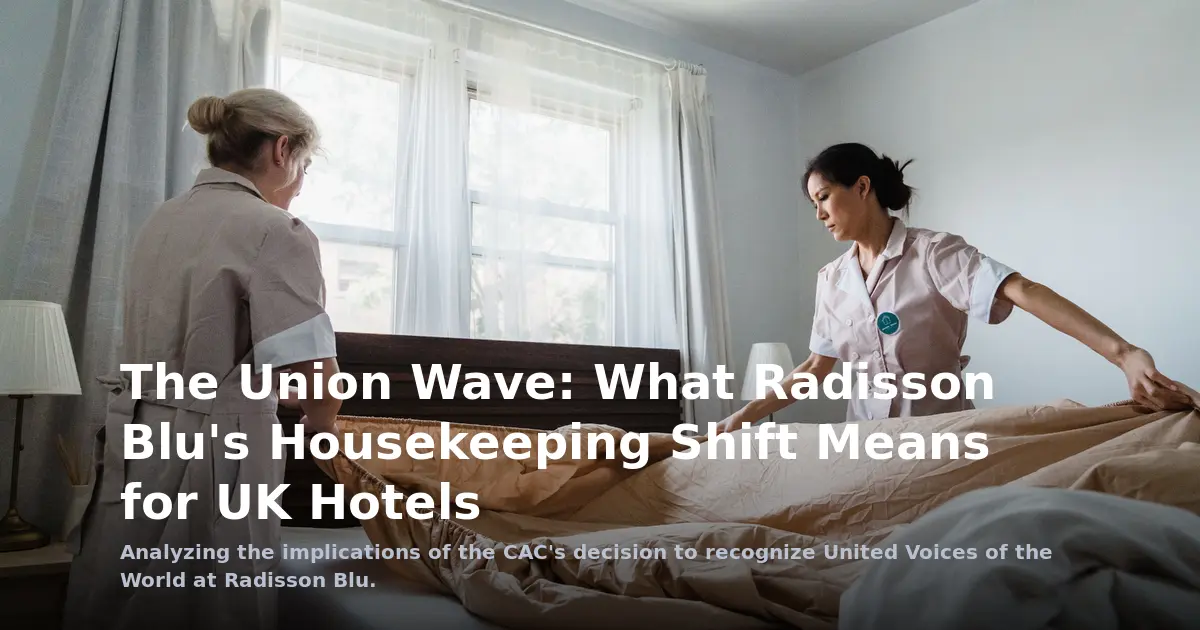
The recent ruling by the Central Arbitration Committee (CAC) to accept a union recognition bid for housekeeping staff at Radisson Blu is more than a localized legal victory for workers; it is a bellwether for the UK hospitality industry. For years, the sector has relied on a fragmented, often invisible workforce to maintain the high standards of luxury service. However, the formal recognition of United Voices of the World (UVW) suggests that the era of unilateral management is giving way to a more structured, collective bargaining environment.
The Mechanics of Recognition and the Membership Check
To understand the weight of this decision, one must look at the legal mechanism employed. The CAC does not grant recognition based on a whim; it requires a rigorous 'membership check.' This process involves an independent verification of how many employees within a specific bargaining unit—in this case, housekeeping—actually support the union.
When the CAC validates such a bid, it confirms that a significant majority of the workforce is not only dissatisfied but organized. For Radisson Blu, this means the union's bid wasn't just a loud demand, but a mathematically proven mandate from the staff. This validation strips away the ability for management to dismiss labor unrest as the work of a few 'disgruntled employees' and forces a transition toward formal negotiation.
A Symptom of Systemic Labor Tension
This push for hotel union recognition does not exist in a vacuum. The UK hospitality sector is currently grappling with a perfect storm of economic pressures: stagnant real-wage growth, a soaring cost of living, and a chronic shortage of skilled labor following the Brexit transition and the pandemic.
Housekeeping, specifically, has become the epicenter of this friction. Often the lowest-paid tier of hotel operations, these roles are characterized by high physical demand and a lack of flexibility. When the gap between the luxury experience sold to the guest and the working conditions provided to the staff becomes too wide, the resulting tension inevitably manifests as collective action. The move toward unionization is a direct response to a perceived failure in internal grievance mechanisms and a lack of transparent pay structures.
Operational Models: Unionized vs. Non-Unionized Luxury
For luxury hotel operators, the prospect of unionization often triggers fears of rigidity. The traditional non-unionized model allows management to pivot quickly, adjusting schedules and roles based on occupancy fluctuations. There is a prevailing belief that unions introduce bureaucracy that stifles the 'spirit of service.'
However, a counter-narrative is emerging. In markets where collective bargaining is normalized, hotels often see lower turnover rates and higher long-term employee loyalty. When workers feel they have a seat at the table regarding pay and safety, the 'churn' that plagues the housekeeping department decreases. The challenge for brands like Radisson Blu will be integrating this new collective voice without compromising the operational agility required in a high-pressure hospitality environment.
The Ripple Effect Across the UK Market
This ruling is likely to serve as a blueprint for other labor organizers. As UVW and similar organizations see a path to victory through the CAC, they will likely target other major international brands operating in the UK. The precedent is now set: if a global brand cannot maintain a satisfactory relationship with its frontline staff, the legal infrastructure for union recognition is accessible and effective.
Hotel groups that continue to ignore the underlying dissatisfaction of their housekeeping and F&B teams risk finding themselves in a reactive position, forced to negotiate from a place of weakness after a CAC ruling has already stripped them of their leverage.
As the hospitality landscape evolves, the industry must move from a strategy of containment to one of engagement. The shift toward hotel union recognition is not an attack on the industry, but a demand for a more sustainable social contract between the people who clean the rooms and the corporations that profit from them. Those who proactively modernize their labor relations will find stability; those who cling to outdated hierarchies will likely find themselves facing a wave of organized resistance.