The Day-Use Pivot: Is Hilton Trading Prestige for Ancillary Revenue?
An analysis of Hilton's expanded ResortPass partnership and the tension between monetizing underutilized assets and maintaining luxury exclusivity.
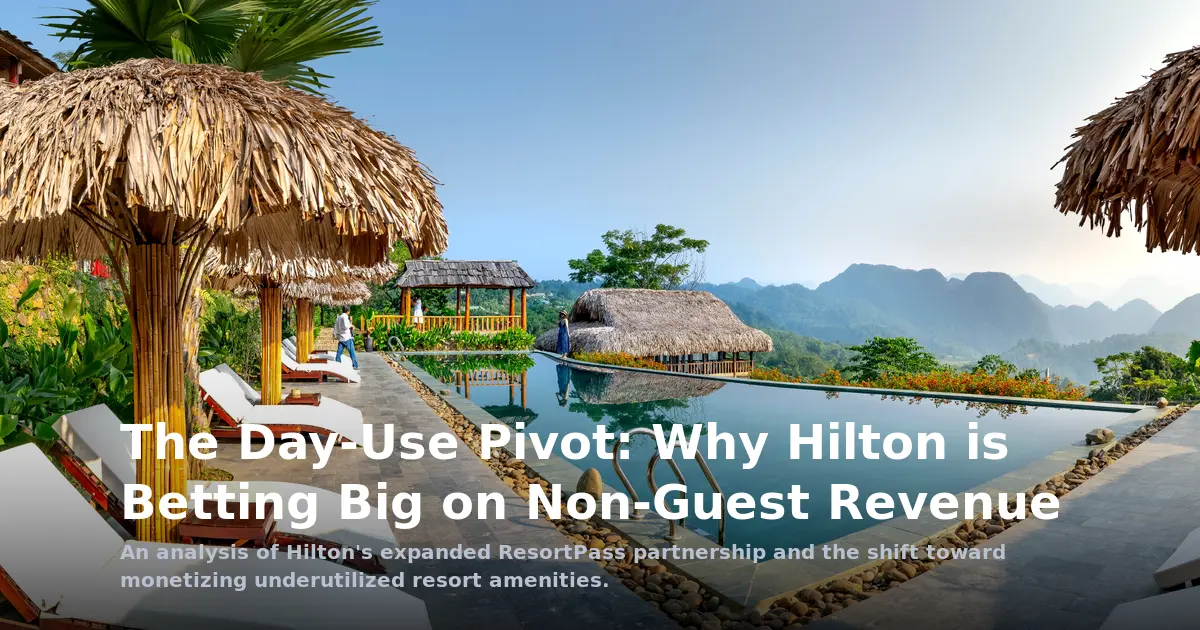
For decades, the hotel pool and spa were the inner sanctums of the hospitality experience—exclusive territories reserved for those who had paid the premium for a room key. However, the traditional boundary between the 'staying guest' and the 'local visitor' is blurring. Hilton’s recent three-year expansion of its partnership with ResortPass signals a strategic shift toward a more transactional model of amenity access, turning underutilized square footage into a consistent stream of hotel ancillary revenue.
On the surface, the logic is sound. Resort infrastructure is expensive to maintain regardless of occupancy. A pool deck that sits half-empty on a Tuesday afternoon is a wasted asset. By scaling access to fitness centers, private cabanas, and wellness experiences across the Americas, Hilton is effectively diversifying its income streams and hedging against the volatility of seasonal travel dips. But this pivot raises a critical question for luxury brand management: at what point does 'open access' begin to erode the perceived value of a high-end stay?
The Friction Between Monetization and Exclusivity
The core tension in the ResortPass model is the conflict between maximizing hotel ancillary revenue and preserving the guest experience. For a traveler paying $600 a night for a luxury resort suite, the appeal often lies in the serenity and exclusivity of the amenities. When those same pools and spas are populated by a rotating door of day-pass holders, the 'sanctuary' vibe is replaced by a high-traffic, commercial atmosphere.
Operational risks are significant. Overcrowding in wellness areas can lead to longer wait times for towels, limited lounge chair availability, and a general sense of congestion. If the ratio of day-guests to overnight guests tips too far, the hotel risks alienating its most loyal, high-spending customers. The challenge for Hilton will be implementing sophisticated capacity management—essentially 'digital velvet ropes'—to ensure that the pursuit of short-term gains doesn't compromise the long-term brand prestige.
Hedging Against Seasonality via the Local Market
While the risks to exclusivity are real, the strategic benefit of targeting the 'local' market is undeniable. The traditional hotel model relies heavily on the transient traveler, leaving properties vulnerable to economic downturns or shifts in tourism trends. By transforming the resort into a destination for locals, Hilton is creating a localized revenue hedge.
Unlike traditional hotel memberships, which often require high upfront fees and long-term commitments, the day-pass model is frictionless. It lowers the barrier to entry, allowing a broader demographic to experience the brand. This not only boosts immediate cash flow but also serves as a powerful customer acquisition tool. A local who spends a day at a Hilton spa is far more likely to book a room for a future getaway or recommend the property to visiting friends.
A New Era of Asset Utilization
This shift represents a broader trend in the industry: the transition from 'hospitality as a stay' to 'hospitality as a service.' We are seeing a move away from the rigid structures of the past toward a more fluid, a la carte approach to amenity consumption. When luxury amenities become transactional day-passes, the hotel is no longer just selling a bed; it is selling a curated lifestyle experience by the hour.
However, for this model to be sustainable, operators must avoid the trap of treating amenities as mere commodities. If the experience becomes too crowded or the service quality dips due to the influx of non-guests, the 'luxury' label becomes a misnomer. The success of this strategy depends on the ability to balance volume with value.
As other major players observe Hilton's trajectory, the industry may see a wider adoption of third-party amenity marketplaces. The future of hotel ancillary revenue will likely depend on a delicate balancing act—optimizing every square inch of the property for profit while ensuring that the guest who actually pays for the room still feels like the most important person on the property.