The Bifurcation of Power: Scaling Luxury Operations at Omni Mount Washington
Analyzing how the strategic split between Managing Director and Resort Manager roles ensures operational excellence at historic luxury assets.
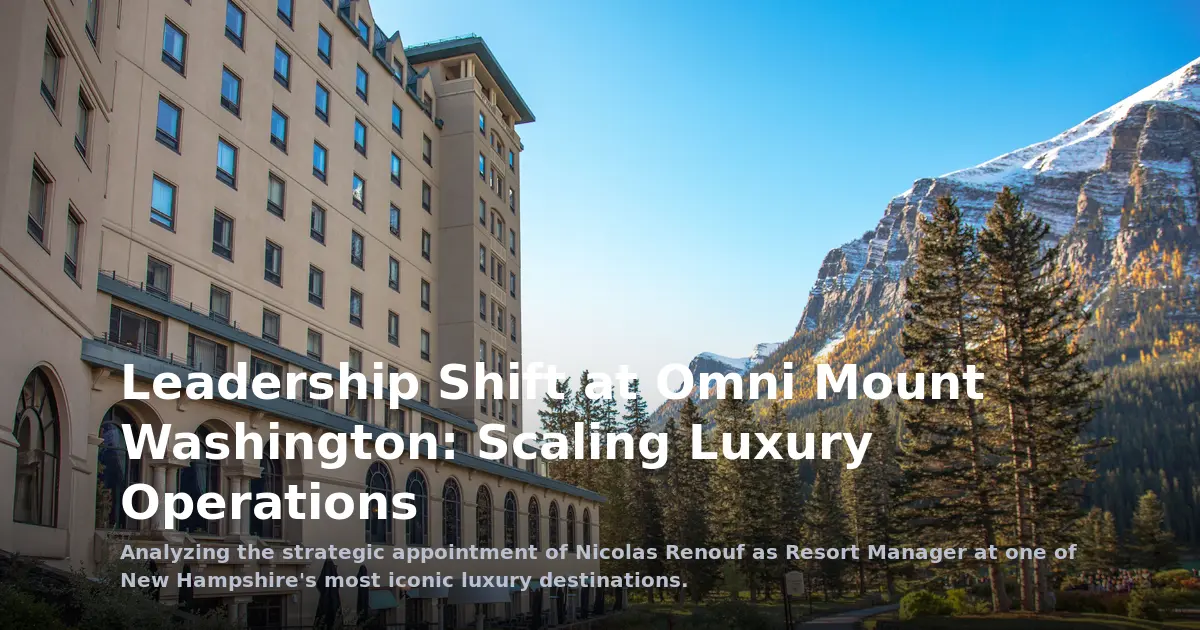
The appointment of Nicolas Renouf as Resort Manager at the Omni Mount Washington Resort & Spa is more than a routine personnel update; it is a reflection of a broader strategic shift in how ultra-luxury assets are managed. In the high-stakes environment of a historic destination resort, the traditional General Manager model—where one individual oversees everything from P&L statements to the precision of a turndown service—is increasingly viewed as a bottleneck to growth.
By installing Renouf to oversee day-to-day operations alongside Managing Director Michael Medeiros, Omni Hotels & Resorts is implementing a leadership bifurcation. This structure separates the long-term asset strategy and ownership relations from the immediate, granular demands of guest experience and staff management. In the context of luxury resort management, this distinction is critical for maintaining a competitive edge in a market where guests expect seamless perfection.
The Strategic Division of Labor
In a traditional hotel structure, the GM is often pulled in two opposing directions: the boardroom and the lobby. The boardroom requires a focus on capital expenditures, revenue management, and long-term brand positioning. The lobby, conversely, requires an obsessive attention to detail and real-time problem solving. When one person attempts to master both, one area inevitably suffers.
At Omni Mount Washington, the division of labor allows the Managing Director to act as the chief strategist and liaison to the corporate entity, ensuring the property remains financially viable and aligned with the brand's global trajectory. Meanwhile, the Resort Manager becomes the 'Chief Operating Officer' of the guest experience. Renouf’s role is not merely administrative; it is about the tactical execution of luxury. This ensures that the operational engine—housekeeping, dining, concierge, and maintenance—runs at peak efficiency without being sidelined by the administrative burdens of asset management.
Scaling Excellence in Historic Properties
Managing a historic property presents a unique set of challenges that differ from a new-build luxury hotel. The infrastructure of a legacy resort often requires more intensive oversight, and the guest expectations for 'old-world charm' must be balanced with modern technological standards.
This leadership model supports the operational demands of a high-capacity resort by providing a dedicated point of accountability for the staff. When a Resort Manager is empowered to focus exclusively on the 'now,' the result is typically a more stable employee environment and a more consistent guest experience. In the luxury tier, consistency is the ultimate currency. A single lapse in service at a destination like the Mount Washington can erode years of brand equity. By narrowing the scope of the Resort Manager's focus, Omni is effectively hedging against operational drift.
The Evolution of the Talent Pipeline
This move also signals a trend within the Omni Hotels & Resorts talent pipeline. By creating these specialized leadership tiers, the company is developing a more sophisticated class of operators. The Resort Manager role serves as a high-intensity training ground, allowing executives to master the complexities of luxury operations before ascending to the strategic heights of a Managing Director role.
Compared to traditional hotel GM structures, this approach acknowledges that luxury resort management is now too complex for a single point of failure. We are seeing a shift toward a 'corporate' model of leadership within individual properties, where roles are specialized to ensure that neither the financial health of the asset nor the quality of the guest stay is compromised.
As the luxury travel sector continues to evolve toward experiential and hyper-personalized stays, the pressure on operational leadership will only increase. The decision to split leadership at the Mount Washington suggests that the future of the industry lies in this specialized approach. Properties that continue to rely on the 'all-powerful GM' may find themselves unable to scale their operations or maintain the rigorous standards required by the modern luxury traveler.