Defending the Crown: Shangri-La’s Strategic Play for Mauritius
The appointment of Elodie Fleury-Carrere signals a shift from traditional luxury to experiential dominance in the Indian Ocean.
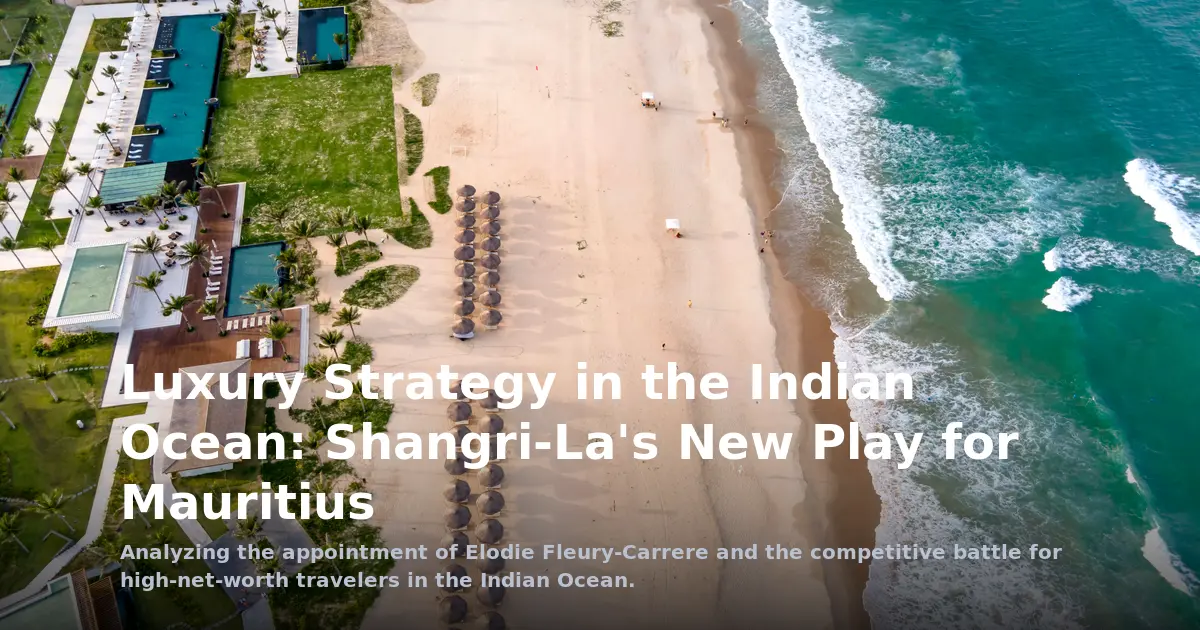
On the surface, the appointment of Elodie Fleury-Carrere as Director of Sales & Marketing at Shangri-La Le Touessrok is a standard executive transition. But in the hyper-competitive ecosystem of the Indian Ocean, no leadership change at this level is merely administrative. For Shangri-La, this move is a calculated defensive and offensive maneuver designed to protect its market share against a rising tide of boutique luxury competitors and a fundamental shift in how high-net-worth individuals (HNWIs) consume travel.
Mauritius and the Seychelles have long been the bastions of 'old world' luxury—expansive resorts, manicured lawns, and a predictable level of opulence. However, the landscape is shifting. The modern ultra-luxury traveler is moving away from standardized grandeur toward 'quiet luxury' and hyper-personalized, experiential stays. To maintain its status as an iconic destination, Le Touessrok cannot rely on its heritage alone; it requires a leadership approach that can translate brand legacy into modern relevance.
The Evolution of Luxury Hotel Leadership in Remote Markets
The role of a Director of Sales & Marketing in a remote, ultra-luxury destination has evolved far beyond managing agency relationships and driving occupancy. Today, luxury hotel leadership is as much about curation as it is about commerce. The challenge for Fleury-Carrere will be to pivot the property’s positioning to attract emerging luxury markets—specifically the younger, tech-savvy wealth of Asia and the Middle East—who prioritize authenticity over gold-leaf finishes.
In the Indian Ocean, the competitive battle is no longer just between the big brands. The rise of small-scale, high-concept boutique villas has created a fragmented market where guests seek intimacy over scale. By bringing in fresh executive talent, Shangri-La is signaling a desire to integrate guest experience directly into its revenue growth strategy. The goal is to move from being a 'place to stay' to a 'destination of intent,' where the marketing narrative is driven by unique experiences rather than room categories.
The War for Executive Talent in the Ultra-Luxury Segment
There is a limited pool of executives who truly understand the nuances of the ultra-luxury segment in remote geographies. The poaching of top-tier talent in the Indian Ocean has become a proxy war for market dominance. When a brand like Shangri-La secures a leader with the right pedigree, it isn't just hiring a skillset; it is acquiring a network of relationships with the world's most exclusive travel designers and luxury consortia.
This talent war underscores a critical industry reality: in the luxury tier, the brand is the promise, but the leadership is the delivery. The ability to sustain 'iconic' status requires a constant infusion of new perspectives to prevent brand stagnation. For Le Touessrok, the risk of becoming a 'legacy' property—one that is respected but no longer coveted—is the primary threat. A strategic pivot in sales and marketing leadership is the most effective way to hedge against this decline.
Integrating Experience with Revenue Growth
Looking forward, the success of this leadership transition will be measured by how well the resort can monetize 'experiential luxury.' We are seeing a global trend where HNWIs are spending more on curated excursions, wellness retreats, and bespoke cultural immersions than on the room itself.
Fleury-Carrere’s mandate will likely involve a deeper integration of the guest journey, ensuring that the sales promise aligns perfectly with the on-property delivery. This synergy is where the next phase of revenue growth lies. By leveraging data-driven insights to personalize the guest experience, the resort can drive higher average daily rates (ADR) and increase the length of stay, effectively insulating itself from the volatility of the broader travel market.
The broader implication for the industry is clear: the era of the passive luxury resort is over. Whether in Mauritius, the Maldives, or the Seychelles, the properties that survive and thrive will be those that treat their leadership roles not as managers of assets, but as architects of desire. The battle for the Indian Ocean will be won by those who can balance the weight of their heritage with the agility of a boutique operator.