Peregrine's Napa Play: The Strategy Behind Luxury Cluster Management
Analyzing Peregrine Hospitality's acquisition of two Yountville landmarks and the trend toward regional luxury concentration.
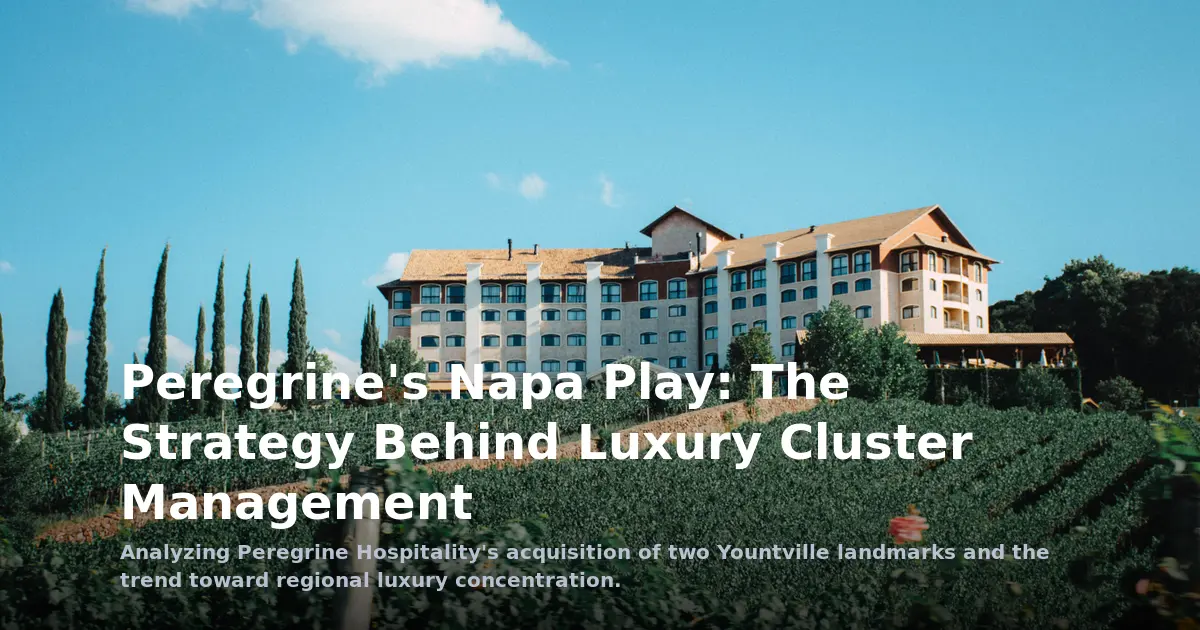
The luxury hospitality sector is currently witnessing a subtle but significant shift in growth strategies. While the previous decade was defined by aggressive global expansion and brand footprint scaling, a new school of thought is emerging: the luxury cluster. Peregrine Hospitality’s recent move to add both Hotel Yountville and the Bardessono Hotel & Spa to its management portfolio is a textbook example of this strategy, concentrating high-value assets within a single, high-demand micro-market.
By securing two distinct properties in Yountville, Peregrine is not merely adding keys to its ledger; it is establishing a regional stronghold. This move raises a critical question for the industry: is geographic concentration a more sustainable model for luxury hotel management than broad diversification?
The Operational Logic of the Cluster Model
From an operational standpoint, managing two properties in the same zip code creates efficiencies that are impossible to achieve with a dispersed portfolio. In the high-stakes environment of Napa Valley, where labor shortages and skyrocketing costs of living often plague operators, a clustered approach allows for a more fluid sharing of resources.
Shared services—ranging from procurement and marketing to specialized maintenance and HR—can be streamlined across both assets. When two properties share a micro-market, the management team can implement cross-property staffing strategies, allowing for a more agile response to demand spikes without over-hiring. This synergy reduces the overhead typically associated with luxury hotel management, where the cost of maintaining a high-touch guest experience often erodes the bottom line.
Furthermore, the ability to segment the market within a single town is a powerful tool. With the 80-key Hotel Yountville and the 65-key Bardessono, Peregrine can capture different guest personas—from the classic luxury seeker to the eco-conscious traveler—without them ever leaving the Yountville ecosystem. This prevents internal cannibalization and instead creates a "destination moat" that makes it harder for outside competitors to penetrate the market.
Sustainability as an Operational Hedge
One of the most compelling aspects of this acquisition is the inclusion of Bardessono, a LEED Platinum-certified property. In the modern era of luxury hotel management, sustainability is no longer a marketing gimmick; it is a financial imperative.
LEED Platinum status indicates a level of operational efficiency that directly impacts the P&L. Lower energy consumption and smarter water management systems reduce the volatility of utility costs, which have become a significant pain point for luxury resorts. Moreover, the affluent demographic traveling to Napa is increasingly prioritizing "conscious luxury." By managing a property that embodies these values, Peregrine is hedging against the reputational risk of the traditional, resource-heavy luxury model.
Driving RevPAR in a Saturated Market
Napa Valley’s high-end sector is notoriously competitive, with a density of five-star offerings that can lead to pricing plateaus. To drive Revenue Per Available Room (RevPAR), Peregrine cannot rely on occupancy alone; it must leverage a sophisticated management style that emphasizes yield optimization and ancillary revenue.
We can expect Peregrine to move away from generic luxury templates toward a more curated, data-driven approach. By analyzing the overlapping guest data from both properties, they can create hyper-personalized packages—perhaps combining the spa experiences of Bardessono with the boutique charm of Hotel Yountville. This creates a "circuit" for the guest, extending the average length of stay and increasing the total spend per visitor.
Risk vs. Reward: The Concentration Gamble
Of course, the cluster strategy is not without risk. Geographic concentration creates a high level of exposure to local economic shocks. A regional downturn, a natural disaster—which Napa has faced with wildfires—or a shift in the popularity of a specific destination can jeopardize a significant portion of a manager's portfolio simultaneously. Diversified assets act as a hedge; clustered assets act as a bet.
However, in the luxury tier, the reward often outweighs the risk. The prestige and operational control gained by dominating a micro-market like Yountville provide a level of leverage with vendors and local government that a single-asset operator simply cannot match.
As the industry evolves, we are likely to see more management firms abandon the "scattergun" approach to growth. The Peregrine model suggests that the future of luxury hotel management lies in depth rather than breadth—creating high-density hubs of excellence that prioritize operational synergy and market dominance over simple geographic expansion.