The Zero-Dollar Marketing Playbook: How Urban Cowboy Scales via Vibe
Analyzing whether Urban Cowboy's strategy of leveraging nostalgia and community over traditional advertising is a replicable blueprint for modern hoteliers.
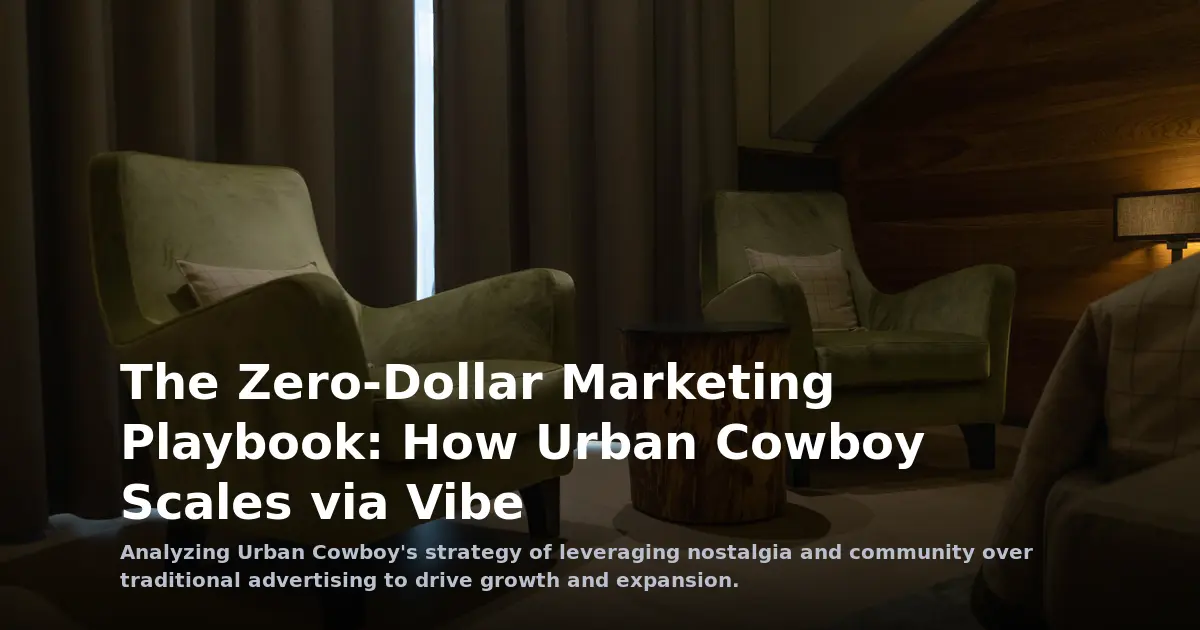
In an era where luxury hospitality brands spend millions on programmatic advertising and influencer partnerships to capture a sliver of market share, Urban Cowboy has managed to scale its footprint while spending virtually nothing on traditional marketing. For founders Lyon Porter and Jersey Banks, the growth engine isn't a media buy—it is the 'vibe.'
This approach represents a fundamental shift in how hotels acquire guests. By prioritizing an aesthetic of curated nostalgia and a 'home-like' atmosphere, Urban Cowboy has turned its physical spaces into their own primary marketing channel. When a hotel is designed to be inherently shareable, the guests become the unpaid marketing department, driving organic hotel growth through authentic social proof rather than polished corporate campaigns.
The Architecture of Shareability
Urban Cowboy’s success is not merely a result of good interior design; it is a strategic bet on the psychology of the modern traveler. The brand leans heavily into a design philosophy that emphasizes warmth, eccentricity, and a sense of place. By creating environments that feel like a well-traveled friend's living room rather than a sterile corporate suite, they trigger a reflexive desire in guests to document and share their experience.
This 'home-like' design serves as a low-cost acquisition funnel. In a saturated luxury market, the risk of a zero-dollar marketing spend is typically high—visibility is the primary barrier to entry. However, Urban Cowboy mitigates this risk by ensuring the product is the promotion. When the aesthetic is distinct enough to be recognizable without a logo, the brand transcends traditional advertising, moving from a service provider to a cultural signifier.
Scaling the Intimate: From Boutique to Branded Residences
The central tension for any boutique operator is the struggle between scalability and intimacy. The very qualities that drive organic hotel growth—the feeling of exclusivity, the curated community, and the quirky imperfections—are often the first casualties of expansion. As Urban Cowboy moves toward larger properties, including beach locations and branded residences, the operational challenge shifts from creation to preservation.
Transitioning into branded residences is a particularly bold move. It tests whether the 'Urban Cowboy' ethos can survive the shift from a short-term transient stay to a long-term residential investment. For the model to work at scale, the brand must move beyond the visual 'vibe' and instill a deeper operational culture of community. If the community-first approach is merely a facade for a specific aesthetic, the model will fail as it grows. If, however, it is rooted in a genuine operational philosophy of hospitality, it could provide a blueprint for other independent operators looking to scale without losing their soul.
The Corporate Contrast
Contrast this with the traditional corporate hotel model, which relies on brand standards, loyalty programs, and massive global distribution systems (GDS) to ensure occupancy. Corporate branding is designed to minimize risk and ensure consistency; Urban Cowboy’s model is designed to maximize character and embrace the unexpected.
While the corporate approach ensures a predictable floor of revenue, it often creates a ceiling on emotional connection. By eschewing the traditional playbook, Urban Cowboy has tapped into a growing segment of travelers who are fatigued by the homogeneity of global luxury. They are not selling a room; they are selling a feeling of belonging and a curated identity.
As the industry continues to pivot toward 'experiential travel,' the Urban Cowboy experiment suggests that the most valuable asset a hotel can possess is not a large marketing budget, but a distinct, authentic point of view. The future of independent hospitality may lie in this lean, organic approach, where the physical environment does the heavy lifting of guest acquisition. The ultimate test will be whether this 'vibe-driven' growth can sustain itself across diverse geographies and larger asset classes without diluting the very magic that made it successful.