Peregrine’s Napa Play: Scaling Luxury Management in Wine Country
Analyzing whether the shift toward professional third-party management for boutique luxury assets risks eroding the unique charm of Napa Valley.
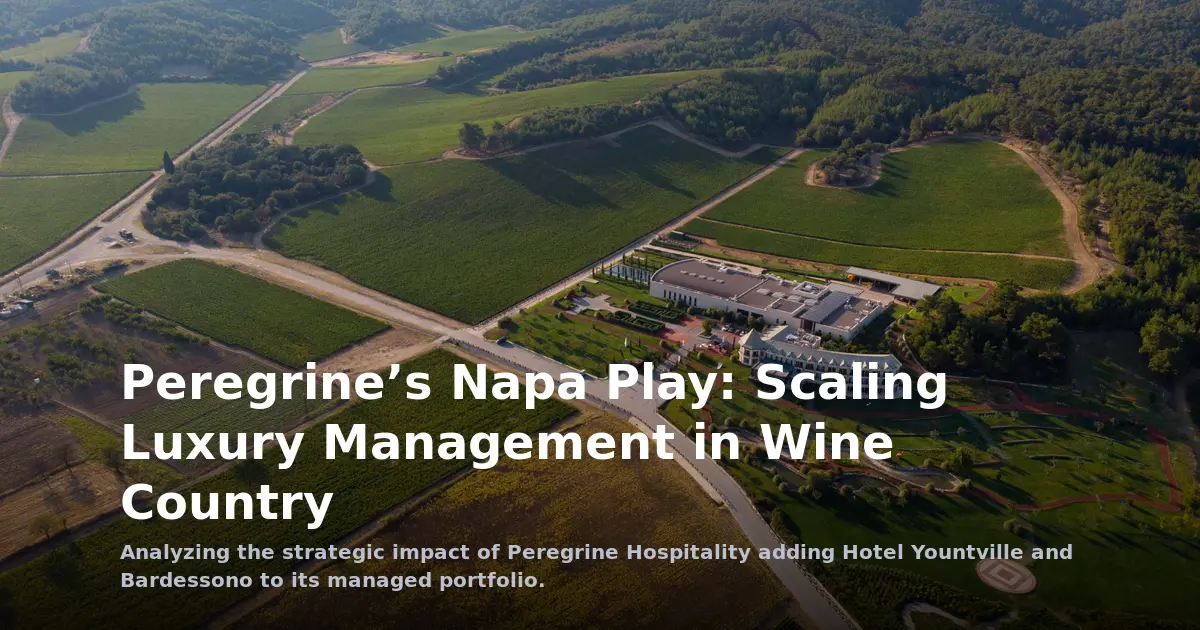
The acquisition of management contracts for Hotel Yountville and Bardessono Hotel & Spa by Peregrine Hospitality is more than a simple portfolio expansion; it is a calculated move into one of the most high-yield leisure markets in the world. By securing these two crown jewels of the Napa Valley, Peregrine is not just adding keys, but is positioning itself as a dominant force in the specialized niche of ultra-luxury leisure operations.
For the hospitality industry, the move signals a broader trend: the institutionalization of the boutique experience. As asset owners seek to maximize RevPAR and operational efficiency, the allure of professional third-party management becomes irresistible. However, this transition raises a critical question for the region: can the 'soul' of a boutique property survive the implementation of scalable corporate systems?
The Strategic Calculus of Luxury Hotel Management
Napa Valley is a unique ecosystem where the product is not merely a room, but an integrated experience of terroir, gastronomy, and wellness. For a firm like Peregrine, managing a cluster of properties in this region allows for significant operational synergies. By controlling both Hotel Yountville and Bardessono, Peregrine can optimize labor sharing, streamline procurement for high-end culinary programs, and create a unified luxury standard that appeals to the high-net-worth traveler.
Effective luxury hotel management in this context requires a departure from the standardized playbooks used in urban business hotels. The operational requirements for ultra-luxury spa and culinary-focused properties are exponentially more complex. They demand a higher staff-to-guest ratio and a level of anticipatory service that cannot be automated. The challenge for Peregrine will be to implement the rigorous financial controls and reporting structures of a professional management company without stifling the intuitive, bespoke service that defines the Napa experience.
Balancing Scale and Authenticity
The primary risk in scaling luxury management is the 'homogenization' of the guest experience. The appeal of Bardessono and Hotel Yountville lies in their distinct sense of place—their ability to feel like an extension of the vineyard and the valley rather than a corporate outpost. When a management company grows rapidly, there is an inherent temptation to apply a 'one-size-fits-all' approach to SOPs (Standard Operating Procedures) to ensure consistency.
To avoid this, Peregrine must treat these assets as idiosyncratic entities rather than line items on a balance sheet. The tension between operational efficiency and boutique authenticity is the central conflict of modern luxury hospitality. If the management approach becomes too rigid, the properties risk losing the very 'independent charm' that allows them to command premium ADRs. The goal must be 'invisible management'—where the backend is professionalized and efficient, but the frontend remains artisanal and intimate.
The Growth Trajectory of High-End Leisure
Peregrine’s aggressive pursuit of these assets suggests a strategic pivot toward high-barrier-to-entry leisure markets. Unlike the volatile corporate travel sector, the ultra-luxury leisure segment has shown remarkable resilience and a willingness to absorb price increases. By embedding itself in the heart of wine country, Peregrine is diversifying its risk and capturing a demographic that prioritizes experience over cost.
This move likely serves as a blueprint for future expansions. As more boutique owners move away from owner-operator models toward professional management, Peregrine is positioning itself as the preferred partner for those who want the sophistication of a large-scale operator but the discretion of a boutique firm. This hybrid model—scaling the management while preserving the asset's identity—is the new frontier of the luxury sector.
Looking ahead, the success of this venture will be measured not by the immediate growth in the portfolio, but by the ability to maintain the prestige of these properties over the next decade. If Peregrine can successfully navigate the tightrope between corporate discipline and boutique whimsy, it will set a new standard for how third-party operators handle the world's most sensitive luxury assets. The industry is watching to see if professionalization leads to perfection or a loss of personality.