Hotel Investment Volume Hits $18B in First Half as Buyers Return
A surge in high-net-worth and private equity activity signals a shift in hospitality ownership as institutional players wait for a pricing floor.
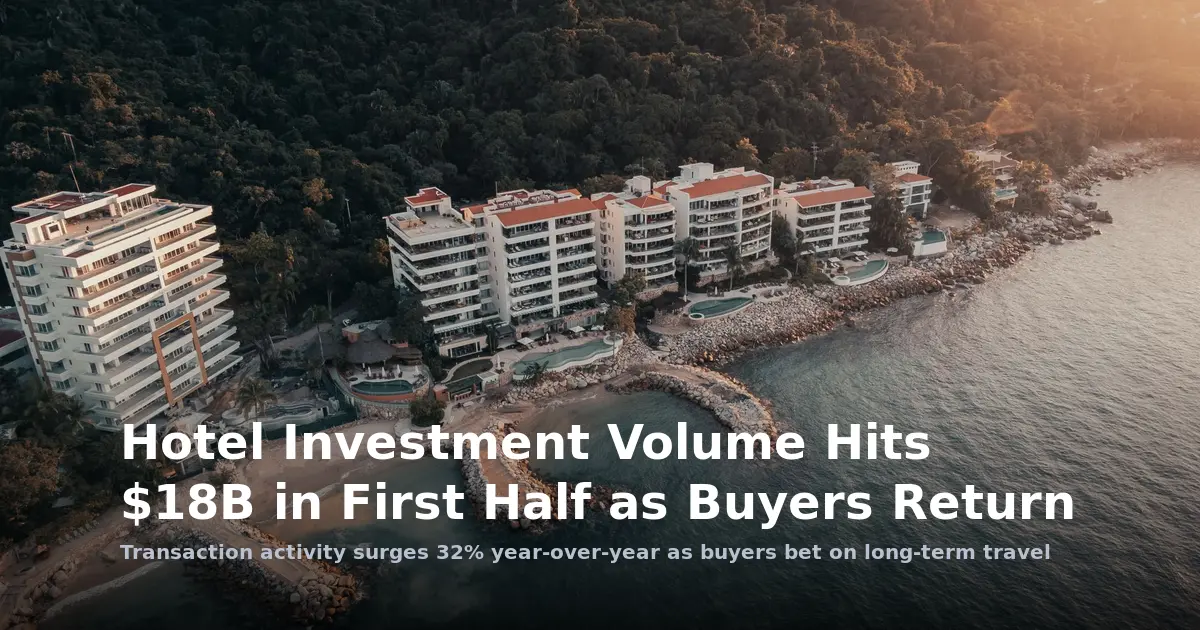
The frozen tundra of hotel transactions has thawed with surprising speed. After two years of pricing paralysis and interest rate volatility, hotel transaction volume surged to $18 billion in the first six months of the year—a 32% jump over the same period last year. According to the latest data from JLL, this rebound isn't a broad-based recovery across all investor classes, but rather a targeted strike by aggressive private capital moving into a vacuum left by cautious institutional giants.
The Rise of the Agnostic Buyer
The composition of this $18 billion windfall reveals a stark divide in risk appetite. Private equity firms and high-net-worth individuals (HNWIs) now account for 58% of all transaction volume. These buyers operate with a fundamental advantage over the traditional corporate structure: speed and flexible capital. While the 'big money'—specifically Real Estate Investment Trusts (REITs)—remains largely on the sidelines, private buyers are capitalizing on the widening bid-ask spread.
REITs are currently handcuffed by the cost of capital. With borrowing costs remaining elevated, the hurdle rate for new acquisitions has climbed, making it nearly impossible to achieve positive leverage. In contrast, private equity groups are utilizing 'dry powder'—cash reserves accumulated during the pandemic—to acquire assets outright or with minimal leverage. This shift transforms the ownership landscape from a consolidated, corporate-heavy market to one fragmented by agile, opportunistic investors who are betting on long-term operational upside rather than immediate cap rate compression.
The Distress That Never Came
For twenty-four months, analysts predicted a 'bloodbath' of distressed hospitality sales. The logic was simple: a massive wall of floating-rate debt was set to mature as the pandemic-era grace periods expired. However, the anticipated wave of foreclosures has been replaced by a sophisticated game of endurance.
Lenders, fearing that a fire sale would trigger a systemic collapse in asset valuations, have opted for pragmatism over panic. Instead of calling loans, banks have aggressively extended maturities and modified covenants. Simultaneously, owners have stepped up to the plate, injecting fresh equity into properties to maintain their debt-to-value ratios. This 'equity cushion' strategy has effectively neutralized the threat of mass distress, turning potential bankruptcies into restructured hold periods.
This stability has created a strange paradox: assets are technically 'underwater' based on original loan-to-value ratios, yet they are not being forced into the market. This lack of forced selling has kept a floor under hotel valuations, preventing the price crashes that many opportunistic buyers were waiting for. The result is a market where sellers are holding firm and buyers are paying a premium for the few high-quality assets that actually hit the open market.
Sector Divergence: Select Service vs. Luxury
Not all hotel segments are benefiting equally from this $18 billion influx. The flight to quality is concentrated in the upscale select-service category. Investors are prioritizing assets with lower operational overhead and higher RevPAR (Revenue Per Available Room) growth potential. The predictability of the select-service model makes it a safer bet for private equity firms looking for a 5-to-7-year exit strategy.
Conversely, the luxury and full-service segments are experiencing a slower recovery. These assets require significantly more capital expenditure (CapEx) to maintain competitive standards, and the labor-intensive nature of full-service operations continues to erode margins. While luxury trophies still command high prices due to their scarcity, the volume of transactions is skewed toward the mid-scale and upscale-select tiers.
Furthermore, the 'lifestyle' hotel trend is driving a specific subset of investment. Buyers are targeting boutique assets that can be rebranded or repositioned to capture the growing Gen Z and Millennial travel spend. This 'value-add' play—buying an outdated asset and implementing a modern brand identity—is currently the primary engine for ROI in the current high-interest-rate environment.
The Path Toward 2025
As the industry moves toward the end of the year, the central tension remains the gap between the 10-year Treasury note and current cap rates. For the market to return to pre-2022 volumes, a stabilization of interest rates is mandatory. However, the current $18 billion surge proves that the appetite for hospitality is fundamentally strong. Hotels are viewed as a hedge against inflation because room rates can be adjusted nightly, unlike office or retail leases which are locked in for years.
Expect the second half of the year to see a gradual return of the REITs, but only after a clear signal that the Federal Reserve has ceased its tightening cycle. Until then, the market belongs to the private equity firms and the wealthy few. The hospitality sector has successfully avoided a systemic crash, but it has entered a new phase of ownership: one defined by agility, equity injections, and a relentless focus on operational efficiency over financial engineering.