The High Stakes of Heritage: Planters Inn's Decades-Late Refresh
Analyzing the risk and reward of a multi-phase restoration at one of Charleston's most established luxury landmarks.
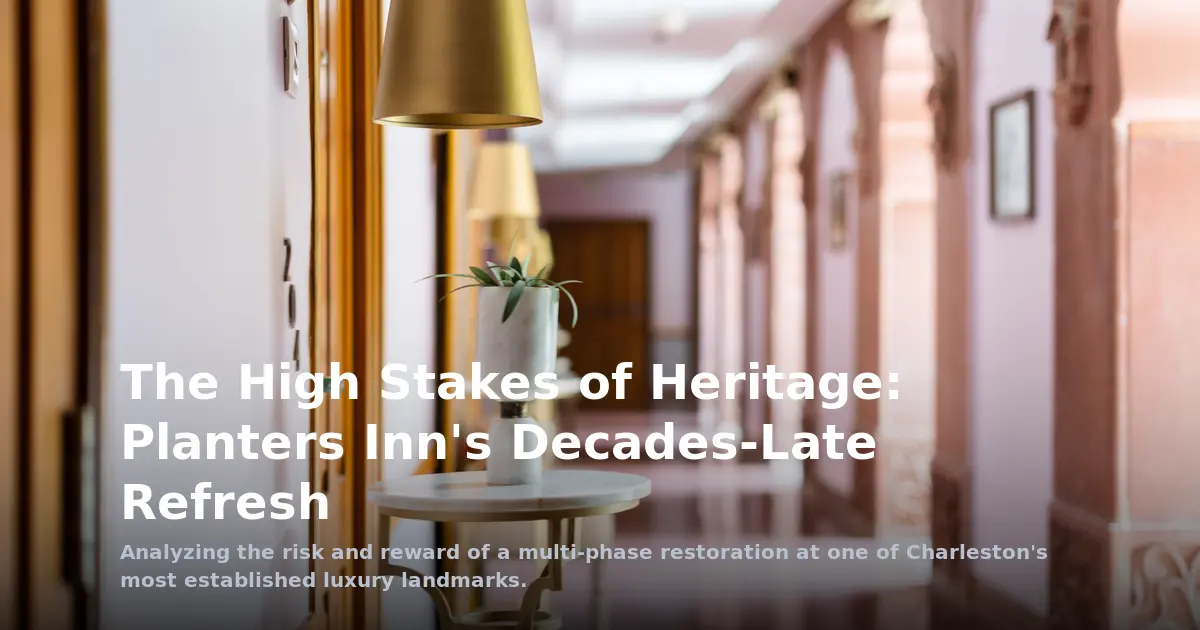
In the hyper-competitive landscape of Charleston’s luxury hospitality market, prestige is often measured by the depth of a property's history. However, there is a precarious line between 'timeless' and 'outdated.' For the Planters Inn, a cornerstone of the city's high-end lodging, that line has become a strategic focal point. The announcement of a comprehensive, multi-phase restoration—the first in decades—is more than a simple aesthetic update; it is a necessary corrective measure in asset lifecycle management.
For years, Planters Inn has leaned on its heritage to maintain its standing. But in an era where new-build luxury entrants are entering the Lowcountry with integrated smart-room technology and sprawling wellness footprints, relying on a legacy reputation is a dangerous game. The decision to undergo a full-scale luxury hotel renovation suggests an admission that the gap between the property's historic charm and modern guest expectations has finally widened too far to ignore.
The Operational Tightrope of Phased Renovations
The project is slated for completion in January 2027, unfolding in two distinct phases. From an operational standpoint, this is a high-wire act. The challenge of a multi-phase rollout is that the guest experience is often compromised in the pursuit of future perfection. When a luxury property remains operational during construction, the 'luxury' element—silence, seamless service, and pristine environments—is the first thing to erode.
For Planters Inn, the risk is twofold. First, there is the immediate impact on Average Daily Rate (ADR) and guest satisfaction scores as noise and dust inevitably bleed into the guest experience. Second, there is the psychological friction for the guest: staying in a 'reimagined' wing while the adjacent hallway feels like a relic of the 1990s. To succeed, management must ensure that the transition between the old and new is invisible, or at least framed as a curated evolution rather than a construction site.
Balancing Heritage with Modernity
The central tension of this luxury hotel renovation lies in the phrase 'honoring heritage.' In the luxury sector, this is often shorthand for 'conservative design.' However, the modern luxury traveler—particularly the affluent Millennial and Gen X cohorts—demands a fusion of old-world soul and new-world efficiency. They want the crown molding and the cobblestone views, but they also want intuitive climate control, high-bandwidth connectivity, and bathrooms that prioritize spa-like functionality over mere tradition.
If Planters Inn simply refreshes the wallpaper and reupholsters the furniture, it will have missed the mark. To remain relevant against contemporary competitors, the renovation must address the 'invisible' luxury: acoustics, lighting design, and ergonomic flow. The goal should not be to make the hotel look new, but to make it feel effortless.
The Peninsula Grill as a Strategic Anchor
Perhaps the most critical component of this overhaul is the update to the Peninsula Grill. In the luxury ecosystem, a destination restaurant acts as a powerful lead generator, drawing in locals and visitors who may not be staying overnight but who form the emotional connection to the brand.
By updating the Grill, Planters Inn is not just refreshing a dining room; it is reinforcing its identity as a cultural anchor in Charleston. A modernized dining experience ensures that the property remains a 'place to be seen,' which in turn drives the perceived value of the guestrooms. If the Grill continues to dominate the city's culinary conversation, the rooms will always have a baseline of demand, regardless of the construction noise next door.
A Blueprint for Historic Asset Management
When compared to other historic refreshes in the Charleston market, the Planters Inn project serves as a case study in the risks of deferred maintenance. Waiting decades between major renovations allows a property to slide from 'classic' to 'tired' before the market reacts. The current move is a strategic pivot to reclaim the top tier of the luxury pyramid.
Looking forward, this project signals a broader trend in the industry: the end of the 'heritage pass.' Luxury assets can no longer rely on their age to justify a lack of modernization. As the boundaries between boutique intimacy and corporate luxury blur, the winners will be those who can marry the authenticity of the past with the uncompromising standards of the future. The success of the Planters Inn restoration will be measured not by how well it remembers its history, but by how well it prepares for the next thirty years.