The Heritage Premium: Analyzing Bath's Boutique Hotel Market
The £2.85m listing of Brooks Guest House highlights the tension between historic prestige and operational reality in UK hotel investment.
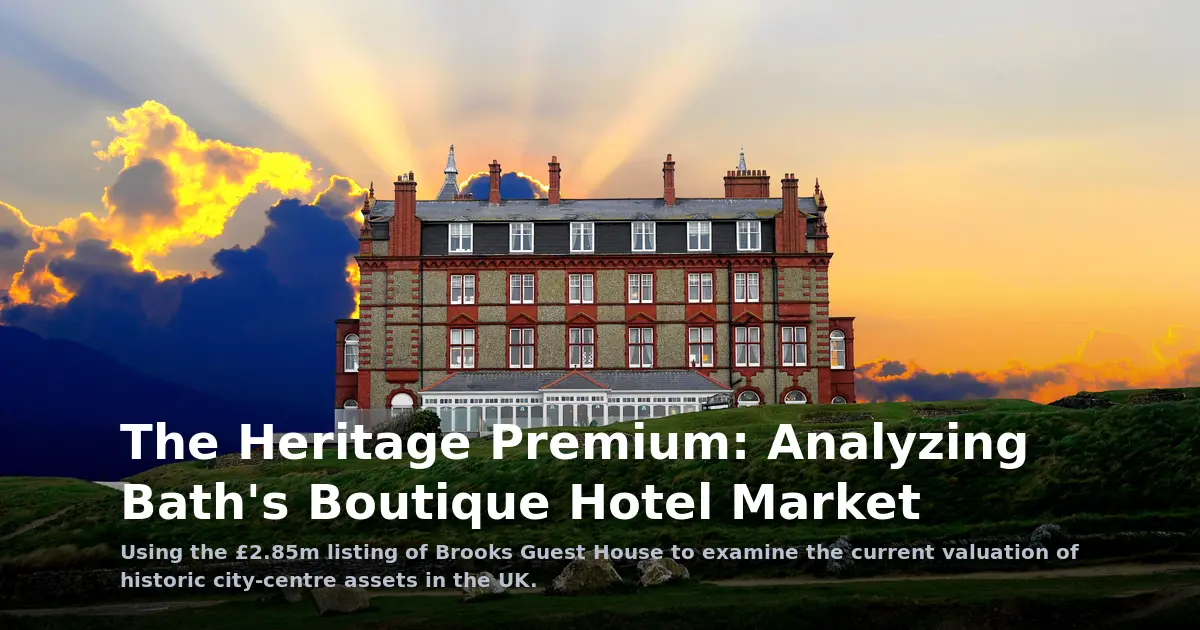
The arrival of Brooks Guest House on the market for £2.85m serves as more than a simple real estate transaction; it is a litmus test for the current valuation of historic city-centre assets in the South West. In a climate where interest rates have remained stubborn and operational costs have soared, the 'heritage premium'—the additional value attributed to a property's history and architectural pedigree—is facing a rigorous stress test.
For years, the strategy for UK hotel investment in cities like Bath has been straightforward: acquire a trophy asset with Georgian or Victorian bones, lean into the 'boutique' label, and command a premium ADR (Average Daily Rate). However, the economics of this model are shifting. While the aesthetic appeal of a heritage property remains a powerful driver for leisure travelers, the backend reality is a growing liability of maintenance, stringent conservation regulations, and energy inefficiency.
The Valuation Gap: Prestige vs. Performance
At £2.85m, the valuation of Brooks Guest House reflects a belief in the enduring resilience of Bath as a premier tourism hub. When compared to similar boutique assets across the South West, the pricing suggests that the market still places a high premium on city-centre footprints. However, a critical distinction must be made between the asset's capital value and its operational yield.
Historic buildings are notoriously 'leaky' assets—not just in terms of thermal efficiency, but in terms of capital expenditure. The cost of maintaining a listed building often precludes the implementation of modern, cost-saving technologies. Investors are now weighing whether the prestige of a historic facade justifies the higher overheads associated with aging infrastructure. In the current cycle of UK hotel investment, the gap between a 'trophy' price and a 'functional' yield is widening.
Agility and the Boutique Advantage
Despite these headwinds, the boutique scale of assets like Brooks Guest House offers a strategic advantage that institutional hotels lack: pricing agility. Large-scale operators are often handcuffed by corporate pricing structures and long-term contracts. In contrast, a boutique owner-operator can pivot pricing in real-time to match the volatility of the post-pandemic tourism market.
Bath continues to benefit from a diversified visitor base, blending international heritage tourism with a growing domestic 'staycation' trend. This demand provides a safety net for smaller operators, allowing them to maintain high occupancy rates even as the broader economic climate fluctuates. For the owner-operator, the appeal lies in the ability to curate a hyper-personalized guest experience—something that is far easier to achieve in a historic guest house than in a standardized corporate hotel.
Institutional Trophy Hunting vs. Operational Reality
There is a clear divergence in how this asset will be viewed by different buyer profiles. For institutional investors, the acquisition is often about the 'trophy'—a strategic land grab in a high-barrier-to-entry market where supply is strictly limited by planning laws. For these buyers, the immediate yield is secondary to long-term capital appreciation.
Conversely, for the owner-operator, the focus is on the operational grind. The success of such an investment now depends on the ability to blend traditional charm with modern efficiency. The ability to integrate smart-room technology without compromising the historic integrity of the building is where the next generation of value will be created.
As the industry moves forward, the viability of the heritage premium will depend on the ability of owners to decouple 'historic charm' from 'operational inefficiency.' We are entering an era where the most successful UK hotel investment strategies will not be those that simply buy history, but those that can modernize the delivery of that history. The market is shifting from a focus on the asset's past to a focus on its sustainable future, making the ability to manage ESG (Environmental, Social, and Governance) requirements in heritage settings the new primary driver of value.