The Invisible Renovation: Balancing CapEx with Guest Satisfaction
Analyzing how strategic capital project planning prevents the 'construction fatigue' that kills hotel ADR and guest loyalty.
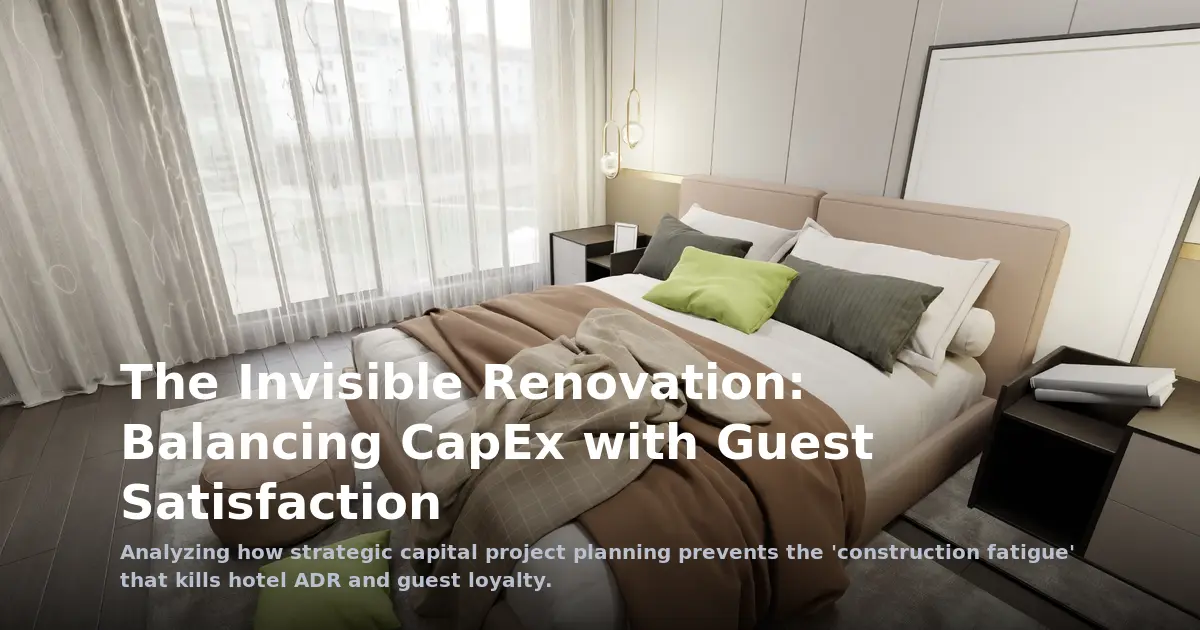
For too long, the hospitality industry has treated capital expenditures (CapEx) as a back-of-house logistical hurdle—a matter of blueprints, contractors, and budget lines. When a hotel undergoes a major renovation, the operational mindset is often focused on the 'completion date' rather than the 'guest experience duration.' This fundamental misalignment creates a dangerous gap in perceived value: while the asset's long-term value increases, the immediate guest experience often plummets.
The reality is that a guest does not see a 'strategic asset upgrade' when they encounter a plastic barrier in the lobby or the distant drone of a nail gun at 9:00 AM. They see a diminished product. When the physical environment is in flux, the psychological contract between the guest and the brand is strained. This is the phenomenon of 'construction fatigue,' where the friction of a renovation environment erodes the premium pricing a hotel can command, leading to a slide in Average Daily Rate (ADR) and a spike in negative sentiment across digital review platforms.
The Psychology of the Construction Zone
Effective hotel capital planning must begin with the understanding that renovation is a guest-facing service product. When a property is under construction, the 'product' being sold is no longer just a room and a bed; it is the guest's patience and tolerance. If the renovation is managed as a mere construction task, the property risks alienating its most loyal segments.
Perceived value is fragile. A guest paying a luxury rate expects a seamless environment. The moment a property introduces 'zones' of disruption, the value proposition shifts. If the hotel cannot maintain the illusion of normalcy, it must pivot its communication strategy—shifting from 'we are improving' to 'we are prioritizing your comfort.' This means proactively managing expectations before the guest checks in and providing tangible value-adds to compensate for the atmospheric deficit.
Strategic Phasing and the Revenue Shield
To protect the bottom line, operators must move away from the 'all-at-once' approach to renovations. Strategic phasing is the only way to maintain operational efficiency while protecting revenue streams. By breaking projects into smaller, manageable increments, hotels can isolate disruption and ensure that a significant portion of the inventory remains 'pristine' at all times.
Crucially, hotel capital planning must be synchronized with the demand curve. Aligning heavy-lift projects with low-occupancy windows is basic logic, but the sophisticated operator looks deeper. They analyze the 'recovery window'—the time needed for a space to transition from a construction site back to a guest-ready environment—ensuring that the property is at 100% capacity exactly when the peak season hits. Failing to account for this lag often results in 'ghost rooms'—inventory that is technically finished but not yet polished for sale, leading to missed revenue opportunities during the most profitable weeks of the year.
The High Cost of Deferred Maintenance
There is a seductive but deadly temptation in hotel management: the deferral of maintenance to pad short-term GOP. However, the ROI of preventative asset protection far outweighs the cost of reactive emergency repairs. When a hotel waits until a chiller fails in July or a pipe bursts in a guest wing, the cost is not merely the repair bill; it is the catastrophic failure of the guest experience.
Reactive repairs are, by nature, disruptive and visible. They happen at the worst possible times and often require the blocking of rooms without warning. In contrast, a disciplined approach to hotel capital planning treats the building as a living organism. By investing in a rigorous cycle of preventative upgrades, hotels avoid the 'crisis renovation'—the desperate, rushed project that occurs when an asset has degraded beyond the point of simple maintenance.
As the industry moves toward more sustainable and technologically integrated assets, the line between 'operations' and 'capital projects' will continue to blur. The future of asset management lies in 'invisible renovations'—the ability to upgrade the guest experience in real-time without the guest ever feeling the friction of the process. Those who view their CapEx budget not as a cost of doing business, but as a tool for guest retention, will be the ones to maintain pricing power in an increasingly competitive landscape.