Beyond the Towel Card: Making Hotel Sustainability Visible
Moving from invisible operational efficiency to guest-facing sustainability experiences that drive loyalty and brand value.
For decades, the hotel industry's approach to environmentalism has been characterized by the 'invisible win.' From the installation of high-efficiency HVAC systems to the procurement of biodegradable cleaning agents, the most significant carbon reductions often happen in the basement or the laundry room. While these operational efficiencies are critical for the bottom line and the planet, they suffer from a fundamental flaw: they are invisible to the guest.
The ubiquitous 'reuse your towel' card was the industry's first attempt to bridge this gap, but it has since become a cliché, often perceived by guests as a cost-cutting measure disguised as altruism. To maintain a competitive edge in a market where travelers are increasingly scrutinizing ESG (Environmental, Social, and Governance) claims, hotels must transition from passive efficiency to active storytelling.
The Psychological Gap in Hotel Sustainability Strategies
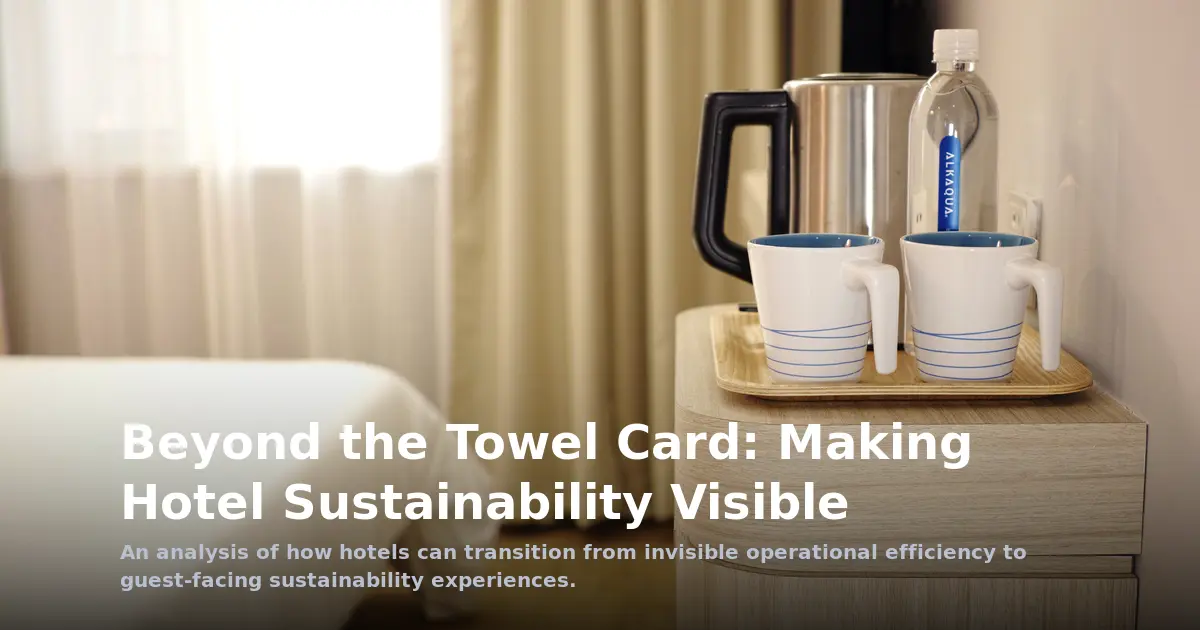
There is a profound disconnect between technical sustainability and perceived sustainability. A hotel may reduce its energy consumption by 20% through smart building automation, yet a guest who sees a single-use plastic water bottle on the nightstand will categorize the property as 'unsustainable.' This is the psychological gap: operational wins are quantitative, but guest perceptions are qualitative.
To close this gap, hotel sustainability strategies must shift toward transparency and integration. The goal is not to brag about a LEED certification in a lobby plaque, but to weave the narrative of sustainability into the guest journey. When a hotel translates a technical win—such as a greywater recycling system—into a tangible narrative about local water scarcity and the property's role in mitigating it, the efficiency becomes an experience.
Avoiding the Green-Washing Trap
As hotels race to make their efforts visible, they risk falling into the trap of green-washing. The modern traveler is digitally native and highly skeptical; they can easily distinguish between a genuine commitment and a marketing veneer. Authentic communication requires a shift from vague adjectives ("eco-friendly," "green") to specific, verifiable data.
Transparency is the only antidote to skepticism. Instead of claiming to be "sustainable," hotels should share their progress toward specific goals. This might mean publishing a quarterly waste-diversion report in the digital guest directory or highlighting the specific local farm that provides 40% of the restaurant's produce. When sustainability is presented as a journey of continuous improvement rather than a finished destination, it builds trust.
Gamification and the Human Element
One of the most effective ways to integrate guests into the sustainability narrative is through gamification and incentives. Rather than asking guests to sacrifice luxury for the environment, forward-thinking operators are creating value-exchange models. This could include loyalty points for opting out of daily housekeeping or "green credits" that can be used at the hotel bar for guests who minimize their energy footprint during their stay.
However, the most critical component of any guest-facing strategy is the staff. No matter how sophisticated the technology, a scripted response from a front-desk agent can kill the authenticity of a sustainability initiative. Staff training must move beyond the 'what' and focus on the 'why.' When an employee can explain the impact of the hotel's composting program with genuine passion and knowledge, the sustainability effort becomes a human connection rather than a corporate policy.
The Future of the Sustainable Stay
As the industry moves forward, the definition of luxury is being rewritten. The old paradigm of excess—endless linens, oversized amenities, and unrestricted energy use—is being replaced by a new luxury of consciousness. The hotels that will thrive are those that treat sustainability not as a back-of-house operational requirement, but as a core pillar of the guest experience.
Ultimately, the shift toward visible sustainability is about agency. By giving guests a meaningful role in the hotel's environmental efforts, properties transform a passive stay into a collaborative act of stewardship. Those who master this narrative will find that sustainability is no longer just a cost-saving measure, but a powerful driver of guest loyalty and brand equity.