Beyond Gold Leaf: The Pivot from Opulence to Purposeful Luxury
Analyzing the shift in affluent traveler demand from material excess to deep, experiential discovery.
For decades, the blueprint for luxury hospitality was written in the language of excess. Success was measured by the thread count of Egyptian cotton, the weight of silver cutlery, and the sheer scale of marble lobbies. This era of 'conspicuous consumption' operated on a simple premise: that wealth is best reflected through the accumulation of high-cost material comforts. However, a fundamental shift is occurring in the psychology of the high-net-worth traveler, rendering the traditional gold-leaf playbook obsolete.
Today, the market is signaling a move away from static opulence toward a model of purposeful luxury travel. The modern affluent guest is no longer seeking a sanctuary from the world, but rather a meaningful engagement with it. The value proposition has migrated from what the hotel provides to how the experience transforms the guest. While a five-star suite remains a baseline requirement, it is no longer the differentiator. The true competitive edge now lies in the ability to facilitate intellectual and emotional expansion.
The Death of Material Excess and the Rise of Awe
The decline of conspicuous consumption is not merely a trend; it is a cultural realignment. In an era of hyper-awareness regarding climate change and social inequality, overt displays of wastefulness have become an aesthetic and moral liability. The new luxury is not found in the size of the bathtub, but in the depth of the discovery.
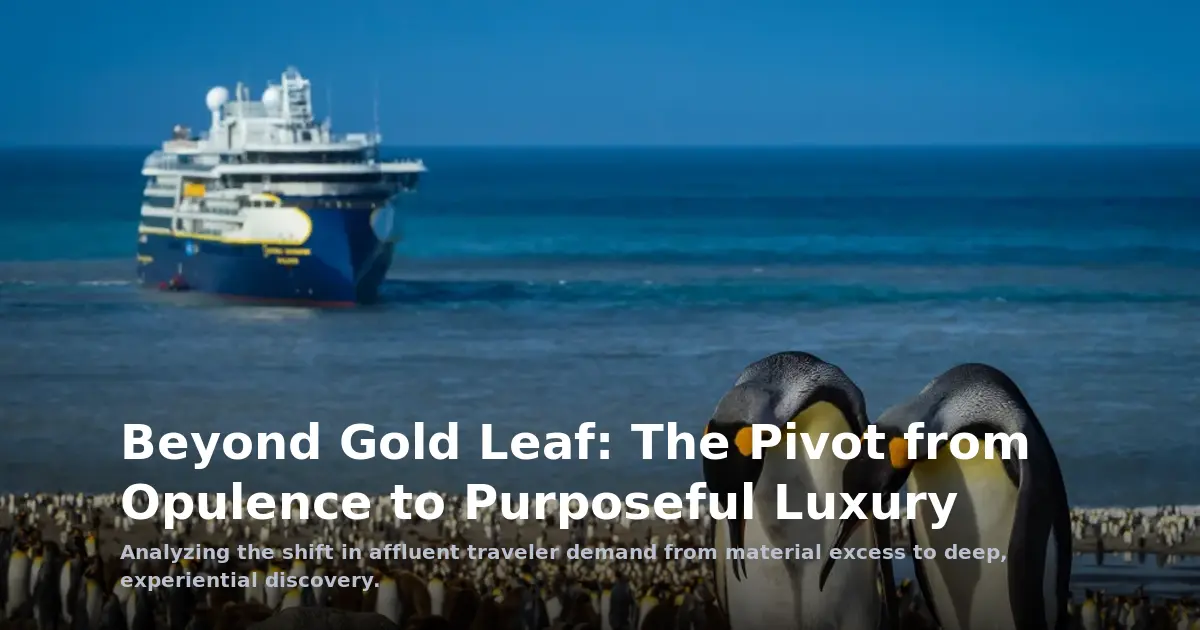
We see this shift most clearly in the meteoric rise of expedition-style travel. When guests pay a premium for voyages to the remote corners of the planet, they aren't paying for the linens; they are paying for the proximity to the sublime. The 'awe factor'—the feeling of being in the presence of something vast and mysterious—has replaced the 'amenity factor.' This transition suggests that the most valuable currency in luxury travel is no longer comfort, but perspective.
Integrating Purposeful Discovery into Static Properties
For legacy hotel operators, the challenge is translating this appetite for discovery into a static property setting. A hotel cannot move its location to the Arctic, but it can pivot its operational philosophy. To remain relevant, luxury hotels must move beyond the 'concierge' model—which focuses on fulfilling requests—toward a 'curator' model, which focuses on designing intellectual journeys.
Integrating purposeful luxury travel into a resort or urban hotel requires a strategic shift in programming:
- From Passive to Active Education: Replacing standard spa menus with wellness retreats grounded in longevity science or indigenous healing practices.
- Hyper-Local Integration: Moving beyond the 'local artisan' gift shop toward immersive partnerships with historians, ecologists, and artists who provide a deep-dive understanding of the destination.
- Sustainability as Substance: Shifting from 'green-washing' (e.g., reusing towels) to regenerative hospitality, where the guest's stay actively improves the local ecosystem or community.
The Risk of the Legacy Trap
There is a significant risk for legacy luxury brands that mistake 'high-end' for 'luxury.' Many heritage brands are trapped in a cycle of incremental improvement—adding a new brand of champagne to the mini-bar or updating the lobby furniture—without questioning the underlying value proposition. This failure to pivot from excess to awe creates a dangerous gap in the market.
As the next generation of wealth—Millennials and Gen Z—takes the helm, their preferences are starkly different from their predecessors. They prioritize authenticity, sustainability, and personal growth. For these travelers, a gold-plated faucet is a relic of the past; a guided conversation with a marine biologist or a curated journey into a foreign culture's hidden history is the new gold standard. Brands that fail to evolve will find themselves managing beautiful museums rather than thriving hotels.
The Future of the High-End Experience
The intersection of education, sustainability, and luxury is where the industry's future lies. The winners of the next decade will be those who recognize that luxury is no longer about the exclusion of the world, but a more profound inclusion in it. The industry is moving toward a 'transformative' model, where the success of a stay is measured not by the quality of the sleep, but by the clarity of the insight gained. As the definition of status shifts from ownership to experience, the hotels that prioritize the intellect and the spirit over the material will be the ones to capture the loyalty of the modern global elite.