Scaling Luxury in Accra: The Tech Stack Behind Belfast Africa's Growth
An analysis of how multi-property luxury operators in emerging markets are leveraging centralized distribution to drive occupancy.
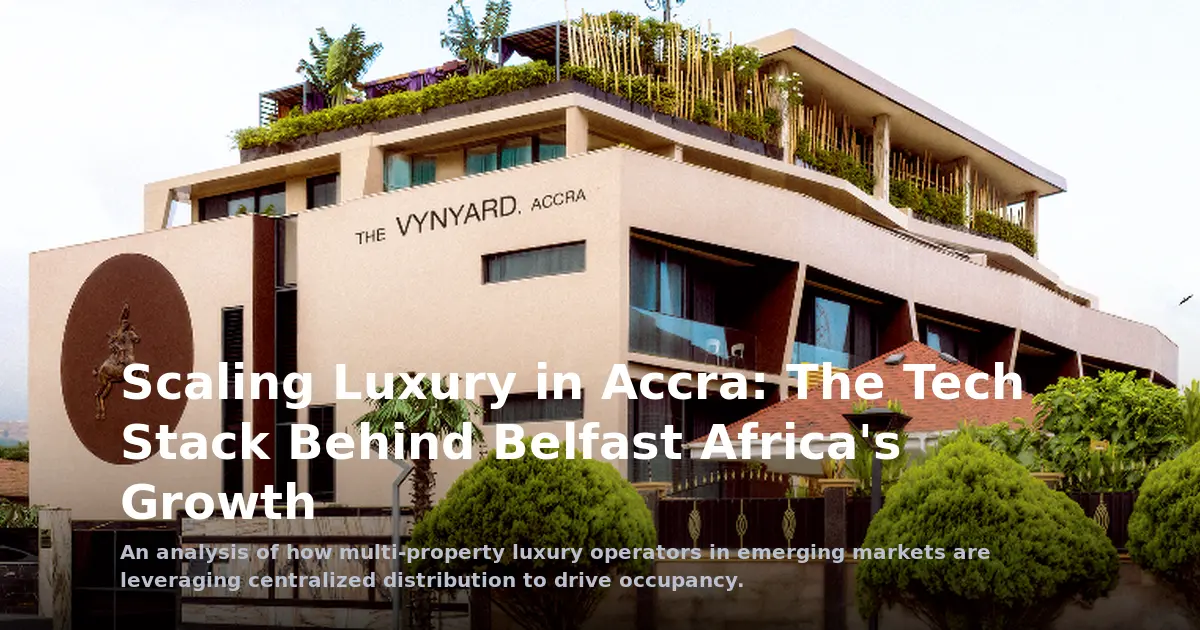
In the rapidly evolving hospitality landscape of Accra, Ghana, the leap from a successful single property to a multi-brand portfolio is often where operational efficiency goes to die. For luxury operators, the challenge is twofold: maintaining the hyper-personalized touch of a boutique experience while scaling the backend infrastructure to support diverse asset types.
Belfast Africa, a premier luxury concierge and property management company, provides a compelling case study in this transition. Managing a portfolio that spans the contemporary Number One Oxford Street Hotel & Suites, the exclusive Kwarleyz Residence, and the intimate Vynyard Accra, the company faced a classic scaling dilemma. How do you maintain three distinct brand identities—ranging from all-suite residences to boutique retreats—without tripling your administrative headcount?
The Operational Burden of Manual Distribution
For many luxury operators in emerging markets, the initial approach to distribution is often manual. This 'brute force' method involves updating rates and availability across various Online Travel Agencies (OTAs) individually. While this may suffice for a single ten-room boutique, it becomes a liability for a multi-property group. Manual entry is not merely a waste of human capital; it is a risk factor. In high-demand luxury markets, the lag between a booking and a manual update across channels inevitably leads to overbookings, which are catastrophic for a brand promising a seamless, high-end guest experience.
By transitioning to a centralized luxury hotel distribution tech stack, Belfast Africa shifted from a reactive to a proactive posture. The move to real-time synchronization ensures that a suite sold at Kwarleyz Residence is instantly removed from all global channels, eliminating the friction of overbookings and allowing the team to focus on guest relations rather than data entry.
Capturing the International Luxury Traveler
Visibility in the luxury segment is no longer just about being present on a few major OTAs. The modern high-net-worth traveler utilizes a sophisticated journey of discovery, often starting with metasearch engines. For a property in Accra to capture a business traveler from London or a leisure guest from New York, it must appear where those users are searching.
Integrating metasearch visibility—specifically through Google Hotel Ads, Trivago, and Tripadvisor—allows multi-property operators to cast a wider net without losing control over their pricing strategy. By leveraging a centralized platform to push real-time data to these engines, Belfast Africa has seen steady month-on-month growth in occupancy. This is the 'multiplier effect' of modern distribution tech: it doesn't just manage the demand you have; it actively generates new demand by placing the property in front of the right eyes at the moment of intent.
Solving the Talent Gap Through Technology
One of the most overlooked benefits of professionalizing the tech stack is its impact on human resources. The hospitality industry globally is grappling with a talent gap, and in emerging luxury hubs, finding staff who are both hospitality-minded and tech-literate can be a struggle.
Fragmented legacy systems—where the PMS, the channel manager, and the reporting tools all live in different silos—require extensive training and a high tolerance for complexity. In contrast, an all-in-one approach to luxury hotel distribution tech reduces the onboarding curve. When the interface is intuitive and the synchronization is automatic, new team members can be brought up to speed in days rather than weeks. This operational agility allows a management company to scale its portfolio without the traditional linear increase in administrative overhead.
The Blueprint for Emerging Luxury Hubs
The trajectory of Belfast Africa suggests a broader shift in how boutique operators in emerging markets should approach growth. The old model of 'growing by adding people' is being replaced by 'growing through systems.' The ability to manage a diverse portfolio—from a high-volume hotel to a private boutique—from a single administrative hub is no longer a luxury; it is a competitive necessity.
As luxury travel continues to diversify into new geographic regions, the winners will be those who can balance the 'high-touch' nature of luxury service with the 'high-tech' efficiency of centralized distribution. The move toward integrated commerce platforms allows operators to reclaim their time, focusing less on the mechanics of the sale and more on the art of the stay.